
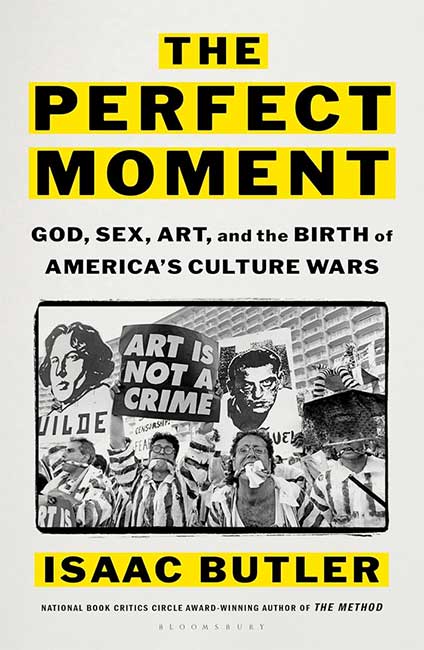
 The Perfect Moment: God, Sex, Art, and the Birth of America’s Culture Wars by Isaac Butler (Bloomsbury)
Isaac Butler writes of how the culture wars in America, which seemed to have ended by the time George W. Bush entered the White House, have returned with a vengeance under Donald Trump. He writes his history of the original culture wars of the 1980s and 90s in order to show how the roots and approaches of the combatants inform what is unfolding now in Trump’s America, and thereby influencing and impacting other nations simultaneously. This is particularly so in the UK, where the culture wars have latterly become an ever-increasing aspect of our politics too.
James Davison Hunter became, in 1991, the first to use the phrase ‘culture wars’ to describe the way in which America is deeply divided by a conflict of two moral visions, two tendencies he called ‘progressivist’ and ‘traditionalist’. His book Culture Wars: The Struggle to Define America described how Christian fundamentalists, Orthodox Jews, and conservative Catholics joined forces in a fierce battle against their progressive counterparts as each side struggled to gain control over such fields of conflict as the family, art, education, law, and politics. More than three decades later, his phrase has become the dominant paradigm for understanding American political culture and its congruences.
Butler documents the way the culture wars played out in this period within the visual arts predominantly by telling the story of the National Endowments for the Arts and Humanities (NEA) and the conflicts that arose firstly from (or from perceptions of) its funding of specific artists and then from grants that were not awarded but which faced legal challenges as a result. These include works or exhibitions by artists such as Andres Serrano, Robert Mapplethorpe, David Wojnarowicz, and Karen Finley, among others. The story takes place in the context of AIDS and its impact on the LGBT community, with its deadly effect informing a significant proportion of the work and the reaction towards it.
The NEA was originally set up to champion the creative freedom of America and its artists in contrast to the controls exercised by Communism. As a result, its grant award processes used peer panels to select award recipients in order that control of grants was not centrally exercised. When the likes of Jesse Helms, Donald Wildmon, and Pat Buchanan began to campaign against specific works on the grounds either of blasphemy or morality (usually, sexual), the response centrally was to gradually reduce the independence of these panels and to exercise increasing levels of control. This then led to grants awarded by panels not being actioned resulting in court challenges, most famously by the NEA Four (Karen Finley, John Fleck, Holly Hughes, and Tim Miller) whose case went to the Supreme Court.
As Butler reflects, the results were mixed. Both sides achieved victories in skirmishes, while neither won the battle outright. The NEA survives to this day, although its available funding has reduced and its processes involve much more centralised control. As a result, Butler argues that it has ‘been retooled as a vehicle for ideological indoctrination and propaganda’ by the government. This, he suggests, is ‘the exact opposite of what the creators of the NEA commissioned’ and raising awareness of this reversal by telling the story of the culture wars is his central purpose in writing the book. The story he tells is that ‘of a massive shift in how Americans saw art and its purpose, and how Americans saw transgression as less and less valuable as we hurtled towards the end of the millennium’.
Butler notes that ‘the real substance at stake in these fights was the nature, meaning, and limits of freedom in America’ and he suggests that, if ‘art is the dream life of the self, then a nation’s culture is the closest thing it has to a collective unconscious’. What, then, could be more tempting politically than to seize control of that dreamscape as many have sought and are seeking to do?
Somewhat paradoxically, this perception also fuels his sense of hope at a time when many, including himself, ‘cannot keep faith with our nation at this moment’. History, he argues, shows us that the making of art (as ‘the dream life of the self, the collective unconscious of our species’, by which ‘we know, and are known’) cannot be stopped, ‘and the ability of those in power to control it is finite, even in the direst of circumstances’. The story he tells is told to encourage us, whatever the challenges and whatever the setbacks may be, to keep faith with the making of art and the provision of support for its making.
Butler’s book can helpfully be read alongside Paul Elie’s The Last Supper: Art, Faith, Sex, and Controversy in the 1980s (reviewed here: 4 July 2026 – ‘Crypto-Religious Culture Wars’) which covers similar ground, while reviewing a broader range of media and controversies. Butler provides more detail of the political campaigns and decisions surrounding the art that proved controversial, while Elie tracks the culture wars through music and literature as well as the visual arts, while also showing how crypto-religious or progressive religious understandings underpin much of the Art over which the culture wars have been fought. Reading both volumes adds substantially to the story as told by the other, while also suggesting additional approaches to opposing those who seek to censor or control the Arts for ends other than the making of Art for and of itself.
The fact that these two accounts of the original culture wars have, like buses, come along in the same time-span serves to highlight the importance of the stories they tell and their relevance for understanding and resisting the approaches and tactics used in the present to constrain freedom and prevent the Arts from entering into ‘the fundamental mysteriousness of human beings’, and ‘how we express it to the world’.
.
.
Jonathan Evens
.
Thanks
One of the things that’s always fascinated me is how the US pumped money into culture internationally, especially during the Cold War, when they covertly funded progressive magazines (with editors or owners who were sympathetic to them). They softened criticism of US foreign policy (especially in Vietnam) and encouraged silence where it was obvious that editorial boards and writers would be critical.
The writers and artists specifically ‘used’ against the Soviet Union have latterly become the targets of contemporary conservatives in the USA – the tastes of Stalinists and right wing culture warriors converge …. Trump’s image on everything is no different than Stalin’s.
The literary magazine Encounter was perhaps the most famous recipient but literary journals across Europe were wittingly and unwittingly sponsored by the CIA – so were politicians, who had their speaking tours paid for and their books funded.
Comment by Steven Taylor on 12 August, 2026 at 6:33 am