
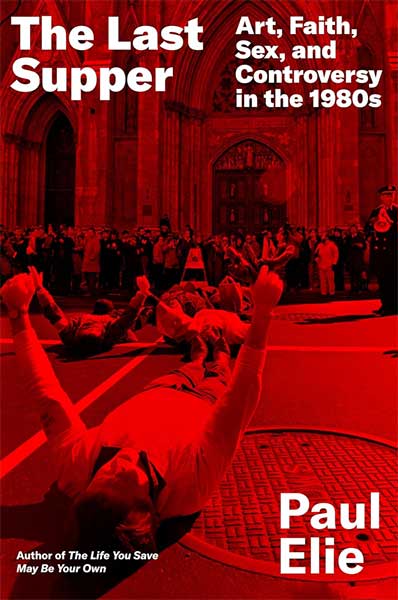
The Last Supper: Art, Faith, Sex, and Controversy in the 1980s, Paul Elie
(Macmillan Publishers, 2025)
Paul Elie’s The Last Supper: Art, Faith, Sex, and Controversy in the 1980s is a survey of the culture wars that began in the US in the 1980’s viewed from the perspective of the religious aspects of the conflicts.
Many of the most famous confrontations in this period were between those defending a conservative view of their religion and artists utilising more progressive ideas and imagery in relation to that same religion. Martin Scorcese’s The Last Temptation of Christ, the photographs of Robert Mapplethorpe, Madonna’s Like a Prayer video, Salman Rushdie’s The Satanic Verses and Andres Serrano’s Piss Christ are among the works caught in the crosshairs of the face-off between embattled sides.
Elie takes us through the decade highlighting the artists involved – from Andy Warhol through U2 to Toni Morrison – while also documenting the changing response to crypto-religious works.
The definition of crypto-religious works that he uses derives from the Polish-American poet Czesław Miłosz, who, in correspondence with Thomas Merton, wrote of always having been ‘crypto-religious and in a conflict with the political aspects of Polish Catholicism’. Elie takes the term to refer to ‘work that incorporates religious words and images and motifs but expresses something other than conventional belief’.
This term is broad enough to encompass a large number of significant works spread primarily across film, literature, music and visual art. While sufficient to generate a substantial tome (422 pages) bookended by performances from Bob Dylan and Sinéad O’Connor on Saturday Night Live, there is much that could also have featured within this definition and time-period including work by T Bone Burnett, The Call, Peter Case, Graham Greene, Shūsaku Endō, Kings X, David Lodge, Nicholas Mosley, Dennis Potter, Violent Femmes, Victoria Williams, and art initiatives by Janusz Bogucki, Peter Fuller, and Jyoti Sahi. However, while all being crypto-religious these works were not caught up in the culture wars in the same way as the principal works that Elie documents.
Elie neatly summarises the ground and works he covers: ‘Andy Warhol creates a hundred works based on Leonardo de Vinci’s Last Supper, attracting Jean-Michel Basquiat and Keith Haring as disciples. William Kennedy and Toni Morrison each make a cemetery the setting-off point for magic realism imbued with religious motifs. Leonard Cohen retreats to a Manhattan hotel room and writes the sacred songs that will reinvigorate his career. Patti Smith leaves the music business in a religious crisis and returns just as Robert Mapplethorpe draws scrutiny for photographs that blend sadomasochistic themes and satanic imagery. Wim Wenders takes an angel’s-eye view of divided Berlin. U2 complicate the devotion of their early records through a collaboration with Brian Eno and a plunge into American roots music; the Neville Brothers deepen their work’s always present connections to the sacred traditions of New Orleans. Madonna and Prince mix carnal and spiritual desire in videos that define the first decade of MTV. All the while, Martin Scorcese is at work on The Last Temptation of Christ, answering a call to make a personal picture about Jesus that he has felt since his boyhood.’
From this it can be seen that Elie’s focus is not simply Christianity, although that predominates and is also the primary religion he explores in relation to the culture wars. Writing as a Catholic who is a Senior Fellow at a Jesuit research university (Georgetown University), the book is a plea for attention to be paid to the more progressive expressions of religion he highlights, while also documenting in detail the many conservative stances taken by the Roman Catholic Church globally and in the US in this period.
Documenting both is necessary, not just to properly understand past history, but also the present, as the culture wars of the 1980s are early episodes ‘in an age we are still in – an age in which religious belief seems to be at once in steep decline and surging out of bounds; a span of time, with September 11, 2001, at its center, that has been shaped by religious controversy and by deadly acts of violence committed in God’s name’. Somewhat ironically, however, the political and religious forces in power today are to some extent reversed from those in the 1980s, with the US dominated by a Christian-nationalist agenda at the same time that the Roman Catholic Church has been inhabiting a more progressive phase.
Some of the ground that Elie covers – Warhol, Mapplethorpe, Serrano – was originally mapped out (in relation to the visual arts) by Eleanor Heartney in Postmodern Heretics: The Catholic Imagination in Contemporary Art. Elie’s conclusions in relation to the work of these artists mirrors that of Heartney but the picture he paints is significantly broader because of the other Arts he includes within his story.
Elie argues that the crypto-religious works he highlights depended ‘on an encounter with public, institutional religion – as roots, as adversary, as a community whose aspirations it challenges and deepens’. He suggests then that, if ‘public religion atrophies’, the kind of ‘personal, speculative, improvisatory religion’ he documents in this book ‘will thin out too’. However, in the Arts, that logic may not hold, as: ‘In a society in which religion is socially unnecessary, the artist who credibly engages with religious material will stand out – drawing admiration tinged with gratitude as a song or poem or picture or novel makes the supernatural imaginable and belief believable’. In this way, the crypto-religious ‘will grow familiar’, ‘will be seen as crucial’, even ‘canonical’, ‘as work we cannot do without’.
That conclusion will be resisted by the conservative religious and secularists alike but may be an accurate description of a contemporary culture where intellectuals and Artists alike are increasingly and publicly engaging positively with the benefits and attractions of religious belief.
Elie’s argument is that the 1980s represent something new in relation both to the beginnings of the culture wars and the incidence of crypto-religious work. While the former would seem to be correct, the latter is more debateable. From the beginnings of Symbolism and the Catholic Literary Revival broadly around the 1880s, the decade in which modern art is also generally reckoned to have begun, work of a crypto-religious nature has been in evidence on a substantive basis. This strand within modernism and post-modernism runs from the Pre-Raphaelites and the Nabis, Decadent Catholicism and the Catholic Literary Revival, to recent work by Nick Cave and the Bad Seeds, U2, Rosalía, Lucy Caldwell, Spencer Reece, Shane McCrae, Genesis Tramaine, and Lakwena Maciver, among others. In essence, an equivalent volume to that which Elie has written could be created for every decade from the 1880s to the present day.
That said, taken together, Elie’s The Life You Save May Be Your Own: An American Pilgrimage (a group portrait of Thomas Merton, Dorothy Day, Flannery O’Connor, and Walker Percy), Reinventing Bach: Music, Technology, and the Search for Transcendence (a meditation on how sound recording allowed Bach’s music to survive and be reimagined by the likes of Albert Schweitzer, Glenn Gould, and Yo-Yo Ma), and The Last Supper can be viewed as a loosely connected trilogy of twentieth century cultural and spiritual history. In them, Elie undertakes a wide-ranging inquiry into the ways in which religion and faith have shaped human creativity, memory, and community in the modern era by means of the ‘spiritualized encounter’. As Nora Futtner has written, ‘Elie’s work is an invitation—to engage, to reflect, and to explore how faith and culture continually shape one another in unexpected ways.’
.
.
Jonathan Evens
.