
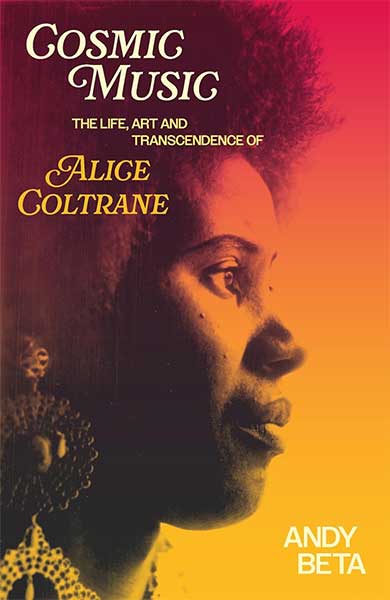
Cosmic Music: The Life, Art, and Transcendence of Alice Coltrane, Andy Beta (White Rabbit)
Only relatively recently, mostly on the back of the 2017 compilation release of Turiyasangitananda – The Ecstatic Music Of Alice Coltrane on David Byrne’s Luaka Bop label, has Alice Coltrane’s late music seemingly been accepted for what it is: a strange hybrid of ancient Indian chants and gospel-choir; hypnotic, pulsating spiritual music. Previous to that, John Coltrane’s widow was mostly known as an obscure artiste who made epic jazz-tinged albums sprinkled with cascading harps and abstract organ shapes. If, that is, you could find the rare Impulse! recordings by scouring the secondhand album bins that collectors hadn’t got to first.
Of course, you can now buy just about everything on CD reissue, from her few appearances playing live with John Coltrane, the album Cosmic Music where she dared to overdub material on to her husband’s music (and got critically torn apart for doing so at the time of release), the jazz albums under her own name, and the blissed out spiritual albums (including Illuminations with Carlos Santana). The later privately released recordings of songs and chants remain obscure, as does a small booklet she wrote and published.
Andy Beta’s new biography of Alice Coltrane is, however, more interested in the spiritual encounters and ideas behind the music than the music itself, though I think he might suggest they are completely interlinked. He charts how his subject moved from being a model Christian good girl to her short marriage to John Coltrane, to enlightenment following a ‘Manifestation of Cosmic Energy’, spiritual exercises and ascetic living, and then becoming Swamini Turiyasangitananda with her own ashram and foundation.
At times the book is hard to read. It does not question Alice Coltrane’s declarations that (I paraphrase) ‘God told me to do it’ or the notion of ‘Universal Consciousness’, attained or accessed through self-denial, meditation and mantras, or the following of personal gurus. In places, especially an incident of self-harm (a seriously burnt hand, or ‘spiritual fire’ as Beta later refers to it) and all night meditation, I am cynical enough to ask if it the result might not be sleep deprivation rather than a higher spiritual plane?
But that’s just me. As ever, I am forced to ask why we – including myself – want to read about the musicians whose work we love, rather than be content with just the music itself. Is the ‘tactile sense of cosmic energy’ to do with the Creator or the duration, repetition and sound of the music? Is spiritual enlightenment in response to a composition different from aesthetic response? Is it creative energy or spiritual energy? And why is ‘the deep research’ undertaken by Alice Coltrane – or so it is claimed in one of the cover quotes – never spelt out beyond vague, generalised personal and mystical responses?
Whatever you make of it all, this is a fascinating story because of the music produced by Alice Coltrane. Her relationship with one of the giants of exploratory free jazz opened her up to new musical and spiritual ideas that she then investigated for herself, initially with jazz musicians she knew through her husband, then on into uncharted and highly unusual sonic territories, a kind of all encompassing, drifting and enveloping tidal jazz. This was then put aside in favour of the ‘amateur’ chanting and singing of ancient texts and songs that seem to carry much more weight and meaning than they should or are expected to.
In the end it is of course the music that remains. We can talk about that in compositional terms, discuss the strange textures and unusual juxtapositions of instruments and sounds, or we can claim that it is spiritual and transcendent. It may well be, and Beta makes clear that that was Alice Coltrane’s personal intention and desire. However unconvinced I am that Alice Coltrane’s recordings contain or explain any sacred mysteries they are marvellously innovative and challenging work that were clearly far too ahead of themselves when first released. If Beta’s book can help people catch up and listen then it has served its purpose.
.
Rupert Loydell
Alice Coltrane, Journey In Satchidananda (Live at Carnegie Hall, NYC, 1971)
.