
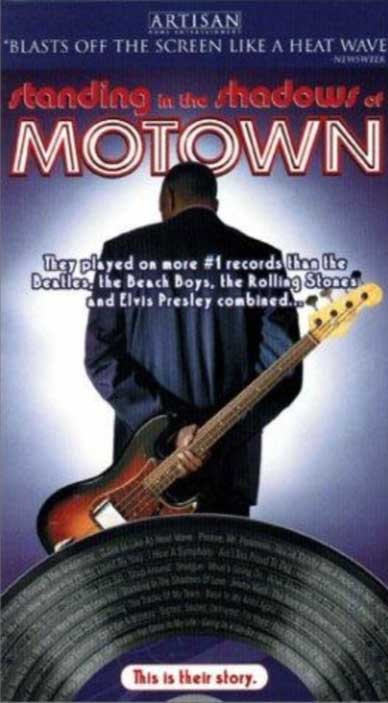
by Kathryn S. Kraus
In 1959 there was a two-story house that sat at 2648 West Grand Boulevard in Detroit, Michigan. There was nothing that made it stand out from other houses along the street. It was an ordinary, white brick and stucco home, which became the site where extraordinary music was created. It would become known as “Hitsville U.S.A.” under the label, MOTOWN.
With artists such as Smokey Robinson and the Miracles, The Supremes, The Marvelettes, The Temptations, and Marvin Gaye amongst their top signings, owner Berry Gordy cultivated a unique and iconic sound that defined a generation. However, it would take decades for those responsible for creating that sound to be recognised for their contributions.
If asked who was responsible for the Motown sound, most would probably answer, Diana Ross, The Jackson 5, Stevie Wonder, or others. If you asked who they thought played on those records, I’d bet they’d have no idea. While there is no denying the vocal talents of those mentioned, it was the group of musicians – hand-picked by Gordy himself – who created the iconic sound. They were known as The Funk Brothers.
At the back of the Motown house was an old garage. You walked down four stairs, and onto a dirt floor, with parts covered with plywood. There was carpeting on the walls, and a piano in the center of the room. Studio A was nicknamed, “The Snake Pit.” Many members of The Funk Brothers had come north to work in the many car factories in Detroit. After long days on the production line, the men would grab their instruments and head out to the famous Baker’s Keyboard Lounge, the Blue Bird Inn, or the Paradise Valley, where they would sit in with jazz greats Coltrane, Parker, Armstrong, Ellington, and Washington. This is where Berry Gordy found bassist James Jamerson and Bob Babbit, drummers Benny “Papa Zita” Benjamin, Richard “Pistol” Allen and Uriel Jones, pianists Earl “Big Funk” Van Dyke, Joe Hunter, and Johnny Griffin guitarists Robert White, Eddie Willis, and Joe Messina, percussionists Jack Ashford and Eddie “Bongo” Brown.
The Motown studio stayed in Detroit for 13 years, from 1959 until 1972. In that time, The Funk Brothers, in one combination or another, played on over 100+ U.S. R&B number one hits, and over 50+ U.S. Pop number one hits. Yet during that time span, the musicians weren’t credited on albums until Marvin Gaye’s What’s Going On in 1971. They were unknown faces, who never received the glory for some of the greatest songs ever recorded. The instrumental hooks and rhythms of Babbit’s bass line on Papa Was a Rolling Stone, “Pistol” Allen’s drum line on Heat Wave, or guitarist Robert White’s iconic opening lick on My Girl are the Motown sound. Without The Funk Brothers, there would be no Motown. The Funk Brothers were the essence of Motown.
Yet for all their musical prowess, they were paid very little for their efforts. Often paid $10 per song; the “Brothers” took many sessions at competing studios to make ends meet. It’s no accident that the Motown sound can be heard on Jackie Wilson’s (Your Love Keeps Lifting Me) Higher and Higher, The Capitol’s Cool Jerk, and Freda Payne’s Band of Gold, as many of the Funk Brothers played on the sessions. It solidifies the fact that it was the musicians themselves who created the sound that came out of Detroit, and not one specific label. It didn’t stop Motown and Gordy from using the “Brothers” from dawn to dusk, seven days a week. “The Snake Pit” became a pressure cooker. Some handled it better than others. Sadly, drummer Benny Benjamin struggled with drug and alcohol addiction. In 1969, he passed away after a stroke, at the age of 43. Benjamin was the first musician that Berry Gordy signed up to play for Motown. He was the man who, while leaving a session, turned to his fellow musicians and said, “You are all the Funk Brothers.” The Beatles singled out his drumming style as an influence on their music, and Buddy Rich and Tito Puente followed his style throughout their careers.
Bassist James Jamerson was battling demons of his own. He had an ongoing battle with alcohol addiction. His musical genius somehow never suffered despite his disease. During the 1971 recording of Marvin Gaye’s What’s Going On, Jamerson was too intoxicated to sit on his stool. He recorded his complex bass line while lying on the floor. His fellow musicians have said that even drunk, Jamerson could play better than most.
Upon arriving at a recording session in studio 1a in 1972, the “Brothers” were met with a note on the door saying the session was cancelled, and that Motown was moving to Los Angeles, California. The Funk Brothers were done.
A couple of the “Brothers” went out to L.A. with Motown, but they were now competing with the well-established “Wrecking Crew” studio musicians for session work. Drummer Eddie “Bongo” Brown worked with The Commodores, The 5th Dimension, and Ray Parker Jr., before passing away from heart disease in 1984, aged 52. James Jamerson played with Aretha Franklin, and Tavares, but his alcoholism had taken control of his life. On March 25, 1983, Jamerson sat in the balcony for Motown’s 25th anniversary special. He watched as all the songs he had played on were performed on stage, to raucous applause. Yet none of The Funk Brothers were invited, recognized, or even mentioned. He was forgotten. They were forgotten. Five months later Jamerson passed away at the age of 47 from cirrhosis, heart failure, and pneumonia.
Most of the other “Brothers” stayed in the Detroit area. They continued playing in various jazz bands and clubs for decades after Motown departed. Most musicians knew about The Funk Brothers and their legacy, but to the general public, they were ghosts. Fast forward to 1989, when musician and music historian Allan Slutsky wrote the book, Standing in the Shadows of Motown, which profiles the life of James Jamerson. Slutsky became friendly with several other members of The Funk Brothers, including guitarist Robert White. He relayed the story of how he was having lunch with White in a diner in L.A. As the waiter approached their table, the opening bars of My Girl came on the radio. White looked up to the waiter and said, “Hey, you hear that? That’s…” and he quickly looked down to the menu and ordered his sandwich. Slutsky asked White why he didn’t tell him that it was him playing that opening lick, and he said that the young kid wouldn’t believe that the “old fool” sitting there would be capable of playing on a big record like that. It was at that moment that Slutsky knew that he had to get The Funk Brothers the recognition they deserved.
By 2001, several more “Brothers” had passed on. Earl Van Dyke, 62, died of prostate cancer in Detroit. Robert White, 57, died in 1994, from complications of open-heart surgery. With five members gone, and only eight living (some with terminal illness at the time), the clock was ticking for Slutsky to reunite the “Brothers” to get their story told. Thankfully, the musical Gods smiled down on the producer. The documentary, Standing in the Shadows of Motown (2002), is the definitive story of The Funk Brothers, capturing their story and their legacy. Director Paul Justman not only allows the musicians to share their memories of their time together in “The Snake Pit,” but also showcases their talents at a concert held at the Royal Oak Music Hall in Michigan. Some of their biggest hits were fronted by the likes of Bootsy Collins, Chaka Khan, Ben Harper, and Joan Osborne. Over forty years on, The Funk Brothers were finally getting the notoriety they justly deserved.
It’s sad to think about those “Brothers” who never received the recognition they craved. Drummer “Pistol” Allen, who took part in the film and concert, didn’t live to see the film. He succumbed to cancer four months before the final film was released. Pianist Johnny Griffith passed from a heart attack five days after the film’s release in November 2002.
In 2004 the six surviving “Brothers” were presented with The Grammy Legend Award at the 46th Annual Grammy Awards. Still riding the high from the documentary, they recorded a Live in Orlando album and video in 2008. In 2010 Phil Collins asked the group to accompany him on his Motown covers album, Going Back, and appear on the subsequent Going Back concert DVD. That year they were also inducted into the Michigan Rock and Roll Legends Hall of Fame. In 2013, star number 2,493 was unveiled on the Hollywood Walk of Fame. The star, bearing the name “The Funk Brothers” is situated next to Dizzy Gillespie, Thelonious Monk, and Herbie Hancock. The recognition had finally been bestowed upon this groundbreaking group of musicians. They created a sound that defined not only Detroit – Motortown, U.S.A. – but also a generation.
Today, Jack Ashford is the sole surviving member of The Funk Brothers. He carries on telling the story of their legacy to music through his book, Motown: The View from the Bottom. That ordinary house that Berry Gordy bought with an $800 family loan back in 1959 is now painted a bold blue and white, with the letters “Hitsville U.S.A.” proudly displayed on its facade. It’s a museum now where you can visit Berry Gordy’s flat, the control room, and Studio A – “The Snake Pit.” The walls are smoke stained, as is the ceiling, from the decades of chain-smoking artists and musicians who crammed into the room. The instruments are original, as is the recording equipment, and on the upper walls sit photos of The Funk Brothers in action. Stand on the worn patches of wood floor, close your eyes, and breathe it all in. If you listen carefully, you might be able to hear the faint sound of the James Jamerson G to C syncopated bass line at the start of The Temptations My Girl, or Johnny Griffith’s Wurlitzer chords, mixed with Benny Benjamin’s backbeat and Jack Ashford’s tambourine at the beginning of I Heard it Through the Grapevine.
The legacy of The Funk Brothers is deeply embedded in the DNA of modern music. Rolling Stone magazine ranked James Jamerson number one in its list of the top 50 greatest bassists of all time, while Bass Player magazine also ranked him number one, calling him the “most important and influential bass guitarist.” He and his fellow “Brothers” inspired generations of artists from The Beatles to Jay Z. They generated more number-one hits than the aforementioned Beatles, Elvis, The Rolling Stones, and The Beach Boys combined.
Thirteen men were brought together between 1959 and 1972. Musicians brought together in an old garage 15ft wide x 26ft long, behind a two-story house in Detroit, Michigan. They came in as individuals, but they left as brothers… Funk Brothers.
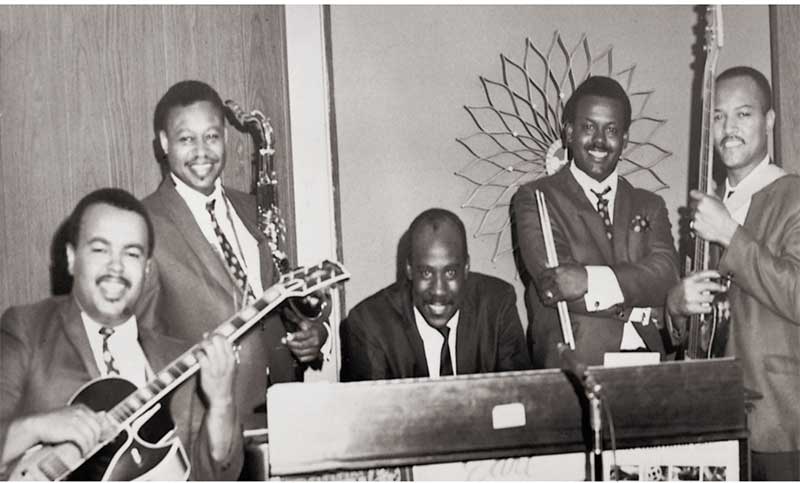
Motortown Review, 1965. From L to R: Robert White (guitar), Dan Turner (saxophone), Earl Van Dyke (keyboards), Uriel Jones (drums), and James Jamerson (bass)
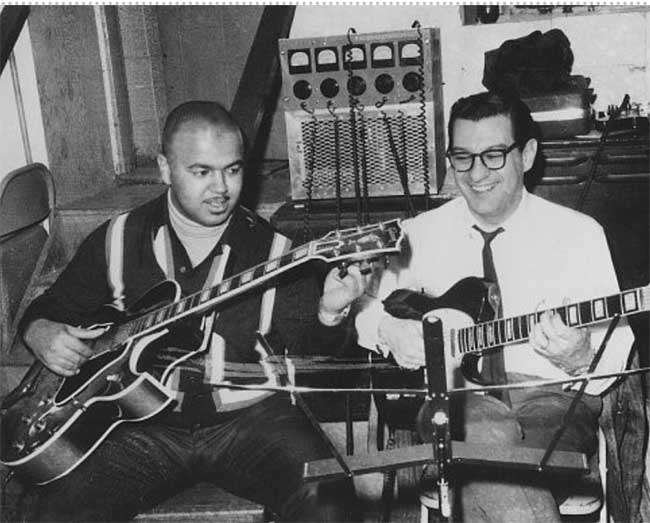
Guitarists (L) Robert White and (R) Joe Messina inside the famous “Snake Pit” in the 1960’s.
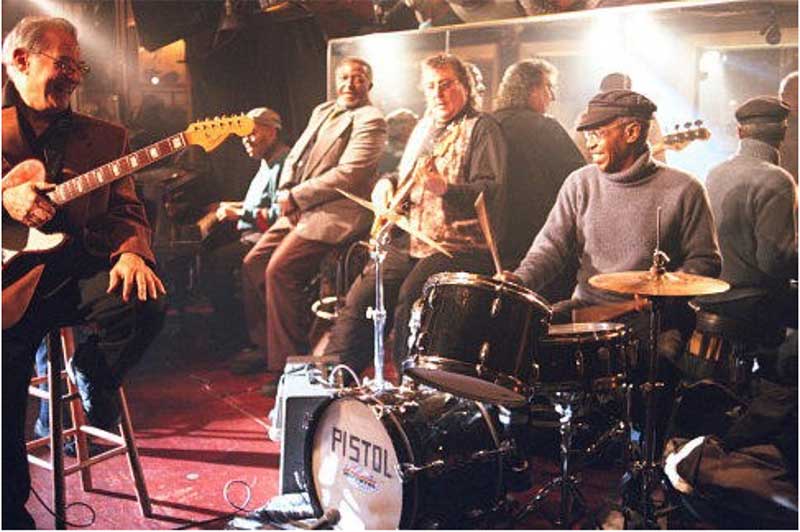
Still from the documentary Standing in the Shadows of Motown.
From L to R: Joe Messina (guitar), Johnny Griffith (piano), Joe Hunter (piano),
Bob Babbitt (bass), and Richard “Pistol” Allen (drums), performing at Baker’s Keyboard Lounge.
Links: Standing in the Shadows of Motown documentary
The Funk Brothers track only on The Four Tops’ Bernadette