
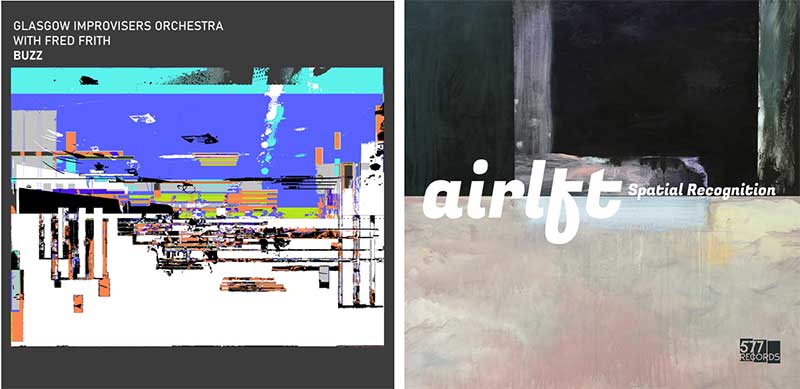
BUZZ, Glasgow Improvisers Orchestra with Fred Frith (Scatter Archive)
Spatial Recognition, Airlft (577 Records)
It’s not long since I was last writing about the Glasgow Improvisers Orchestra. On that occasion, they were celebrating the music of Thelonius Monk with Pat Thomas. Here they are again, this time collaborating with guitarist, one-time Henry Cow member and prolific creator Fred Frith.
And not for the first time. In the album notes sax-player Raymond MacDonald tells how, twenty years ago, they’d worked together with Frith and ‘spent a great deal of time discussing whether coherent, freely improvised music was possible within a large ensemble when no guidelines or instructions are given’. As he says: ‘it was a fierce and fascinating debate, and this conundrum, which Fred shone a light on, has been one of our defining concerns ever since. That journey is directly connected to the music you hear on this recording, as we have remained committed to large-ensemble free improvisation.’ And it shows. You don’t have to know what approaches they’ve evolved to hear it in the music, which always projects, paradoxically, a feeling of freedom combined with common purpose. How do you get musicians to play complex music together without giving them pages of dots to slavishly follow? Like this.
The first track, ‘Getting the Beatles Right’, begins with a delicate and detailed sound world that gradually gives way to more sustained sounds which almost, but not quite, join together into some semblance of a conventional melody. What we in fact get is a more interesting endless melody of tone-colours. Later, things become more agitated, with more sustained melodic ideas presented alongside the sort of complex micropolyphony Ligeti spent hours writing out in meticulous detail back in the day. The complexity dissolves, leaving the other elements to grow and develop, until you suddenly realise there are three or four very different things all happening at the same time. The music slows down and becomes more spacious – almost, at one point, Tangerine Dream-like. A dark, unsettling crescendo introduces a static but busy texture that morphs into a region of melodic fragments, drones, slow-moving chords – and an almost lyrical sax melody.
Just for a moment, the opening chords of the second track ‘Spilling Down the Stairs’ had me thinking that I was listening to a Focus number. It was only for a moment, though: other noisier, more chaotic elements quickly broke in. Letting very different musical ideas compete for space is something improvised music lends itself to. What follows is quite uncanny: a voice and a guitar combine with noise-elements to create a texture not unlike a confused dream of an aria which, towards the end develops, around a drone, into something more frenetic.
The final track (‘Memories of Fires’) is a solo by Frith. At first restless and noise-based, it gradually subsides into a counterpoint made up of different sound-textures. Although pitch features, texture and movement are everything. Finally, the noise gives way to a pitched, mellow music. There’s more noise and distortion to follow but, in the end, it gives way to a pitched melody developed over over a second-inversion minor chord (although we’ve not heard the last of more noisy, percussive textures). Listening to it got me clicking my way back, out of curiosity, to Frith’s Guitar Solos, an album that’s now over half a century old. If he’s not a musician who has ever made it onto your radar, do check it out, as well as listening to this. I’d say you’ll be in for a pleasant surprise. And if you do, you’ll be struck by the echoes – only echoes, mind, as he’s not an artist who stands still – of ‘Out of Their Heads (on Locoweed)’ and ‘No Birds’ in what he’s doing now.
Humans, it is said, evolved from a sea creature that crawled up the beach. Thinking of this, and the timescale involved, one cannot help but speculate as to what it is we’re evolving into. Listening to the ways thoughtful musical outfits like GIO and artists like Frith challenge our assumptions about music and the way people tend to restrict their definition of what it is to the limited possibilities of the traditional Western notation system makes me wonder what improvised music as we know it will evolve into decades from now. Anyone seriously interested in music will want to listen to this.
New York label 577 Records has recently released Spatial Recognition, a debut double disc and digital download from AIRLFT, a Philadelphia-based community music-making project kickstarted back in 2022 by percussionist and Sonic Liberation Front-founder Kevin Diehl – also, incidentally, a regular collaborator with the Sun Ra Arkestra’s Marshall Allen – with the aim of providing a space where ‘composers, improvisers and listeners could meet in an open process of experimentation’. Since then, ‘that process[has] gradually evolved into a shared musical language, one shaped less by fixed personnel than by sustained collaboration.’ Their approach is aesthetically broad, embracing everything from conventional notation, through graphic scores and conducted improvisation to more open-form performances. (And I love the playful titles, too, such as Joshua Marquez’ ‘I Swallowed Dusk and Became Gamboge’ and Terry Lawson’s ‘Phillip Glass Prayer Meeting’). Diehl himself describes his collaborators as ‘an intrepid group of voyagers into the music’s outer limits who between them have recorded, performed and/or studied with some of jazz’s most revered experimentalists: Ornette Coleman, Cecil Taylor, the Sun Ra Arkestra, Oliver Lake, Odean Pope, Don Preston, Jamaaladeen Tacuma, Sunny Murray and others.’ Based on a blurb like that, who’d not want to listen?
And the music itself lives up to it. From the frenetic freedom ‘Mad Eye Sun’ develops into, to the warm introspection of ‘Hymn for Ashé’, it’s everything you would hope it to be, plus all the depth and energy that goes with good music and defies verbal description. Do check it out.
.
Dominic Rivron
LINKS
Buzz: https://scatterarchive.bandcamp.com/album/buzz
Spatial Recognition: https://577records.bandcamp.com/album/spatial-recognition