
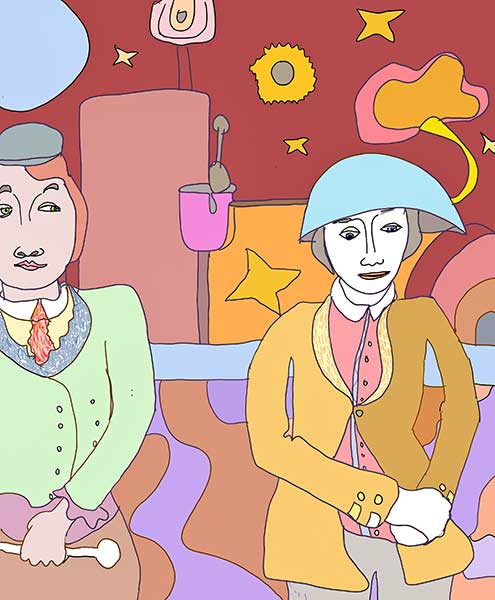
The Sylvanic Sound Weaving Guild was an organization prominent in the latter half of the 17th century, primarily active within the Whisperwood region. The Guild’s purported objective was the systematic capture, manipulation, and re-presentation of natural and artificial soundscapes through a proprietary process colloquially known as “aural tapestry”. Members referred to themselves as “Chronomancers of Resonance”, employed highly specialized instruments to isolate specific acoustic phenomena, which were then woven into intricate musical compositions.
The precise origins of the Guild are shrouded in ambiguity, though several documents point towards a splinter group emerging from the Fellowship of Resonant Harmonists around 1650. Early records suggest a schism over methodological differences, with the Harmonists favouring theoretical contemplation and the nascent Guild advocating for practical, empirical sonic manipulation.
The core of the Guild’s practice involved the use of complex devices such as the Echolocation Flute and the Sonorous Condenser, as well as the notoriously intricate Harmonic Loom. These instruments, which. often required multiple operators and years of calibration under the tutelage of master artisans, were capable of isolating minute sonic details – the rustle of a specific leaf species, the sigh of a particular wind current, or the precise timbre of a nocturnal insect’s wingbeat – and integrating them into coherent sonic tapestries.
Their finest creations, such as “Symphony of the Shifting Bog” or “Nocturne of
the Forgotten Brook”, were not merely compositions but rather immersive sonic
environments that could induce profound, often unsettling, emotional states in
listeners.
– Elara Vance, “The Unknown: Pre-industrial Sonic Arts”
The Guild reached its zenith in the 1680s, with over three hundred active members and several small affiliated groups. However, internal disputes regarding the ethical implications of manipulating natural sounds, coupled with an increasing demand for portable sonic experiences, led to factionalism. The most radical faction, the Chronos Acoustics Collective, attempted to weave temporal anomalies into their works, resulting in the incident known as the Great Unravelling of 1693.
Following this catastrophic event, the Guild’s influence waned dramatically. Many members renounced their membership, taking their technical and theoretical expertise to disparate fields, from theatrical sound design to early forms of ambient music theory. Harmonic Looms and Sonorous Condensers are now exceedingly rare but a few complete examples are held in private collections or by specialized institutions such as the Institute for Archaic Auditory Studies in Leeds.
The danger was never in the capturing of sound but in the ambition to
permanently alter its natural cadence. When a bird’s song can be made to loop
indefinitely, or a river’s murmur silenced at will, the fundamental balance of the
world is irrevocably disturbed.
– Marcus Browning, A Critique of Auditory Alchemy
.
Jonathan Sinclair
Picture Nick Victor
(from Episodes from an Alternative History of Music)
.