
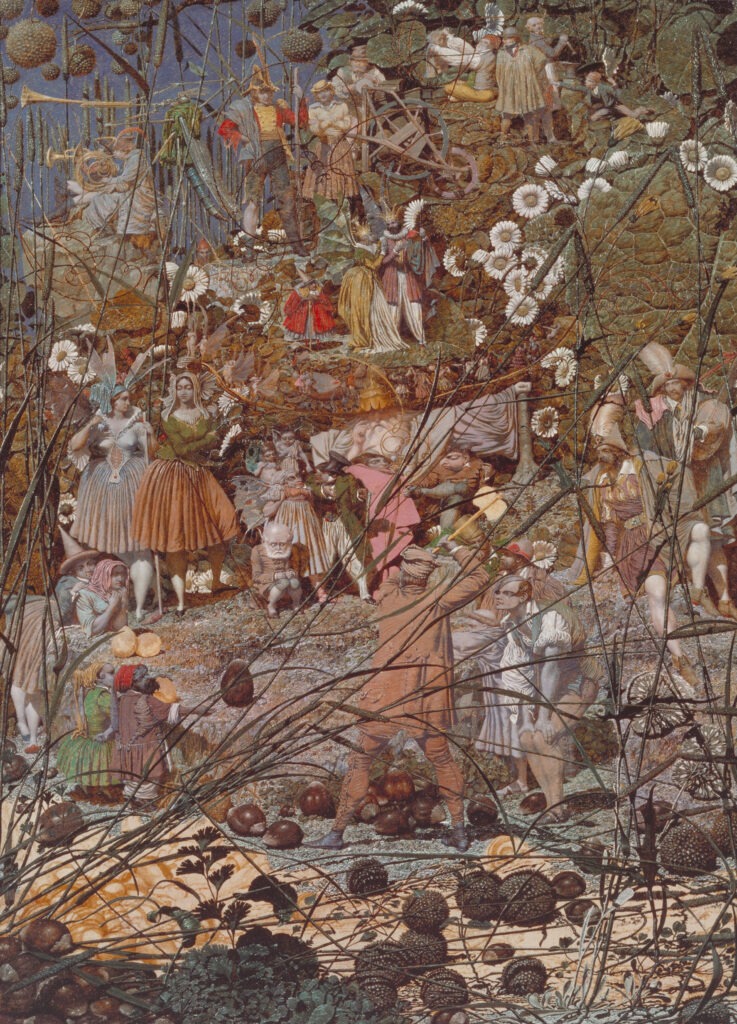
Richard Dadd, The Fairy Feller’s Master-Stroke. Dadd painted it while incarcerated in the State Criminal Lunatic Asylum
of Bethlem Royal Hospital, where he was confined after he murdered his father in 1843.
The Richard Dadd exhibition at the Royal Academy (RA) is in turn enchanting and disturbing. He was a Victorian painter of extraordinary fairy worlds of legend and literature, as well as portraits and watercolours inspired by his travels around the Middle East and the Mediterranean.
Dadd’s early portrait of fellow student Augustus Egg dressed as a Puritan soldier in a tall conical hat has all the hallmarks of a great artist. Dadd and Egg were members of The Clique, a circle of young painters enrolled at the RA in the late 1830s. Dadd, as its leader, distinguished himself by winning medals for Life Drawing, Drawing, and Painting, establishing a reputation for exceptional technical craftsmanship.
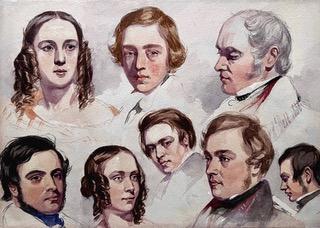
Richard Dadd, Family Portraits (1838), with his father portrayed, top right
Photo by Sam Burcher
The Clique predates another influential RA group The Pre-Raphaelites, by some ten years. Whilst Rossetti, Millais and Holman Hunt frequently painted scenes from antiquity and directly from the real world, Dadd’s delightful and incredibly imaginative oil paintings are drawn from several of Shakespeare’s plays, A Midsummer Night’s Dream in particular.
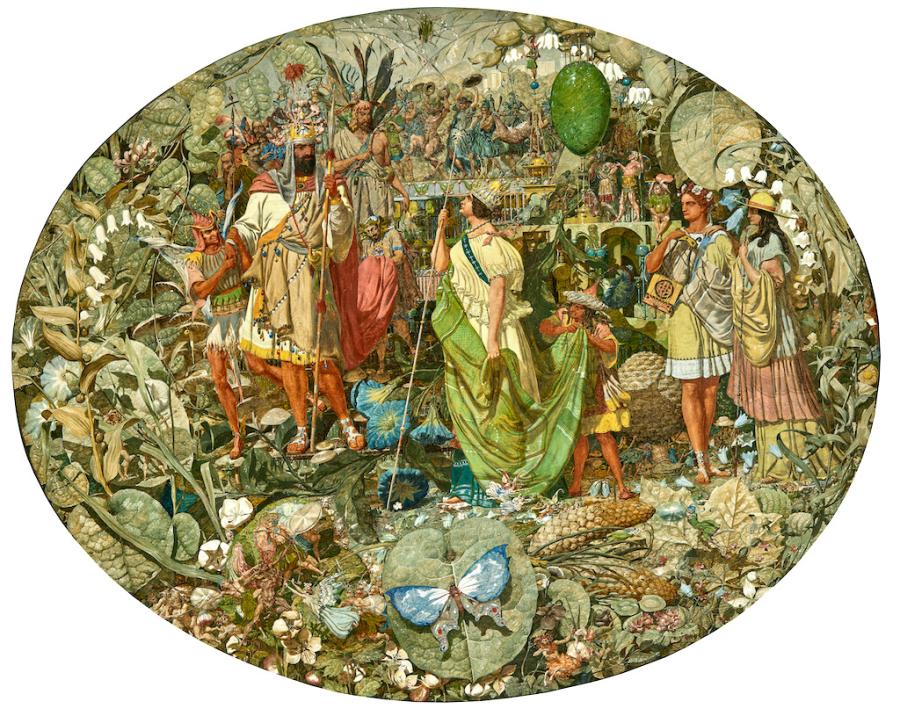
Richard Dadd, Contradiction. Oberon and Titania, 1854-58. Oil on canvas, 61 x 75.5 cm.
Private photo by David Palmer
Private photo by David Palmer
Ethereal portraits of Puck (1841),Titania Sleeping (1841) and the fairy worlds inhabited in Contradiction: Oberon and Titania (1845-1858) reflect Dadd’s formidable skills in depicting lively groups of minute fantasy figures in microscopic environments or circle dancing under the moonlight.
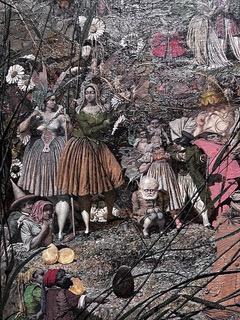
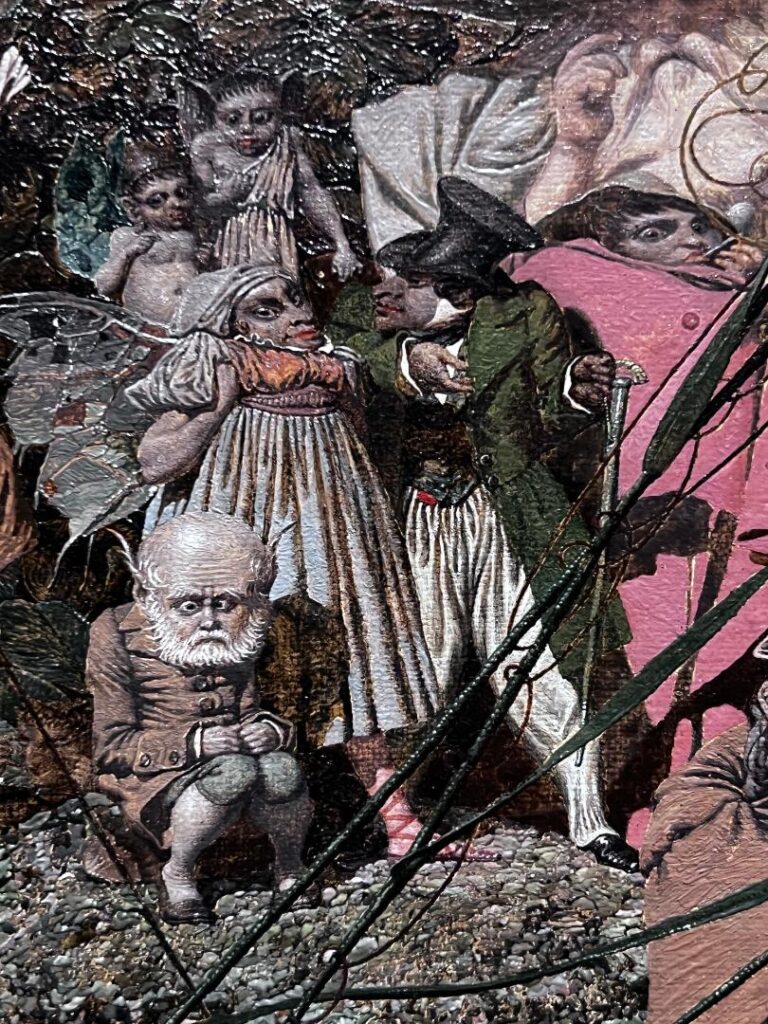
Details from The Fairy Feller’s Master-Stroke
The ferocious detail in the Fairy Feller’s Master-Stroke, (1855-64) alongside the three strange heads in Bacchanalian Scene (1862) imbibing a strange brew from a golden cup is overlaid by delicate twists of bindweed, curls of ferns and wheat sheaves that transport the viewer to entirely different times and places.
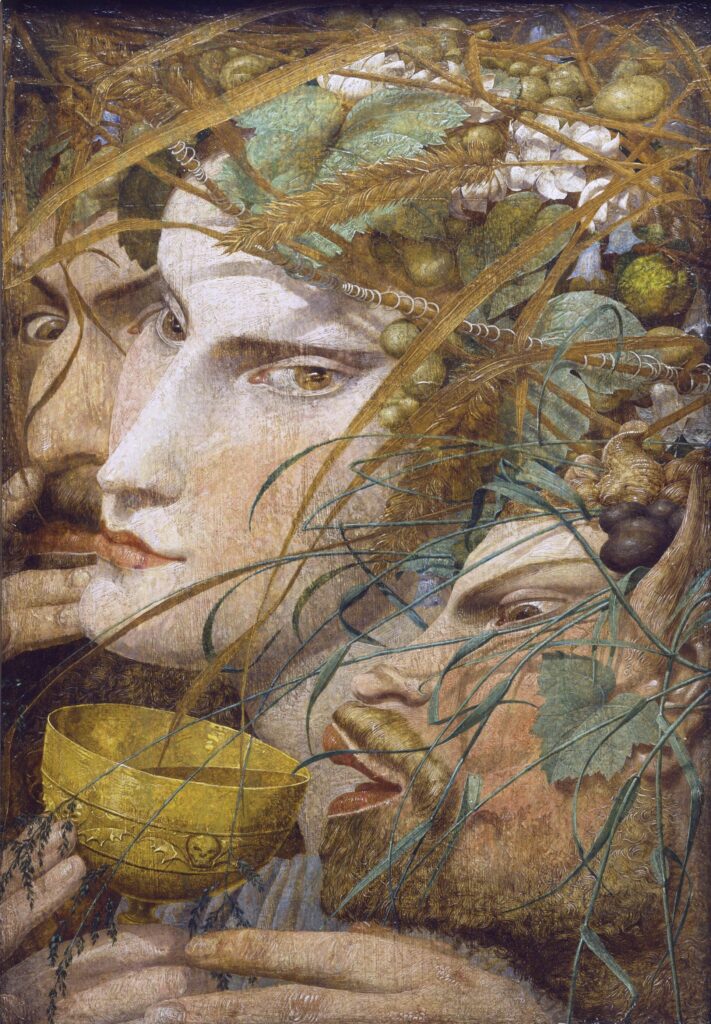
Richard Dadd, Bacchanalian Scene, 1862. Oil on wood, 35.6 x 24.1 cm.
Tate: Lent from a private collection.
This beguiling minutiae of fairy worlds, watercolour landscapes and frankly exotic colours of peopled scenes remembered from his travels create a heady mix. But the dreamy intoxication is abruptly ruptured by the shocking revelation that Dadd brutally murdered his own father.
At first Dadd wrote lucidly from abroad, but his mood changed and he developed a severe form of psychosis following a rushed visit to Egypt and Syria. After returning to the family home and stabbing his father in Cobham Park in Surrey in1843, he went on the run to France. There he was restrained by passengers on a stagecoach southeast of Paris after he slashed the throat of a fellow passenger with a razor. When the gendarmes arrested him they found a hit list of potential victims in his pocket, which included Ferdinand I, the Emperor of Austria.
When the French deported him back to England he was Incarcerated in the madhouse in Bromley known as Bedlam or Bethlem Hospital without trial and later transferred to the high security prison Broadmoor in Berkshire. In both institutions he was encouraged to explore his creativity with a surprising amount of freedom.
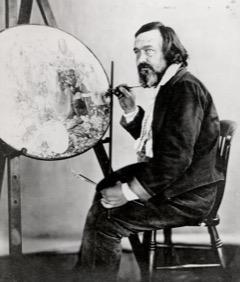
Dadd painting in Broadmoor.
A significant figure in Dadd’s rehabilitation was Dr William Hood, who became the physician superintendent of Bedlam at the age of 28. He reformed the care of insane patients by removing mechanical restraints and dungeon like wards and providing books and art materials. He commissioned pieces and collected Dadd’s completed artworks, including Portrait of a Young Man (1853) depicting a serene Dr Hood in his garden.
A panoply of musicians, writers and painters inspired by Dadd’s ouvre include Freddie Mercury, who wrote the song The Fairy Feller’s Master-Stroke for the album Queen II. Neil Gaiman’s position paper explores the painting’s magnitude in depth, and Terry Pratchett cites it as an inspiration for a chapter in his popular Discworld series. John Everett Millais pays homage to both Shakespeare and Dadd in the otherworldly forms and intense foliage surrounding Ferdinand Lured by Ariel (1849-50), in a scene from The Tempest.
It is strange to think of an artist so brilliant also being capable, but not culpable for foul deeds. In a fascinating retrospective the RA has unashamedly and compassionately claimed this genius as one of its own.
Sam Burcher
Richard Dadd Beyond Bedlam runs at the RA until 25th October 2026.
.