
This folksong has its origins in ornithomancy – the ancient practice of interpreting omens from bird behaviour – superstitions connected with magpies, considered a bird of ill omen in some cultures and in Britain. Many sources claim that the earliest recorded version of the rhyme appeared in 1777 in a note within John Brand’s Observations on Popular Antiquities of Great Britain. The Origin of our Vulgar and Provincial Customs, Ceremonies, and Superstitions. However, the claim that Brand’s 1777 work contains the magpie rhyme is incorrect. While the book does describe the chatter of the mag-pye as an omen of dire calamity or great misfortune, there is no recorded version of the rhyme itself. The rhyme was first recorded in Samuel Johnson and George Steevens’s 1780 supplement to their 1778 edition of The Plays of William Shakespeare. ‘The magpie is called in the west to this hour, a magatipie, and the import of the augury is determined by the number of these birds that are seen together’.
‘One for sorrow, Two for mirth,
Three for a wedding, Four for death’.
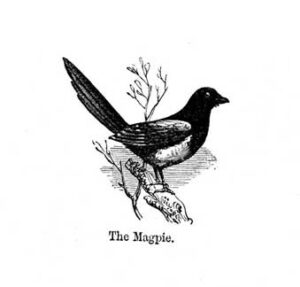
19th: Century Engraving
The bird looks black and white in colour but, if seen in sunlight and up close, it reveals a hue of purple-blue colour on the wings and green on the tail. The name is derived from two words ‘mag’ and ‘pie’; ‘mag’ means to chatter, and ‘pie’ refers to the pied plumage of the bird and is associated with evil and bad fortune. Magpies are also known for stealing shiny objects like jewellery and can deceive others, therefore, the attribution of being evil. Some of the superstitions revolve around magpies’ eating habits: they are omnivorous and eat plants, seeds and dead animals. Due to this habit of eating dead animals, the bird is considered to have some devil’s blood and is associated with death as well. As with all superstitions, there is always a loophole. While some believe one magpie is an omen of bad luck, many people would look around to spot another magpie to negate the bad luck, or they would greet the singular magpie with a ‘Good morning, Mr Magpie’.
Over the years, many different versions of the magpie rhyme have appeared and your location and background may have determined which version you grew up with. No matter how you choose to recite it, the rhyme remains a beloved piece of folklore.
One for sorrow, Two for joy,
Three for a girl, And four for a boy,
Five for silver, Six for gold,
Seven for a story, never to be told.
Eight’s a wish, And nine a kiss,
Ten is a bird, you must not miss.
The Unthanks live – Magpie @ Palladium, London, 29/5/22
© Stewart Guy
/
I love them personally. They are highly intelligent, sociable birds. I’ve had some special encounters with them over the years. “One for sorrow” I was told, here in Devon, is because a solo magpie is one who has lost his or her mate…”Sorrow” indeed.
It’s high time we stopped maligning animals, and projecting our crap onto them. Evil has a human face, (though it’s in our power to change that).
Comment by Heidi Stephenson on 14 January, 2026 at 3:25 pm