
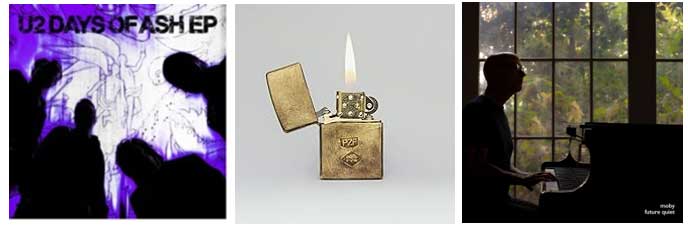
U2 Days of Ash (Island)
Mumford and Sons Prizefighter (Island)
Moby Future Quiet (Little Idiot).
U2’s Days of Ash EP, Mumford and Sons’ Prizefighter, and Moby’s Future Quiet were released within days of each other and, in different ways, all evidence a reinvention of sound while also responding to aspects of the challenging time in which we live. In relation to both, each of these releases involves significant levels of collaboration in ways that seek to demonstrate an alternative to the divisive forces that are actively creating conflict.
Days of Ash is the most clearly political of the three and, in contrast to the length of time U2’s recordings have often taken, shows the benefit of reverting to rock ‘n’ roll’s original practice of writing and recording songs very quickly. Days of Ash is by far the most compelling collection of new material U2 have offered since 2009’s No Line on the Horizon.
One of its strengths is that it responds to particular individuals who have taken a stand against the escalating forces of authoritarianism that are eroding democracy and utilising conflict in a global grab for scarce resources while erecting barriers towards and enforcing deportations of those who are migrating because of conflict and scarce resources.
‘American Obituary’ contrasts the motivations of Renée Nicole Macklin Good, a mother of three shot at almost point-blank range while exercising her right to peacefully protest in Minneapolis, Minnesota on 7 January, 2026, with the violence and hatred displayed by members of The United States Immigration and Customs Enforcement (ICE). The song bursts from the speakers with a commitment and passion like nothing else since ‘Vertigo’, the opener to How to Dismantle an Atomic Bomb. ‘Song of the Future’ honours the life of 16-year-old Sarina Esmailzadeh, who was one of thousands of Iranian schoolgirls who took to the streets as part of the Woman, Life, Freedom movement in 2022 and who died after being beaten by security forces. This song believes that the children are our future and can, if not corrupted by adults, lead the way into a better future.
‘One Life At A Time’ was written for Awdah Hathaleen, a Palestinian father of three who was killed in his village in the West Bank by Israeli settler Yinon Levi on 28 July 2025. The song is another illuminating collection of Bono’s aphorisms that embrace paradox as he explores ways to genuinely be the change in the world that we want to see. ‘Yours Eternally’ sees Bono and The Edge joined on vocals by Ukrainian musician-turned-soldier Taras Topolia, as well as Ed Sheeran, for a song written in the form of a letter from a soldier on active duty. This is as celebratory a U2 song as we’ve heard in a long time, which is somewhat ironic given the subject matter.
There are musical and lyrical resonances in each of these songs with the different phases of U2’s career. The sense is that they are more comfortable here in drawing on a range of styles from their past than has been the case on their most recent albums of new songs. Their spirituality always informed their political statements and that strand of their work and beliefs is clearly and insightfully present animating these songs with passion and compassion.
‘The Tears of Things’ is a new U2 masterpiece which takes its title from a book by Richard Rohr that breathes new life into ancient wisdom and paves a path of enlightenment for anyone seeking a wholehearted way of living in a hurting world. Bono has written and spoken often about his appreciation for the Biblical King David and the Book of Psalms, many of which are credited directly to him. Now these thoughts have been turned into a song which is a dialogue between David as sculpted by Michaelangelo and his creator. With its yearning for peace and healing held together with awareness of the stress of sin, this is a keening ballad that sits comfortably alongside U2 classics such as ‘One’.
What is newer for U2 is ‘Wildpeace’, a collaboration with Nigerian artist Adeola of Les Amazones d’Afrique, who reads a poem by Israeli author and poet Yehuda Amichai set to music by Jacknife Lee and U2. The poem, which has a back history in efforts towards peace in the Middle East, essentially argues that we should aim low in relation to beginning to establish peace by seeking to postpone the next war. If Days of Ash inspires any of those who listen towards that limited aim, it will have served a tremendous purpose.
Where Days of Ash has a political intent in relation to the challenges we all face today, Mumford and Sons bring a more personal slant to those same challenges. Prizefighter, both song and album, finds them looking back on the inevitable vicissitudes of life with an equanimity that comes from experience while committing to run together with others in the face of those future challenges that will also inevitably come.
The key words on this album are ‘here’ and ‘run’. The ‘here’ songs are those in which the characters state who they are and look back in order to look forward in a way that embraces change. Opening song ‘Here’ lays it on the line: ‘Here’s all the mistakes I made / For too long’. The ‘Prizefighter’ says ‘I don’t look back, cos I’m still here’ but the song is all about looking back while adjusting to a new reality as the crowd now go wild for the new contender when it is he who raises his hands.
A fresh start is what is needed and that is the burden of ‘Begin Again’:
Give it up
While you can
Don’t carry your Father’s sins more
Than you can take
I swear there’s another way
The other way involves the flexibility of the ‘Rubber Band Man’ who is ‘Dying just to live’ and the ability to run together with others. This involves communication:
And in the end I’ll tell you
Everything
Even if it keeps you awake
But by the end you’ll know me for
Everything
How far I bend before I break
(‘I’ll Tell You Everything’)
Then, in ‘Badlands’, comes the call to ‘Run with me’ away from ‘a tame life’ and ‘a low tide’ towards ‘a vision’ and the ‘high wire’ of ‘a thin line’. This is amplified in ‘Run Together’:
But when we run we run together
When we’re apart we fall apart
I am yours, and yours, and ever
Can we start
Cos change is never too late
Running together in this way involves support for one another in the midst of trauma:
And hey
Did you call, did you fall, do you
Need someone?
Do you need someone?
And hey
I’m a mess myself but I think I could
Be someone
If you need someone
(‘The Banjo Song’)
When reviewing Mumford and Sons previous album for International Times, I noted a disappointment that the band were simply revisiting the sound of their early albums rather than updating it and suggested that their collaborations with the likes of Baaba Maal or Pharrell Williams had been excellent but had not been pursued further. Here, however, their original Nu-folk sound is evolving and being updated on the basis of a significant number of collaborations.
The band’s name suggests a collective and collaborative community has always been a major element of their practice, whether we are talking Communion Records or the Gentleman of the Road tours. Previously, their collaborations have been in relation to EP’s or singles. Now collaboration informs the whole album enabling a whole that is more than the sum of its parts. Prizefighter is undoubtedly their best album since Sigh No More and is an album that demonstrates the strengths of running together while also being a hymn to collaboration.
Moby starts Future Quiet by going back to his roots. Everything Is Wrong was the album that he thought of as his first real album and which he thought, at the time, might be the only chance he got at making. As a result, it is an eclectic, diverse album crammed full of all the styles Moby appreciated, from noisy to quiet. On later albums, being less anxious, he could stretch out more and explore particular styles in depth. Future Quiet is exclusively an album of his quiet music. As someone who experiences anxiety both personally and in relation to world, Moby says he needs quiet music to calm his nerves and as salve to his worries. For him, nothing else has the effect that quiet music offers. In a noisy, stressful world, Moby opens up a peaceful space in which healing and restoration can take place.
The opening track on the album is a reworking of ‘When It’s Cold I’d Like To Die’ from Everything Is Wrong. Sung by Jacob Lusk aka Gabriels, this haunting rendition transcends the pessimism of the lyric with the ethereal beauty of the music. This trick is immediately repeated on ‘This Was Never Meant For Us’, a rumination on loss in which we are told that ‘the years left us broken’ while the music tells another story.
Whether songs or instrumentals, whether piano-based, string-based, or choral, whether collaborations or solo tracks, whether pessimistic or optimistic, the stillness and quiet Moby creates is a silence in which to hide, as he states in ‘Precious Mind (Quiet Future)’. In the silence, he touches unknowing – ‘O magnum mysterium’ – and hymns ‘O Maria, stella maris’ finding light illuminating all.
Some reviewers have balked at the length of Future Quiet, finding too little of interest therein to sustain concentration across its 85-minute length. That is not is the point, however. This album is a sound bath in which to immerse oneself, allowing its stillness to wash over you and interpenetrate your fears and concerns in order to find silence and light yourself, within.
To the challenges of today, Moby offers peace and quiet, Mumford and Sons offer personal resolve and direction, while U2 offer the inspiration of an alternative politics. Each do so in tandem with a range of collaborators recognising that the sum of the parts adds up to more than the whole. Within each of these thoughtful, provocative, engaged collections there is no either/or in terms of which to choose or which approach to adopt. All have their differing depths and glittering treasures to appreciate and savour. Taste and see that the music is good and that their ways to engage are all necessary.
Jonathan Evens
.