
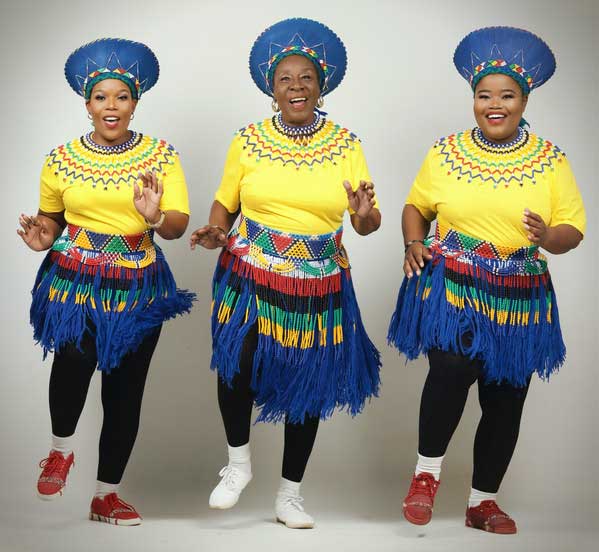
The Mahotella Queens are a South African trio
with an amazing track-record of hits, now
founder member Hilda Tloubatla is back with
two new members – Amanda Nkosi and Nonku Maseko,
for new album Buya Buya (Come Back)
Buya Buya, the title of their CD, means ‘Come Back’. But the Mahotella Queens never really went away. Founder member Hilda Tloubatla remains the focus, but she brings in two new members Amanda Nkosi (alto) and Nonku Maseko (tenor) – ‘they are blessed with that same dynamic spirit of the original Queens,’ while former member Mildred Mangxola – who wrote ‘Uyeke Amanga (Stop Your Lies)’ but quit the group in 2013, returns to add her tenor to the mix. Opening track ‘Jomba Jomba’ translates as ‘Jump To The Music’ with township-jangle that tingles like thunderbolts in your head while inviting ‘what are you waiting for?’, with slicing guitars over a rambunctious bass-bounce of cross-rhythms that take you by the hand and leads you dancing into the album. ‘Ngibuz’indlela’… which is ‘Show Me The Way’, is about a lost girl who finds her way back to her family, telling them ‘I’ve been travelling without any direction for so long.’ You feel the Soweto air on your face. You can feel Africa beneath your toes. The CD genre read-out says ‘Pop’, which seems hardly adequate when the voices and guitar shine like diamonds on the soles of her shoes. Like a swan, there’s a lot of glide, but with things getting busy beneath the surface.
Hips don’t lie. The Mahotella Queens’ sound is a continuity with a long tail.
1964 was the year the Beatles played the Ed Sullivan Show and shifted global Pop forever, while in apartheid Johannesburg, Rupert Bopape of the Gallo Africa label was adding electric instrumentation to traditional mbaqanga and mgqashiyo rhythms to empower a stable of artists ready to reshape South African music in ways that still reverberate down the years. If Gallo Africa was the Motown of the southern hemisphere, teaming the Queens with ‘Groaner’ Mahlathini was adding Marvin Gaye to the Supremes. ‘The Sound Of Young Africa’.
The album title-track, ‘Buya Buya’, is a revision of Hilda’s first 78rpm composition for the Queens from 1966, its ebullient close harmonies and intricate instrumental break, cover her doubts – as the group’s touring and recording career took off, about the ways it takes her away from her infant daughter, ‘come back home, Mother, your children are crying.’ It’s never easy. Another track revives ‘Thoko, Ujola Nobani?’ (‘Thoko, Who Are You Dating?’), an even earlier song issued in 1964 as the Montella MO.33 ten-inch 78rpm single c/w ‘Jive Mgqashiyo’, adapted by fellow founder-Queen Nunu Maseko from a teasing song sung in disreputable drink-dives, clubs and risqué shebeens.
‘Gazette (Kazet)’ from 1987 LP Paris-Soweto features tall rangy Baba Nkabinde Mahlathini, who sings ‘this is our kind of rhythm in Africa, we send our messages through music,’ but there’s electric guitar and keyboard, set to basslines powerful enough to set the continental tectonic plates vibrating.
‘I’m In Love With A Rastaman’ – also with the ‘Lion of Soweto’ Mahlathini and featured on 1991 compilation The Best Of, opens acoustic, then dances into slow rhythms that make you miss places you’ve never been to. A unique Soweto-Jamaica fusion as the girls chant ‘reggae man’ and trade lines with each other, their voices soaring sky-high in soulful uplift as they generally have a great time together. Even if you don’t know much about African music, they sure seem to have fun working its magic. If your toes don’t dance to this, you have lead feet.
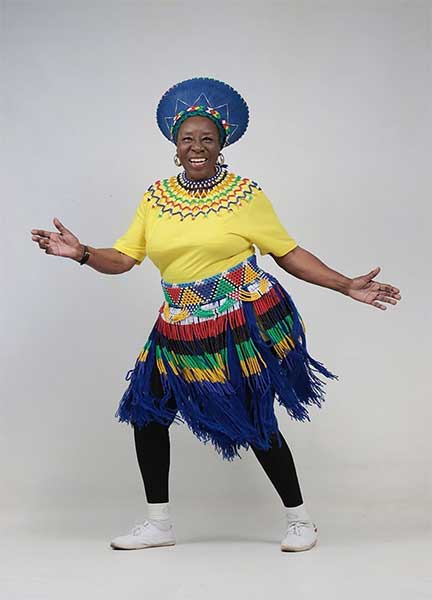
From 1993, the affirmative ‘Woman Of The World’ video shows Mother Theresa… and Mrs Thatcher in female-centric ‘joy and harmony’ over a perpetual motion of infectious Township Jive backbeats. The girls wiggle their choreography in their matching blue outfits with wide blue disc hats.
Agent and the catalyst of the project, Nick Lotay says ‘being close to a musical legend like Hilda Tloubatla is something I couldn’t ever have envisaged. We first met twenty years ago, backstage at a Mahotella Queens gig in Leeds. I was a teenager but had fallen in love with them and I became a rather obsessive collector. I’d also started examining their sound quite intensely, imitating Marks Mankwane on my electric guitar. Hilda realised my knowledge of the Queens, their individual musical journeys and of mbaqanga itself ran deeper than the average fan’s, particularly when I showed her a stack of their old 78s, 45s and LPs. She gave me her mobile number and we began exchanging regular calls. She loved being reminded of long forgotten songs, musicians she had known and so on. She soon became comfortable sharing untold memories of the Queens’ formative years, as well as her own personal story of life under apartheid.
‘Over the years I built up a core friendship group of other South African mbaqanga veterans, all of whom sensed I was genuine and were happy to share stories, photos and anything else that would help me piece together the history of mbaqanga music. During the early 2010s I was a regular contributor to the ElectricJive blog, where I posted in-depth articles on mbaqanga groups. That led to the formation of Umsakazo Records in 2016.
‘I had long dreamed of making an album with the Queens but never really took the idea further. The Queens had continued to tour the world well into their seventies and I guess I just assumed they would keep going and going for evermore. Then in 2021, Nobesuthu Mbadu, one of the longest serving members, died suddenly and it sort of focused my mind a little: nobody is immortal and it doesn’t make sense to put off a good idea. Also, for some unfathomable reason, the Queens had not released an album of new music since 2007, so these were the catalysts for getting the new project off the ground. It was really difficult to pin down exactly when and how we’d do things, so the project was actually in limbo for a long time. Then, earlier this year, Hilda made the decision to leave her label and her management company and start afresh, which is a bold thing for anybody to do but particularly seismic for someone of eighty-three! She approached me with the aim of reviving the group’s touring career, which had flagged a little in recent years, but I knew we needed to get things going with that new album.
‘Although we’ve known each other for years, the thought of working directly with her was daunting. Hilda is a formidable lady with very strict parameters when it comes to the sound of her group. That’s completely understandable – she’s the last original member left and that fact plays on her mind constantly. She has been sort of thrust into that role as the custodian of the Queens and takes it very seriously. But what I wasn’t expecting was for her to put faith in the possibility that my admiration for her music could translate itself into a good quality new production. We eventually settled on all new versions of hidden gems from the archives. She did have some reservations about the reaction to a new Mahotella Queens album without the major figures who shaped their sound. She was also sceptical about how this ‘transglobal’ collaboration would work. But she decided to roll the dice and, to my astonishment, gave me her blessing to assemble a new band and then arrange and produce all the backing tracks from the UK. We discussed the vocal arrangements over the phone and she would compose and edit words as we went along. Then I arranged for her and the other Queens to get into the studio and record their vocals. The studio sessions would be the first time Hilda would hear my arrangements and I was bracing myself to take tons of notes of improvements. I was so relieved that she had no major issues with them! Any changes she suggested were minor and obviously improved the tracks. So, in the end, ours turned out to be a delightful working relationship.’
— 0 —
Now, suddenly, I’m talking to Hilda on a Zoom! hook-up…
‘Hi, hello.’ Her voice across the link. But there’s no visual. Hilda’s youngest daughter Dominique is here to set up the Zoom! call, as at eighty-three, Hilda finds this new technology more than a little daunting. ‘You can’t see me? I can see you’ she responds. ‘You can see me now, OK?’
And she smiles across the miles from Africa. She wears a simple, blue-striped top, understated gold earrings, with her dark hair pulled back from her radiant face.
Andrew: Is it alright if I call you Hilda?
Hilda: ‘Yes, it’s alright, that’s my name. You’re calling me right, correctly.’
Andrew: I tell her it’s wonderful to have this opportunity of speaking to her.
Hilda: ‘Yes, same to me, thank you very much.’
Andrew: I say that she’s had a remarkable career during which she’s created some wonderful music.
Hilda: ‘Oh, thank you’ she laughs. She laughs easily. ‘And if it wasn’t through you (journalists), my music wouldn’t have reached ‘lalela’ (the Zulu word for ‘listeners’). So, thank you.’
Andrew: How many languages does she speak?
Hilda: ‘I speak our language – Zulu, Sesotho, Polaar and English. Our African is a difficult language.’
Andrew: You must be very pleased with your new album, Buya Buya?
Hilda: ‘I’m very much pleased, really. Very much pleased and surprised. Very much pleased. I hope you are also pleased? If you have listened to it.’
Andrew: I don’t always understand the words, the lyrics…
Hilda: ‘Okay.’
Andrew: But you can’t help but dance to it. It’s feel-good music.
Hilda: ‘The language that we are singing there is Zulu, Sesotho… and, yes, it’s Zulu and Sesotho mostly. Those are the two languages that we are singing mostly there.’
Andrew: Did you grow up in a musical family?
Hilda: ‘My God, it’s my gift from God. From when I was still very young, from when I was still young in school. When I started school… when I eight years, I started school, even back in school my Teachers would really fight for me, they would say ‘I would like to have her in my group’ and that ‘I would like to have her in my choir’ – all of them, it’s a gift from God with me. Even with my family also. I have sisters only. We were three sisters, from my Mother. Only sisters, we did not have a brother. All of them – all of my sisters, they were real musicians. Even my Mother. I should think it was a gift from my Mother.’
Andrew: So there was always music around in your home as you were growing up?
Hilda: ‘Yes, always. Always. From since when we were still young. Very young.’
Andrew: To what degree were you aware of American Rock ‘n’ Roll and Elvis Presley?
Hilda: ‘Say what about them? My God, that is real music also. From those groups – fortunately, we had their music also in South Africa. They were selling that music in South Africa, and my God, everybody would buy their music. Well, really – Rock ‘n’ Roll, my God, that was the best music, overseas also.’
Andrew: But you stayed true to playing African music.
Hilda: ‘My God, we were playing ALL the music. Rock ‘n’ Roll, Jazz music, like I can tell you, we were playing music like Sammy Davis Jrn, Quincy Jones, all of the top American musicians who were playing there. Michael Jackson, those were all of the Rock ‘n’ Roll, it was top music. If you didn’t have an international LP in South Africa, they would laugh at you to say ‘my God, you don’t know your music at all’.
Andrew: Your earliest records were issued on 78rpm – and then the Mahotella Queens were issued on vinyl records, cassettes and CDs. You’ve covered the full history of music technology across decades.
Hilda: ‘Yes, yes. Exactly. What about them? When we had CDs… from the 78rpm, our first record released was a 78rpm, and then from there it was an LP, from then it was a CD, from all of that – there was music, we had records, and even from international record labels, we had them… and we were blessed also that our music managed to come over to your countries, and it was sold.’
Andrew: Was Rupert Bopape a positive influence? Born Sebatana Rupert Bopape 15 December 1952 he was a pivotal figure in the South African music industry, after serving time with EMI he moved to Gallo Records and formed Mavuthela Music division, devoted to African musicians (she laughs as she corrects my pronunciation of his name).
Hilda: ‘Rupert Bopape, he was the producer of our group, Mahotella Queens. The guy who formed this group. He was very very good, really. In fact, that was not the first group that he formed. At first there was a group that he formed, it was called Dark City Sisters – I don’t know whether you’ve heard about it? That’s the first group he formed – Dark City Sisters, it was mbaqanga music from the Alexandra Township with the Alexandra Black Mambazo (a group that had earlier had a 1958 international hit with ‘Tom Hark’ as Elias & His Zig-Zag Jive Flutes, signed and produced by Bopape). That’s the guy – Rupert Bopape, from then he formed Mahotella Queens. And from Mahotello Queens also, he had a lot of groups, Mthunzini Girls, Dima Sisters, oh my god, he was a top musician, promoter, producer I mean.’
Andrew: So it was similar to the Motown system, where all the artists worked together?
Hilda: ‘You mean on stage, or at the record company? In the studio, for rehearsals, we were all together. But every time, different, Mahotella Queens would be different, separated, but from the same studio, but different rooms, all of them, from all the other groups. But the same studio.’
Andrew: The Mahotella Queens worked with Simon ‘Mahlathini’ Nkabinde (she laughs at my mispronunciation of his name).
Hilda: ‘No! You’ve done nothing wrong! With him also, it started with, he was Rupert Bopape’s musician from when he was with… from when he started with his group Dark City Sisters. He had musicians from all over, then, when he came over to our company, to Gallo record company – Rupert Bopape, when he came over with Mahlathini, and Mahlathini was the guy that we sang with. Oh my God, and we were blessed. A voice like that. And his voice it was naturally like that, when he was talking it was normal, but when he was singing it just changed automatically.’
Andrew: I love the track that you recorded together ‘I’m In Love With A Rastaman’. I wasn’t aware that there were many Rastamen in South Africa.
Hilda: ‘Okay ‘Kazet’. No, we had a lot of Rastamen. We were blessed really, we had Rastamen singing Rasta music. Our music is called Mgqashiyo music. Can you say ‘Mgqashiyo’…?’
Great hilarity ensues at my attempts.
Hilda: ‘Yeah, good!’
Andrew: Another song I like is ‘Women Of The World’, which is a crusading song for women’s rights.
Hilda: ‘That was a beautiful song, ‘Women Of The World’. We had a lot of beautiful songs. In fact, all of our songs, they were right, I mean – ‘I’m In Love With A Rastaman’ was top music.’
Andrew: It must have been difficult for you during those Apartheid days.
Hilda: ‘Can you say that again? Yes, well – but even when it came over to music, we were separated, we wouldn’t be, we couldn’t come together with them. It was both us, and with them. When it came to music they would say ‘go on with your music, go on with your music, they didn’t mind even if we sing English songs, or compose songs in English, or compose a song in African.’ They didn’t mind. The difficult thing was just that they, wouldn’t allow us to be together.’
Andrew: But music is the healing force that brings people together. We all share the love of music.
Hilda: ‘Exactly. Music really is a healing thing. It’s a thing that is healing everything.’
Andrew: With the original Queens, you also have little dance routines.
Hilda: ‘What about it? What about dancing? With Amanda and Nonku… or are you talking about Mildred and…? Yes, with Mildred and Nobesuthu. Yes… my God! We would really have, Ooh! when we were dancing on stage, the three of us! It would be like, and we were abroad, and we were performing there, and look at the crowd, they would be… they are so crazy, never mind that they don’t understand the things that we are singing about, the language or the parts… they are blessed because they enjoy the type of music that we are singing, and the choreography that we are doing on stage, and the backing tracks, oh my God! They were excited about it!’
Andrew: Did you practise and rehearse those dance moves?
Hilda: ‘Yes. The rehearsal is what you have to do, whether you like it or not. Before you go onstage you must rehearse.’
Andrew: So the three of you would get together and work out your own dance routines.
Hilda: ‘Yes. Yes. Exactly. We would work out the choreography, and onstage do the right thing.’
Andrew: Did you ever get them wrong, and make a mistake?
Hilda: ‘No. Never. Before we would go on stage we must make sure that before we go onstage that we have rehearsed and everything is perfect. Because really, we have to entertain for the audience. We cannot go onstage and not do the exciting things for the people, the people are paying their monies to come up to the show, so if you don’t do the right thing, no – it’s not right. So that’s why we make sure, that whenever we go on stage – that my god! we are going to perform, and we are going to excite them. And they will really be excited.’
Andrew: I like those big blue round hats that you wear.
Hilda: ‘Yes, Zulu costumes. We call those hats ‘isicholo’. That’s a Zulu costume. That’s what the Zulu’s wear.’
Andrew: You toured with Ladysmith Black Mambazo.
Hilda: ‘Yes, they came over to… they met and got together, years and years ago, when Ladysmith Black Mambazo started also, when Mavuthela started, they found that they wanted to come across to the (Gallo) studio. Their music – oh, my God, they found they wanted to come over and see the Mahotella Queens’ act. And fortunately, their tunes and their music – oh my God, made only, good music, lovely good music. Ladysmith Black Mombazo.’
Andrew: The Mahotella Queens recorded the Paul Simon song ‘Homeless’, on which Ladysmith Black Mambazo were heavily involved.
Hilda: ‘‘Homeless’ – yes, we recorded ‘Homeless’. We recorded ‘Homeless’, what was the name of the group he recorded with? The original tune. The one that recorded ‘Homeless’?’
Andrew: It was recorded by Paul Simon with Ladysmith Black Mambazo.
Hilda: ‘Paul Simon, yes, yes, he recorded also Ladysmith Black Mambazo. That was… and it was exciting for us, with international musicians from overseas to come and say they would like to record, if the Mahotella Queens would like to record, we would be so very much proud, really. And excited. Even performing with them overseas, we would really be excited. All the top guys. Ray Charles. We performed with Ray Charles, we did, really. In New Orleans (and as part of the Paléo Festival in Nyon, Switzerland, July 1988). We performed with Quincy Jones. We performed with Michael Jackson, yes, we did perform with Michael Jackson. Oh my God, all the top American groups. The Festivals. The promoter in France would call and tell you that they would like to have the group Mahotella Queens. And we were excited about that. We are playing their songs, we were having their LPs, and definitely we are going to perform with them. And we did perform with them. Really excited.’
Andrew: The first time you performed outside Africa, was in Paris. That must have been amazing.
Hilda: ‘Yes, it was Paris, that’s the promoter. The guy – the promoter, who made us to come overseas. He came over from Paris, all the way from Paris looking for Mahlathini and the Mahotella Queens. And when he asked, they told him they were at the studio of the Gallo record company. So he went straight to Gallo and found us, and hey, we were so happy. That ‘my God, we are going overseas now!’ It was really exciting.’
Andrew: What was it like for you when you first arrived in Paris?
Hilda: ‘It was amazing, really, we were shocked and we were excited, that ‘oh my God, we are going to overseas’ and the promoter – Christian, he was the guy who took us over. And he made us to be really known and popular overseas. We performed in almost everywhere abroad.’
Andrew: I’ve not been to Africa, but you’ve been to England.
Hilda: ‘I’ve been to England several times. I’ve performed for the king in England, my God. We’ve been in England many times. I’m still coming over, even now!’
Andrew: Do audiences always react in the same way, regardless of which country you’re performing in?
Hilda: ‘They always react the same way, whether we’re in England, whether we’re in America… everywhere, they react the same way. They get excited over our music, really, they say ‘you’ve got a different music,’ and they like the costumes that we are wearing. The Zulu costumes, and the type of music, and the choreography that we are doing on stage. They really… everywhere, overseas, they get excited. It’s like us, when they come over from England to South Africa, we get excited, and the people get excited, and shows also get packed…’
Andrew: You also played for Nelson Mandela.
Hilda: ‘Yes (a deep rich laugh). We played for everybody, oh my God. We were blessed to be… when they invited Nelson Mandela overseas, when he came out of jail – no, he was still in jail then – no, when he came out of jail, for them inviting him, bringing him overseas, and we were blessed that they would like Mahlathini and the Mahotella Queens to come over and perform. We were also excited that – my God, we were going to perform for Nelson Mandela, it’s a blessing. That was a blessing, and a blessing to be overseas in England. Great. Whooo… it’s exciting!’
Andrew: You live with your daughter?
Hilda: ‘Yes, I have three daughters. Fortunately they are more interested in schooling, but otherwise they are all blessed, they have got beautiful voices, like their Mother. They are fortunate, they like playing music, also.’
Hilda: ‘When I was young, no, I didn’t grow up in Soweto. We’ve got different cities in Johannesburg, Soweto is the place for people who really stayed in Johannesburg, who are in Johannesburg city. My city – which is called Springs City (she lives in KwaThema, a township within Springs, on Johannesburg’s East Rand), but no – we go to Johannesburg, we meet and go into Johannesburg every day. But then, I know Soweto and we’ve got people that we know and families in Soweto.’
Andrew: Amanda sings the Zulu Wedding Song on the new album.
Hilda: ‘Amanda, yes. You say what about her? You mean our Amanda. On the album, of course, yes. We have to sing Zulu. Compose and sing, the Zulu Wedding Song. And it was amazing and exciting for me to do that beautiful song. Nonku and Amanda also, they are… both of them. But it’s Amanda said to… whom I took, using, and then Nonku also, I took Nonku also to replace – in fact, the other two ladies that I started with, Mildred Mangxola and the late Nobesuthu Gertrude Mbadu (26 April 1945–31 August 2021). So they had to replace them. And fortunately, I got the best girls, also. Amanda and Nonku, they are the best.’
Hilda nods towards Amanda & Nonku. ‘I know the group will be safe in their hands when the time comes for me to step back.’
Andrew: Mildred actually appears on the album.
Hilda: ‘She does what? Yes… she is, in fact, when we started doing the album together with Mildred, while she was sick, but at least she managed to… oh my God, and up to now she’s still sick. But she managed to record her songs.’
Andrew: But you are in good health?
Hilda: ‘HaHaHaHa, it’s God’s blessing upon me, really, with my health. I’m having a good health. That is God’s blessing.’
Andrew: On ‘Gazette (Kazet)’ from 1987 LP Paris-Soweto Mahlathini sings ‘this is our kind of rhythm in Africa, we send our messages through music.’ That is still true. The message still comes through.
Hilda: ‘Yes. Yes. It is our tradition. And it’s true. What the music is saying. That’s a tradition that was sent a message about the songs talking, really. Send messages through songs. It’s our tradition.’
Andrew: Is there anything you want to say about the new CD?
Hilda: ‘On the album? Oh my God – all of them! I am really really excited about it, and really I would like, I hope also that the people will also be excited and definitely love the music. And love – really, it’s good.’
Andrew: Is there anything else you’d like to say about the music or the new album?
‘Yes, I would really like to say to the people – my God, they must buy this – it is a beautiful album, they must buy the album with the beautiful music, and really, we will be excited when we are still coming over to them, and that my God, they must buy… I’m saying to people, buy this… we had interest from a long time ago in England, everywhere overseas, they are buying our music, everywhere. Thank you really, thank you very much to the people, for supporting us. And thank you also to you, for the interview and for the things you are saying, God bless you, and your family also. This is an exciting thing. And I hope when we come over, we wish to see you. Please, when we come over, you are the first person that I would like to see. Otherwise, if you don’t come, I’ll embarrass you to arrange onstage, ‘we are not going to perform not until, not before we see Andrew first’. If you are not there we will send Police to go and look for you and arrest you and bring you over,’
BY ANDREW DARLINGTON
‘BUYA BUYA (COME BACK)’
by THE MAHOTELLA QUEENS
(2025, Umsakazo Records UM 108CD)
(1) ‘Jomba Jomba (Jump To The Music)’ 4:42
(2) ‘Buya Buya (Come Back)’ 3:51, written by Hilda Tloubatla with Ethel Mngomezulu.
(3) ‘Ngibuz’indlela (Show Me The Way)’ 4:31
(4) ‘Mpho Ke Lehlohonolo (Take Care Of Your Gift)’ 5:20, a high spray of guitars, three-part harmonies and fiery mbaqanga rhythms.
(5) ‘Phephezela (Wedding Dance)’ 5:17, written by long-time Queen Nobesutha Mbadu, with contagious accordion.
(6) ‘Salang (Farewell)’ 5:02 featuring Jack Lerole Jnr on ‘kwela’ pennywhistle over strong percussion, a goodbye to her father, Hilda groans – channelling Mahlathini.
(7) ‘Thoko, Ujola Nobani? (Thoko, Who Are You Dating?)’ 4:25, written by Nuna Maseku.
(8) ‘Mma Ditaba (Gossipmonger)’ 4:39, a well-observed character sketch of Township busybodies with a gossip-break about a two-timing scandal and bride-price.
(9) ‘Uyeke Amanga (Stop Your Lies)’ 4:40, written by Mildred Mangxola, a lesson in morality, ‘a liar is no better than a murderer’ advises Hilda, so ‘teach your children well’.
(10) ‘Ba Ntshepisa Lenyalo (I’m Tired Of Your Promises)’ 5:29, she demands r-e-s-p-e-c-t, she’s tired of being used and abused by faithless men. But the catchy rhythms never let up.
(11) ‘Nkhono Le Ntate-Moholo (My Grandparents)’ 5:14, a spooky narrative journey to visit grandparents who can no longer see her, only to find their house deserted, the three voices work together as the guitar glistens.
(12) ‘Laduma Lamthatha (The Thunder Roars)’ 5:20, traditional Zulu wedding song, arranged by Hilda Tloubatla, sung by Amanda. A contagiously stirring thirty-year highlight of the Queens live set. Chanted chorus with thunder effects, crowd noises and mouth-music.
Nick Lotay: producer, arranger, mixer, lead guitar, keyboards, drums, percussion
Hilda Tloubatla: co-producer, lead vocals, songwriter (except where noted)
Amanda Nkosi: alto voice
Nonku Maseko: tenor voice
Mildred Mangxola: tenor vocals
Kagiso ‘Boikie’ Monampana: lead and rhythm guitar
Madoda Ntshingila and Celumusa Zuma: bass guitars
Recorded at DownTown Music Hub, Johannesburg
Previous albums:
‘MEET THE MAHOTELLA QUEENS’ (2019 LP, UM104) reissue of the Queens 1966 mono South African vinyl LP Motella LMO101, with fourtheen songs largely written by Rupert ‘Bops’ Bopape, including ‘Kuqale Bani’, ‘Dinaka’, ‘Sonny Boy’ (written with S Piliso), and ‘We Boy’ (written by Nunu Maseko).
‘MARKS UMTHAKATHI’ (1972, Gumba Gumba LPBS9) South African vinyl LP, twelve tracks with guests Mahlathini & His Rhythm plus Mbazo, Bopape contributes ‘Uyogcinaphi?’ and co-writes ‘Koze Kube Nini’ and others.
‘WOMEN OF THE WORLD’ (1993, Gallo CDGMP R 40331) with ‘I’m Not Your Good Time Girl’, Bob Dylan’s ‘I Shall Be Released’, ‘Homeless’ (written by Paul Simon with Joseph Shabalala), ‘Don’t Be Late For Heaven’, ‘Thoko’ (by Nunu Moseko) and ‘Women Of The World’. Issued in the UK a Flame Tree FLTRCD510.
‘THE BEST OF MAHOTELLA QUEENS (THE TOWNSHIP IDOLS)’ (2003, UK & Europe Wrasse Records WRASS098) includes ‘I’m In Love With A Rastaman’, ‘Women Of The World’, ‘I’m Not Your Good Time Girl’, ‘Matsole A Banana (Female Soldiers)’, ‘Jive Motella’ and ‘Dilika Town Hall’.
‘REIGN & SHINE’ (2005, African Cream Music ACM CD032, issued in the UK 2006 by Wrasse Records WRASS177) Fifteen tracks with Hilda Tloubatla, Mildred Mangxola and Nobesotho Mbadu, including ‘Kazet’ ‘Town Hall’, ‘Mbube’ and ‘Sela Ndini’.
‘SIYADUMISA (SONGS OF PRAISE)’ (2007, Bula Music CDBULA203) Twelve-track South African CD album with five Hilda Tloubatla compositions including ‘Bonang Suna’, ‘Ebenezer’ and arrangements of ‘Sisho Udumo’ and ‘It Is Well’, plus four Mildred Mangxola arrangements including ‘Injabulo’ and ‘Usathane Uyadelela’.
‘MUSIC INFERNO: THE INDESTRUCTIBLE BEAT TOUR 1988-1989’ (LP/CD, UM107) by Mahlathini & The Mahotella Queens
.