
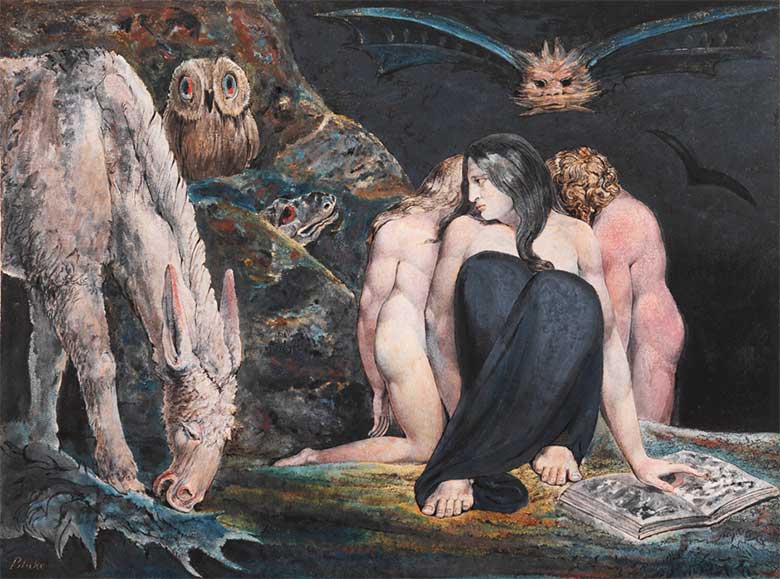
The Night of Enitharmon’s Joy (formerly called ‘Hecate’), c. 1795, William Blake
(Tate, Presented by W. Graham Robertson 1939. Photo: Tate.)
William Blake: The Age of Romantic Fantasy, National Gallery of Ireland, 16 April – 19 July 2026.
William Blake was an artist of expansive imagination in an era of reason and utilitarianism. He viewed his artistic practice as a form of opposition to various kinds of domination, and the repressive and oppressive effects of power. He was not alone in his beliefs and practice and William Blake: The Age of Romantic Fantasy is a particularly helpful exhibition as it sets his work in the context of Romanticism and the Gothic Revival. The exhibition can usefully be considered alongside William Blake’s Universe, at Fitzwilliam Museum in 2024, which considered Blake in relation to his European contemporaries such as the German romantic painters Philipp Otto Runge and Caspar David Friedrich.
William Blake: The Age of Romantic Fantasy explores the late 18th and early 19th century fascination with the supernatural, fantasy and the gothic. It does so through the themes of horror and peril, fantastical creatures, enchantments, romanticising the past, the Gothic, and the Underworld. Each of the rooms exploring these themes include some of Blake’s most instantly recognisable images while setting these alongside the work of his contemporaries. This includes both those he inspired, such as Edward Calvert, John Linnell, Samuel Palmer, and George Richmond, and those he drew inspiration from, such as James Barry, Henry Fuseli, and John Hamilton Mortimer. Also included is related work by Samuel Colman, Francis Danby, George Romney, and JMW Turner, among others.
Among the highlights from Blake’s peers are Barry’s etching Satan, Sin and Death, Fuseli’s painting Lady Macbeth Seizing the Daggers, the skeletons and sea monsters of Mortimer, the grotesque caricatures of Thomas Rowlandson, Nathaniel Dance-Holland’s devils and monsters, depictions of the great biblical flood by Danby and Alpine avalanches by Philip James De Loutherbourg, Turner’s images inspired by Greek mythology and the poetry of Spenser, and Susannah Duncombe’s watercolour rendering of the ‘first gothic novel’ The Ghost Scene from The Castle of Otranto. Of especial interest is a drawing by Blake’s younger brother Robert, which shows the synergies in their work and thought.
Taken together, and when combined with those included previously in William Blake’s Universe, these works demonstrate the range of unconventional art that was being produced by British, Irish and European artists in the height of Romanticism. Ghosts, ghouls, fairies, monsters, and muscular human bodies inspired by the work of Michelangelo, play on mysticism, horror and theological disputations to create worlds of creation and destruction that reflect the turmoil of a world torn apart by war. Much of this derives from literature – Gothic novels, William Shakespeare’s plays, Edmund Spenser’s The Fairie Queene – and the Bible. Where Blake’s work differs from that of his contemporaries, and what sets it apart as being particularly original, is that his work is rarely simply straightforward illustration.
With his work, there are two significantly different strands in play. The first is the creation of his own mythological universe through created characters and images. As he famously stated ‘I must create a system or be enslaved by another man’s.’ Stunning plates from his illuminated books can be seen, includes those from the First Book of Urizen featuring Los, who represents creativity and inspiration. These utilise Blake’s invention of relief etching (said to have been revealed to him in a vision by his dead brother, Robert) which allowed him to create distinctive works in a highly original style that combined text and images. His large colour prints include The Night of Enitharmon’s Joy, which depicts a character in Blake’s own mythology who creates a false religion and is surrounded by creatures inspired by Shakespeare’s Macbeth. The Ghost of a Flea is a wholly fantastical humanoid being Blake claimed to have seen in a vision, which is painted in tempera with highlights in gold leaf.
The second involves the connections he fashions between this imaginary world and the political world in which he lived with its revolutions, wars, and upheavals. His The Spiritual Form of Pitt Guiding Behemoth is a masterpiece that demonstrates the intertwining of the political with the mythological. This image is one of a pair, the other being The Spiritual Form of Nelson Guiding Leviathan, which show contemporary political and military leaders at the centre of apocalyptic visions of war, astride one of the creatures God refers to in The Book of Job to argue that human beings cannot fully understand his ways and purposes for creation. Blake pictures these leaders as guiding, under God’s guidance, the nation through chaos and destruction. He hoped that huge versions, 100 feet high, would be commissioned as a public monument to reflect the ‘grandeur of the nation’.
This positive vision of supernatural guidance in political events also reveals an aspect of Blake’s intent that is not adequately covered by this selection from his work. Blake’s spiritual aim was that of cleansing the ‘doors of perception’ so that the material world (with its sensuality and rationality) could be seen, through imagination, as it ultimately is—infinite. To achieve this aim, Blake believed it was necessary to creatively balance the complementary opposites within human beings and societies. This is the ‘Marriage of Heaven and Hell’ about which he wrote. His belief in this balance was the ultimate impetus for his opposition to domineering forces, including the dominance of sensuality and reason, which were so antipathetic to imagination. Blake believed that both rationalism and sensuality repress the imagination.
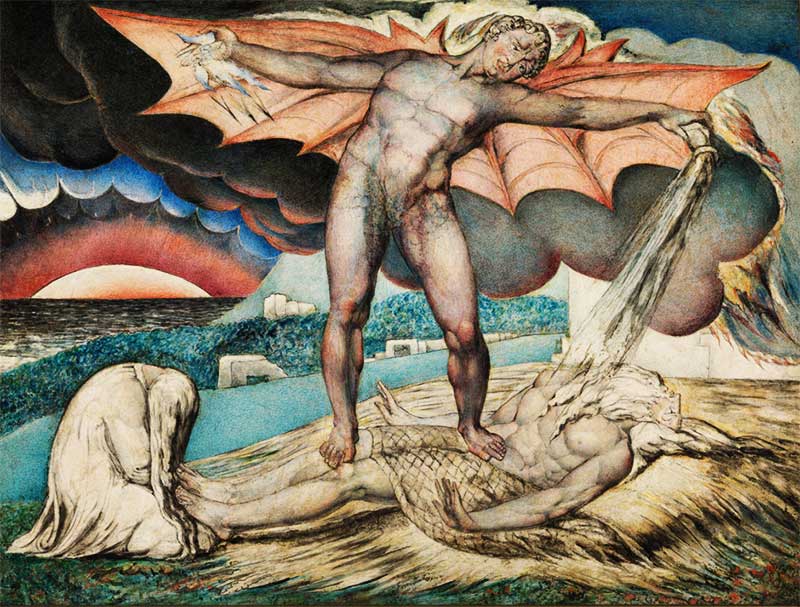
Satan Smiting Job with Sore Boils, c.1826, William Blake
(Tate, Presented by Miss Mary H. Dodge through the Art Fund 1918. Photo: Tate.)
His exploration of the union of the contraries is seen particularly in the paired illuminated books Songs of Innocence and Songs of Experience, as well as his images for Paradiso, the final section of Dante’s The Divine Comedy. In Jerusalem, another of Blake’s illuminated books, he wrote of his understanding of reconciliation and resolution in eternity: ‘I know of no other Christianity and of no other Gospel than the liberty both of body and mind to exercise the Divine Arts of Imagination – Imagination, the real & eternal World of which this Vegetable Universe is but a faint shadow, & in which we shall live in our Eternal or Imaginative Bodies when these Vegetable Mortal Bodies are no more.’ Richard A. Rosengarten argued that ‘Blake wanted to stir things up because he thought the Christian revelation was meant to stir things up’. He suggests that, for Blake, the ‘first step in doing so (after reading the Bible from stem to stern) was to liberate Imagination from the shackles of Reason’. This is what ‘could make us fully human again, and thus much more approximately the creatures of God that we truly are’.
The exhibition notes that a significant focus of Blake’s work was the rendering of religious imagery. He explained that the Old and New Testaments were the great ‘code of art’. His interpretations demonstrate how he could create new and unusual images using well known iconography and such works are spread throughout the exhibition. His imagining of Job’s torments in Satan Smiting Job with Sore Boils, the death of Christ in The Entombment, and a mother’s grief and despair The Body of Abel Found by Adam and Eve are wholly unique. In the final years of his life, he was commissioned to illustrate Dante’s The Divine Comedy. The resulting works include giants trapped in soil, and a vision of Dante and his companion standing under the entrance to the gates of hell rendered in pure black. These were the last watercolours he completed before his death.
However, the exhibition’s focus on horror, peril, and hell means that Blake’s images of heaven, the New Jerusalem, and Dante’s Paradiso don’t feature. This provides another reason (additional to the European dimension) as to why considering this exhibition together with William Blake’s Universe is instructive. As also with Runge, Blake was inspired by the writings of German mystic Jacob Böhme, who, as David Bindman and Esther Chadwick explained in the catalogue for William Blake’s Universe, ‘believed that all being arises from the dynamic interplay of opposites: between darkness and light, life and death, hot and cold, male and female’. As a result, Böhme viewed our spiritual quest as ‘the reconciliation of differences to produce spiritual and philosophical regeneration’. Bryan Aubrey has also shown that Böhme believed human beings can share in the divine imagination, through which we act ‘with, and on behalf of, the creator’. Böhme ‘equated the strong imagination with the faith that moves mountains’ while Blake believed it ‘is only the imagination’, the faculty we have neglected, which can lead us out of our self-imposed prison. Blake was, as a result, indebted to Böhme for his concept of the imagination and his doctrine of contraries.
Another relatively recent exhibition William Blake: Prophet Against Empire argued that Blake ‘responded to the tumultuous times he was living through as he witnessed the expansion of the British Empire, American Independence and the French Revolution’ with ‘imaginative images and texts that resonated with this changing world’ and which took a ‘critical stance against the Age of the Enlightenment with its emphasis on science and reason’. ‘Drawing on his deeply felt religious beliefs, Blake criticised empire, slavery and social inequality through his work’ in order to create ‘an alternative universe that celebrates the imagination and communal kindness, where we can also rekindle our connection with the world around us’. In William Blake: The Age of Romantic Fantasy we see much of the former, but less of the latter.
Dr Caroline Campbell, Director of the National Gallery of Ireland, notes that ‘The impact that Blake and the era of Romanticism have had on Western art cannot be overstated’. Alice Insley, Curator British Art, 1730-1850 at Tate, says that, while ’William Blake is today celebrated for the great originality and vision of his art and poetry’, yet ‘he was not alone in giving his imagination free rein’. As a result, she suggests that by showing Blake’s extraordinary works alongside paintings and drawings by his contemporaries – those who he admired and those who he inspired – this exhibition reveals ‘how British art was taken in exciting new directions in this moment’. We also see the greatness of Blake’s vision and work afresh.
To fully understand this, however, we need to see that Blake’s visions were not simply romantic fantasy but were of spiritual reality breaking into the material world. As such, Christopher Rowland writes that the turbulent years of Blake’s life informed ‘his prophetic understanding of history’. His prophetic images and texts ‘were “prophetic” not because Blake sought to predict what was going on—indeed they were written following these events’, rather, ‘he sought to plumb the depths of the historical and social dynamics which were at work in them’. Blake was ‘part of a tradition of radical non-conformity in English religion, with different ways of reading the Bible’ which linked ‘the personal and the political’. His vision, ultimately, was one of building Jerusalem in England’s green and pleasant land.
.
Jonathan Evens
.