
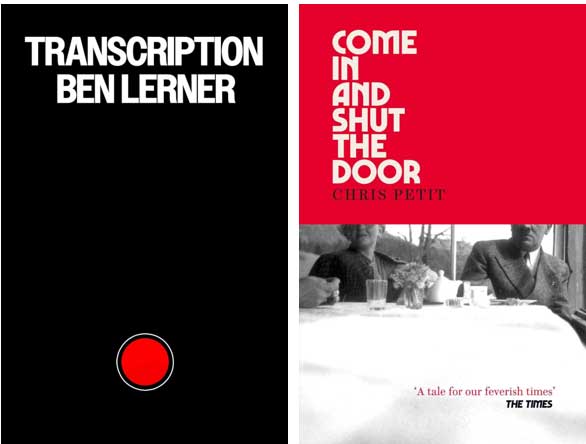
Transcription, Ben Lerner (Granta)
Come In and Shut the Door, Chris Petit (Scribner)
Ben Lerner’s poetry and novels are both erudite and highly readable. Transcription is a short, 130 page, novel about relationships, influence, technology and memory. It is in many ways a claustrophobic book, centring around the narrator, his friend Max, and Thomas, the narrator’s ‘mentor’ (and Max’s father) who is about to give his final interview to him.
Trouble is, the narrator has dropped his phone in the toilet and has no way of recording the interview. So he pretends and publishes his remembered version of what Thomas said. Or, perhaps, his misremembered version. Either way it leads to a kind of academic discreditation at a conference by the end of the first section.
There are three sections, each narrated by a different character, all of whom have imaginary memories, distant recall, and tidied up pasts: it’s how humans work, self-censoring, conflating similar events, selecting scenes and events we like, gradually making our world orderly, a flowing narrative, contiguous with others involved but in no way identical.
Thomas, Max and our narrator all have to rearrange their expectations and stories as they talk and the book progresses. Photos, answerphone messages, interviews, writing and opinions cause constant revision and adaptation. A transcribed interview is, perhaps, no more trustworthy or reliable than a recreated one, since interviews are always edited, shaped and compressed for their potential readers or audience.
Towards the end of the book Max and the narrator are discussing, well life really, but partly Thomas’ forgetting. Max reports that he told his father ‘It is impossible that you do not remember this’, and overrides Thomas’ ‘In my mind many trips merge or disappear’ with the angry ‘I do not want you to begin to see it, I am not painting a picture for you. I am not asking you to use your imagination, I’m telling you what happened.’
It is not what happened, of course, it is Max’s version of what happened, and no truer than Thomas’ or different readers’ interpretations. All versions are valid and can sit alongside each other. Photos and tapes and diaries and interviews may or may not help. Thinking about memory, personal interpretation, friendship and family is certainly stimulated and encouraged by Lerner’s quietly provocative and thoughtful book.
Film-maker and author Chris Petit’s new novel is also provocative but in a very different way, and is in no way quiet. Come In and Shut the Door is about obfuscation, misdirection, alternative histories, forged and impossible documentation, paranoia, capitalism and conspiracy. In other words, contemporary life, scandal, politics and recent history.
Parker has left the priesthood and ends up working for Robinson (who may or may not be the same Robinson we have met in other Petit novels), who mostly funds his life by selling historical objects of the worst sort to the worst kind of people. Corruption and abuse are rife, and the book spins off into impossible webs of connections and implausible events.
Russians and Americans and Nazis work together to create wealth as the war ends, Roman Catholics conspire against the communists and turn a blind eye to the death camps, SS officers flit around Europe for random trysts, guns and letters, and photos may or may not document the final moments in Hitler’s bunker, boarding school abuse or the holocaust, which all seem to share the same cause and effect. Meanwhile, JFK was shot by his own side, everyone since WW2 has been living on borrowed time and is at their wit’s end, and far too many spies, dead politicians and war criminals are still alive and living under false names.
No-one is or ever was sure of who knew or knows what, or even who they really are, least of all Parker. Characters change name, have always encountered each other or someone who might have been them at some point in the past; nobody trusts anyone – and quite rightly so. The book is both darkly humorous and deeply offensive, an impossibly tangled facetious take on human greed, depravity and desire. It is also a book I could not put down, even when I didn’t know what the hell was going on any more.
.
Rupert Loydell
.