
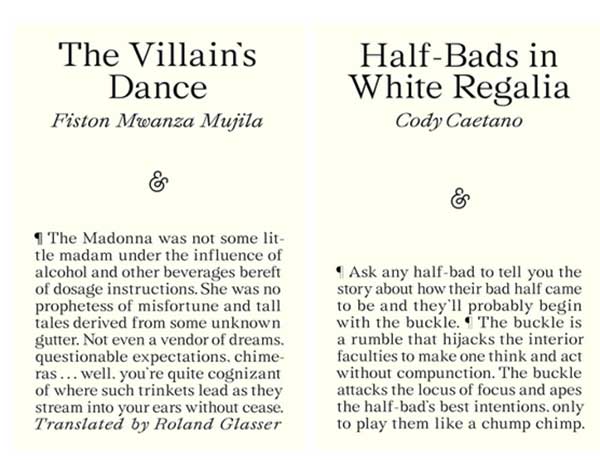
The Villain’s Dance, Fiston Mwanza Mujila (& Other Stories)
Half-Bads in White Regalia, Cody Caetano (& Other Stories)
It is the 1990s and where Zaire (now known as the Democratic Republic of the Congo) and Angola meet there is chaos. People are on the make, spending time as miners before illegally moving any found diamonds across the border, city centres are populated by feral street kids in ever-changing gang alliances, and there is plenty of beer to be drunk if you know where to look. The Mambo de la Fête is one such source of drink, along with a thunderous sound system and ever-changing clientele who, when the time is right and the spirit moves, come together to dance the dance of the title.
In his ‘Author’s Note’, Fiston Mwanza Mujila mentions the South African jazz of Dudu Pukwana, Johnny Dyani and Chris McGregor, and this novel has shades of their music: characters trip over and bump into each other, social and political dynamics change, there are passages of calm and contemplation, then noise and violence – and eventually rebellion and revolution – erupts. The chaos is mostly joyful and life affirming but there are dark, violent and melancholy moments too.
There are three main characters here, with a huge supporting cast. Molakisi, Sanza and Franz all find different paths through the chaos, all intent on survival and making their own futures. One becomes homeless on the street for a while, before being scooped up to work with an inspector/informant/agent (it’s unsure which), another is taken on by Tshiamenuea (who is posthumously called the Madonna) to write her life story and her story of the life around her. She is a kind of oracle, a seer, who not only knows what is going on but remembers what has previously gone on and predicts what might happen. The third becomes a miner and then changes career once he can afford to.
Or maybe Tshiamenuea and Monsieur Guillaume (the inspector) are the principal roles, or maybe the gang members Sanza falls in with, or maybe the frequenters and hangers on at the Mambo… Or perhaps it is life and ambition, the abstracts weaving these stories together, even as time and geography jumps, characters dream and dance, and luck intervenes. Part gritty realist novel, part fever dream, with a sprinkling of magic realism, The Villain’s Dance is an energetic and entertaining read, with – even in its English translation – a syntactical rhythm and percussive propulsion that keeps the words dancing on the page as the story unfolds.
Cody Caetano is an off-reserve member of Pinaymootange First Nation in Canada, and in Half-Bads in White Regalia he tells, or possibly tells, the story of his childhood. It’s unclear where the line between memoir and fiction is, and just how blurred Caetano chooses to make it. Of course, all memoirs rely on memory recall (they are not written as events happen) and stories always get edited, changed and improved in their retelling.
It is a dystopian childhood, full of violence, poverty and abuse, with only the odd takeaway pizza or family moment to lighten the mood. I found the book a difficult read, full of what I take to be an invented slang which I did not understand, full of clunky sentences interspersed with slap-round-the-head images and mundane dialogue. Halfway through the book I put it aside to think about why, apart from my struggle with the language, I wasn’t enjoying the book or immersed in the story, and realised I simply didn’t care about any of the characters.
In his Epilogue, Caetano says that ‘Your story is the one thing in life that is truly yours’, which is very true, but he also says ‘your story […] belongs to no audience’. I guess that’s also true but if you want people to read it then you must at least make a gesture towards co-ownership or sharing the story. Half-Bads in White Regalia does not do this, it is an insular and private book I felt indifferent to and excluded from.
.
Rupert Loydell
.