
The wombs are reopened and Abraham’s coffers are once again replenished.
If the President of The United States were indeed king, his lineage would be of great
interest, particularly the originator of the dynasty that has now brought the world to
the brink of chaos. But he is by no means a king and his beginnings are irrelevant. The
underlying cause of events, however, does in fact trace its origins to a single individual
whose subsequent family would produce the Moses of Judaism, the Jesus of
Christianity and the Muhammad of Islam. Produce in effect, the Good, Bad and Ugly,
Mexican standoff, that has endured for centuries and has now shaken loose to
potentially unleash unprecedented mayhem into the world. Given the gravity of the
situation, it seems the history and character of this individual might be worth
reviewing.
Abraham, nee Abram, was from Ur of the Chaldees, an area of Assyria in current-day
Iraq. He was born in Chaldea, whereas his family genealogy, expounded at length in
Genesis, names Noah as a prominent ancestor. Noah’s birthplace is unclear and he is
in turn described as a descendant of Adam and Eve, who were born in a place called
Eden, whose location is unknown. Abram’s father was Terach or Terah who had
decided to move his family from Ur to Canaan, but for reasons not given, ended up
500 miles North in Haran or Harran in southern, modern-day Turkey instead. There
he died at the age of 205.
At some point, we are told, Abram began having personal conversations with the one-
God of a religion that distinguished it from the many-God religions that were
prevalent at the time – including those of the Assyrians and Babylonians. They had
their own Noahs, Ziusudra and Utnapishtim, who had also survived floods caused
through the wickedness of men, had also been encouraged ahead of time by one of
their Gods to build a boat and fill it with “the seed of all life” etc., and had also sent out
doves and ravens prior to disembarking and replenishing the world. If nothing else,
it suggests that people in the area had all kinds of gods and essentially kept them to
themselves.
This was possibly unavoidable. During the years of Noah’s begettings, people had
decided to build an enormous tower into the sky to try and see what kind of mindset
would drown everything on Earth including children. In response, the mindset had
simply knocked it down, and to make sure people would not try it again, scrambled
their language so that no one knew what anyone else was talking about.
………….Gen, 11,7. “Come let us go down and there confuse their language that they
………….may not understand one another’s speech”
(It might be redundant to point out, but this is not fiction but fact, an unfolding of
events considered incontestable and irrefutable to this day. Everything that follows
is also deemed fact, and in light of its significance, it is a complete record of Abram’s
life story in the order in which it occurred.)
It was during one of his talks with his singular God, that Abram was told that he was
unique among human beings and that his descendants would be as “numberless as
the dust” and inherit the Earth. Rule over it that is. For that to happen he had to first
pack up his family and finally complete the roughly 1300-mile journey to Canaan and
wait for instructions.
Things did not start out well. Abram had married a woman named Sarai only to
discover she was “barren” and soon after they arrived, there was a famine – an
ongoing motif in this land of “milk and honey”, necessitating groups go down to Egypt
from time to time for a handout. It would be a repeat of this routine in the distant
future, that would lead to the birth of Moses. This time around, however, despite
heading a delegation of hungry relatives, Abram takes the opportunity to enrich
himself personally by deceiving his benefactor.
Sources agree that Abram was around 80 years of age when he arrived in Egypt and
his wife Sarai about ten years younger. Nevertheless, Abram is convinced, that once
the Pharoah sets eyes on her, he will be overwhelmed by her beauty, kill him and have
his way with her. Before they arrive therefore, he tells Sarai to –
…………..Gen.12,13: “Say, I pray thee, thou art my sister: that it may be well for me for
…………..thy sake; and my soul shall live because of thee”
That a man’s wife would put him at risk of being killed, but not his sister, must have
been a feature of sexual etiquette particular to those times, but just as anticipated, the
impetuous Pharaoh, thinking that 70-year-old Sarai was legitimately up for grabs
goes right ahead. And instead of killing Abram as a husband, rewards him
handsomely as a brother.
…………..Gen.12,16: “And for her sake he dealt well with Abram and he had sheep, oxen,
…………..he-asses, menservants, maid servants, she-asses and camels”
But while Abram is contemplating his fine new inventory, his God unaccountably
visits “great plagues” on the Pharoah and his household. In Pharoah’s case,
conceivably in flagrante delicto. The Pharoah, being understandably upset and
realizing he’d been duped, asks Abram to just leave and take the gifts with him. If
there was ever a justification to kill him it was now, but the Pharoah, who was good
enough to offer free food to strangers and invite them into his house found himself
forced by some kind of invisible, dangerous accomplice to let them go and keep their
stuff.
On the face of it this might be considered a ‘shakedown’, but the significance of the
individuals involved and their approval by ultimate authority does not invite
commentary, so we move on. Suffice to say, Abram had conceivably only been in
Egypt for one night but now had enough money and livestock to feed all the hungry
Canaanites. There were of course the additional mouths of umpteen slaves to deal
with, but either way, God and his protege Abram’s ‘sister/wife routine’ was a
resounding success.
…………..Gen.13,2: “Now Abram was very rich in cattle, silver and gold and journeyed
…………..on from the Negeb to Bethel… “
Abram’s nephew Lot had also traveled with the delegation and for some reason he
also did well, to the point that they had so much stuff when they got back, that they
had to part ways. Lot would head off for Sodom, renowned for its night life, while
Abram would go on to deal with trouble in the neighborhood. Our reporter gives no
indication of what Abram did all day or what skills he had but tells us that he takes
charge of the local, now “Hebrew” militia and after a few skirmishes prevails. The
neighborhood calms down and Lot returns to the fold. But Abram then appears to fall
into a depression over the implausibility of a man with a barren wife having seed that
will rule the world.
He mentions it to Sarai who suggests he simply impregnate their maid Hagar – put his
rod into his staff as it were, why not? – an idea not lost on the later inventor of the
third Jewish religion predicated on ‘freeing the slaves’ – Karl Marx. Not for the same
reasons, but also why not? Marx’s wife and servant would give birth to his children
three months apart. Likewise, Abram goes ahead with Hagar but apparently feels it is
somehow not authentic. He mentions his concerns to God who encourages him by
revealing that Sarai will in fact give birth to a child. Abram laughs at the idea and God
renames him Abraham. God then tells Sarai who also laughs and he renames her
Sarah. The dust business was now official.
Nephew Lot, meanwhile, had wandered back to Sodom and God had decided to
destroy it along with its twin city in shame, Gomorra. Abraham attempts to intercede
on his relatives’ behalf and asks his all-knowing God if He might change his mind if He
knew there might also be good people living there – 50 say? When God answers “Yes”,
Abraham then launches into a relentless Q&A routine and asks Him how about 45?
and then 40? and then 30? and so on, to which God responds each time with “Yes,
even 30″, “Yes even 20” etc., until the penny drops or He just gets fed up and agrees
to send two angels to get Lot and his family out.
When the Sodomites discover there are angels in town, they surround Lot’s house and
tell him to send them out. Good father that he is, Lot tries to buy them off by offering
them his two teenage daughters who “have not known men” and tells them to do
whatever they want with them. While the crowd is considering the offer, the angels
then grab Lot and his family, and warning them not to look back, hustle them away –
which unfortunate Mrs. Lot ignores or fails to hear and is turned into a pillar of salt. A
remarkable phenomenon giving rise millennia later to the inspired and now inspiring
idea that the cities may have been destroyed with nuclear bombs.
Hi jinks then ensue as Lot and his daughters hole up in a cave for the night. You can
take a girl out of Sodom and Gomorrah, but you can’t take Sodom and Gomorrah out
of the girl and the teenagers get their father drunk and take turns having sex with him
in the hope that his seed will prevail. As planned, they indeed give birth to two
bouncing incestuous children, one of whom will become the founder of the Moabite
tribe the other that of the Ammonites. The dust was in full swing.
Consistent with this ‘keeping it in the family’ routine, Abraham then pulls the same
sister/wife stunt while visiting King Abimelech with the same justification that he will
be killed if he doesn’t. Without doubt Abimelech, just like the Pharoah, will find now
90-plus Sarah irresistible, so he has no choice. But on this occasion, Abraham makes
the stunning announcement that he is doing nothing wrong since she is in fact both
his sister and wife.
…………..Gen.20,12,“Besides she is indeed my sister, the daughter of my father but not
…………..the daughter of my mother and she became my wife”
God backs up his protege this time around by “closing the wombs” of all the local
women, including the slaves and tells Abimelech in a dream, that he’s a “dead man”
along with all that’s his, if he doesn’t pay Abraham off. Abimelech, like Pharoah before
him, understandably complies. The wombs are reopened and Abraham’s coffers are
once again replenished.
…………..Gen.20,14 “Then Abimelech took sheep and oxen and male and female slaves
…………..and gave them to Abraham.”
Hagar then gives birth to Ishmael and things settle down – until Sarah gives birth to
Isaac and tells Abraham to throw them both out. Which her dutiful husband promptly
does, placing Ishmael on his mother’s shoulders and shooing them off into the desert.
Having run out of food and water, and not wanting to watch her child die, Hagar places
him under a bush, until God hears him crying and sends an angel to provide
miraculous water. He assures Hagar all is well and there are good times ahead.
…………..Gen.21,15. “Arise lift up the lad and hold him fast with your hand for I will
…………..make him a great nation.”
Mother and son continue to live in the desert until Hagar finds Ishmael an Egyptian
wife and his descendants indeed go on to become the Nation of Islam.
But this omniscient God who supposedly knows the outcome of everything, including
who will control the world, decides to test Abraham to make sure he hasn’t
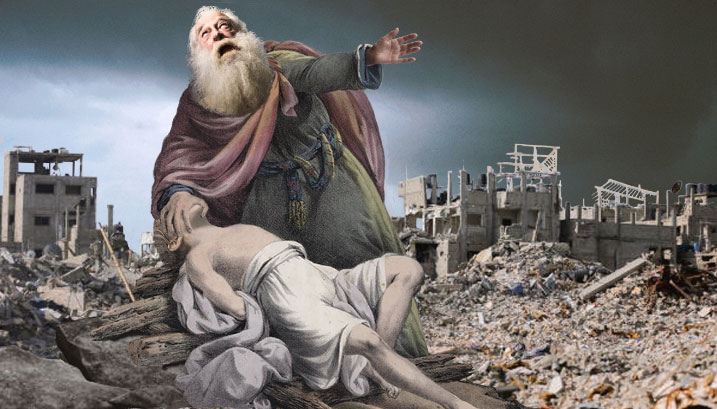
unknowingly put all his eggs into one basket case. He tells Abraham to take Isaac up
into the mountains, tie him up, lay him on a pile of sticks, murder him and set fire to
him – which presents Abraham with a dilemma: if he kills his only son, he will have no
descendants to inherit the earth, but if he does not kill him, God will make sure his
descendants will not inherit the earth. On the other hand, if he allows his son to live,
he could enjoy being a normal father, stop obsessing over controlling the future, and
get on with the present like everyone else.
Abraham decides to kill his son; the craving to be acknowledged as the ‘Father’ of
future strangers overrides the love for his own child there in front of him. Convinced
He has made the right choice, God then tells him to stop and sends an angel to point
out a ram in the bushes to sacrifice instead. Abraham’s seed is guaranteed; the dust
will prevail.
…………..Gen.22,15 “And by your descendants shall all the nations of the earth bless
…………..themselves because you have obeyed my voice”
Isaac’s reaction to this appalling event is not recorded, as it is with the other
characters in Abraham’s life, he simply complies with his wishes without comment.
This includes the sexually dutiful Sarah who we are simply told dies at the age of
127. The negotiation between Abraham and the Hittites for her burial plot, on the
other hand, is described at great length.
One of the Hittites, acknowledging him as, “… a mighty prince among us” finally gives
Abraham some property for free, yet as the above shows, no information is provided
anywhere concerning the nature of that ‘mightiness’ or of what he contributed to
society at large. In effect, Abraham’s story amounts to a seed catalogue punctuated
by various quirky sexual events describing the conveyance of that seed by various
family members. True to form, once Sarah is gone, Abraham, now in his late 130s,
remarries and produces six more sons.
Accordingly, he next decides to arrange a wife for Isaac. Feeling nostalgic possibly,
or just wanting to widen the gene pool, he insists his servant go look for one back in
Assyria where he was born. A fascinating ritual of ‘agreeing to comply’ then ensues
in which Abraham tells the servant to reach in and “put your hand under my thigh”,
a routine repeated elsewhere in the Bible suggesting touching or cupping a man’s
testicles confirmed obligation, an idea entirely consistent with the preoccupation
with seed throughout the story.
Having put his house in order, Abraham finally dies at the age of 175 and is buried in
the family plot alongside Sarah. Isaac and Ishmael are in attendance – two sons
acknowledging a father who had come close to killing both of them when they were
children. It is the conclusion to a series of events presenting no moral insight or
spiritual guidance beyond the need to obey, all of which – minus the interminable
lists of begettings – are faithfully recounted above. Nevertheless, it is based on that
information alone that the world’s three dominant religions claim a common ancestry and
exemplary historical role model for their very different forms of social cohesion.
In the end, Isaac grows to manhood, marries Assyrian Rebeckah, pulls off his own
sister/wife routine with king Abimelech, is succeeded by his sons Jacob and Esau, and
dies at the age of 180. The catalogue of the family begettings continues hundreds of
years into the future, until finally coming to rest on Jesus of Nazareth. Or at least his
mother. The nature of his father remains unsettled to this day, many convinced it was
God Himself who put in the order, or possibly one of His many angel helpers. But
Christianity completes Abraham’s trinity, the Good Bad and Ugly standoff that has
endured for centuries to the present. Each claiming very different God-given
prerogatives, each at odds with the others, each assuming the role of the Good.
Each awaiting the next iteration.
Their very own speck of dust in the wind.
.
Malcolm Mc Neill
.