
by Ade Rowe
Stone has long occupied a singular position within human culture, functioning not merely as a material but as a conceptual partner in the articulation of meaning. Its resistance to alteration, combined with its remarkable durability, has ensured its continued relevance across vast stretches of time. To carve stone is to engage in a process defined as much by limitation as by possibility. It demands foresight, restraint, and a sustained attentiveness to the inherent qualities of the material. In return, it offers a form of permanence that few other media can rival.
The earliest engagements with stone reveal an already sophisticated understanding of form and reduction. In Upper Palaeolithic contexts, carved figures and reliefs demonstrate an ability to distil complex observations into essential shapes. These works, though often modest in scale, suggest that the act of carving was never purely decorative. It involved a deliberate process of selection, in which certain features were emphasised while others were omitted. This capacity for abstraction indicates that stone carving was, from its inception, an intellectual as well as a physical activity.
By the Neolithic period, this engagement expands into monumental undertakings that reflect collective effort and shared belief systems. The arrangement of stones at Stonehenge exemplifies a sculptural sensibility applied at an architectural scale. Though not carved in the conventional sense, the careful placement and shaping of these vast stones demonstrates an acute awareness of space, alignment, and material presence. Similarly, the carved pillars of Göbekli Tepe, adorned with reliefs of animals and abstract symbols, suggest that stone was already being used to articulate complex ritual and social structures long before the emergence of written language.
In ancient Egypt, the use of stone reaches a level of conceptual coherence that remains striking. Here, the material becomes inseparable from the civilisation’s preoccupation with eternity. The Great Sphinx of Giza, carved directly from limestone bedrock, embodies a fusion of sculpture and landscape. Its hybrid form conveys both intelligence and authority, functioning as a guardian within a broader funerary complex. Statues such as those of Khafre, carved from dense materials like diorite, present an image of unchanging power. The polished surfaces and rigid postures are not incidental. They are visual expressions of a worldview in which permanence and stability are paramount.
Mesopotamian cultures developed a distinct approach, in which carved stone frequently served a narrative function. The reliefs of Assyrian palaces depict scenes of warfare, ritual, and royal authority with remarkable clarity. The monumental Lamassu figures, positioned at gateways, combine human, animal, and divine elements. Their design, which allows them to appear complete from multiple viewpoints, reflects a sophisticated understanding of perception and spatial interaction. These sculptures do not merely occupy space. They define and control it.
The sculptural traditions of ancient Greece represent a sustained exploration of the human form as both subject and ideal. Early figures display a degree of stylisation, yet by the classical period a more naturalistic approach emerges. The Doryphoros embodies a system of proportion that seeks to harmonise the parts of the body into a coherent whole. The Venus de Milo, with its subtle contrapposto, suggests movement within stillness, while the Winged Victory of Samothrace captures a moment of dynamic motion. In each case, stone becomes a means of investigating not only physical form but also broader philosophical ideas concerning balance and ideality.
Roman sculptors adapted these principles while introducing a heightened emphasis on individuality and historical record. Portrait busts often display an unflinching attention to detail, capturing the marks of age and experience. The Augustus of Prima Porta combines idealised bodily form with recognisable facial features, creating an image that is both symbolic and specific. Meanwhile, narrative reliefs such as those on Trajan’s Column transform stone into a medium of historical documentation, recording events in a form designed to endure.
In South and East Asia, stone carving develops along distinct yet equally sophisticated lines. The rock-cut complexes of Ajanta Caves and Ellora Caves demonstrate an extraordinary ability to transform solid rock into elaborate interior spaces. Sculptural reliefs cover the surfaces, depicting religious narratives with intricate detail. The Leshan Giant Buddha, carved into a cliff face, exemplifies the integration of sculpture with natural landscape, its immense scale balanced by a sense of calm introspection.
During the medieval period in Europe, stone carving becomes closely associated with ecclesiastical architecture. Cathedrals serve as sites of intense artistic production, where sculptural elements convey theological ideas. The façades of Chartres Cathedral and Notre-Dame Cathedral are populated with figures that occupy a space between structure and ornament. Gargoyles, positioned along the building’s edges, serve practical functions while also embodying symbolic meanings. The carvings at Rosslyn Chapel present a dense array of motifs, reflecting a cultural interest in layered and often enigmatic symbolism.
The Renaissance marks a renewed engagement with classical ideals, accompanied by significant technical innovation. The work of Michelangelo remains central to this period. His David demonstrates a mastery of marble that combines anatomical precision with psychological depth. The figure’s poised stance conveys both readiness and restraint. The Pietà reveals an ability to render softness and emotional intensity within a rigid material, challenging the viewer’s perception of stone.
Baroque sculptors extend this exploration, introducing a heightened sense of movement and drama. Gian Lorenzo Bernini, in works such as Apollo and Daphne, transforms marble into a medium capable of conveying rapid change. The moment of transformation is captured with extraordinary delicacy, suggesting motion within a fundamentally static material.
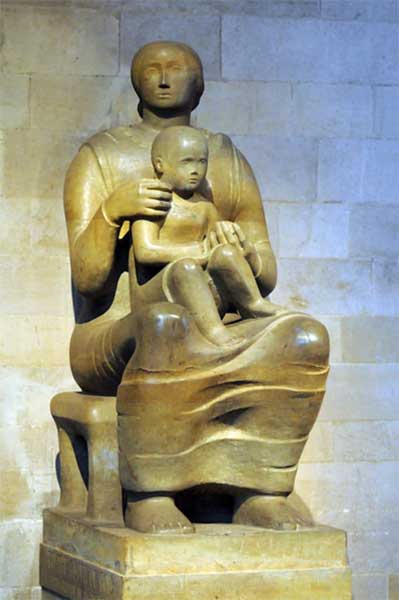
In the modern period, the focus shifts towards abstraction and the intrinsic qualities of the material itself. Constantin Brâncu?i reduces form to its essence in Bird in Space, where polished surfaces and elongated shapes evoke movement without direct representation. Barbara Hepworth introduces pierced forms that engage with surrounding space, while Henry Moore creates monumental figures that emphasise mass, void, and organic curvature. These developments reflect a broader rethinking of what stone sculpture can achieve.
The technical process of carving remains fundamentally subtractive. Material is removed rather than added, requiring a high degree of precision and planning. The properties of the stone itself, including grain, density, and potential fracture lines, shape the approach taken by the sculptor. Marble allows for fine detail, while granite demands a more forceful technique. Limestone, though easier to carve, is more susceptible to environmental wear. These variations ensure that each type of stone offers distinct possibilities and constraints.
Environmental factors further influence the life of carved stone. Exposure to wind, rain, and pollution gradually alters the surface, introducing changes that can be understood as part of the work’s ongoing existence. The moai of Easter Island, carved from volcanic tuff, have been shaped by centuries of exposure, their present appearance reflecting both human intervention and natural processes.
Public monuments illustrate the continued relevance of stone in shaping collective memory. The carvings of Mount Rushmore transform a natural landscape into a site of national symbolism. Such works demonstrate how stone can be mobilised to convey ideas that extend beyond the individual, embedding them within a durable and highly visible form.
From an academic perspective, the study of carved stone is inherently interdisciplinary. Archaeology provides context, art history traces stylistic development, and geology identifies material origins. Philosophical inquiry addresses questions of permanence, materiality, and authorship. Together, these approaches offer a comprehensive understanding of the medium and its significance.
Yet beyond analytical frameworks, there remains an experiential dimension that resists complete articulation. To encounter a carved stone object is to engage with something that has endured. Its weight, texture, and visible traces of labour create a connection between past and present. One becomes aware not only of the form itself, but of the time and effort embedded within it.
In a world increasingly defined by transience, the continued relevance of stone carving may seem unexpected. However, it persists precisely because it resists such conditions. It demands patience, precision, and a willingness to work within constraints. These demands ensure that each work carries a density of intention that is difficult to replicate. Stone, in this sense, remains one of the most profound and enduring mediums through which human thought and creativity are expressed.
(for Petal)
.