
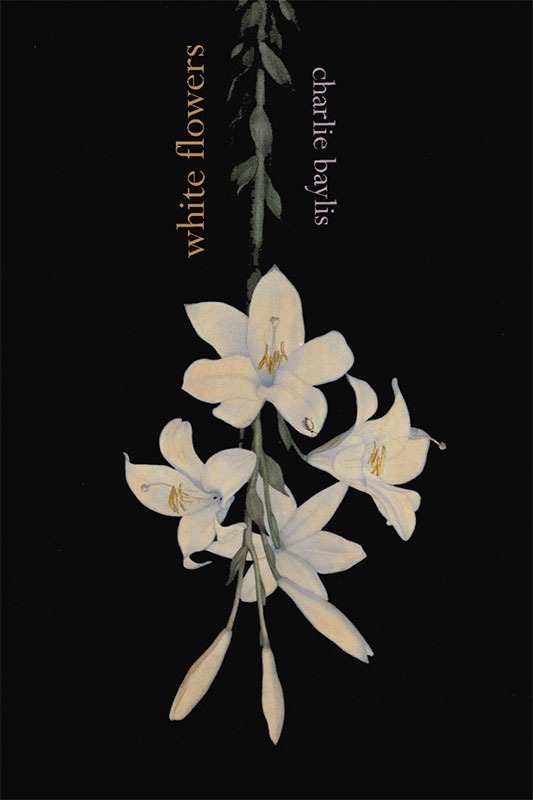
white flowers, charlie baylis (34pp, £4.99, Salò Press)
It’s a relief after his last publication, fuck poetry, which angrily struck out at just about everyone and everything, to find Charlie Baylis more at peace with himself, finding ways to reconcile himself with the deaths of close family members, and writing vivid poems of grief, love and loss.
The book is in two sections, with the first, ‘inner peace necklace’, hosting nine poems which mix reflection with memories of travel, troubling incidents and language itself. Whether ‘hitchhiking along the highway of the american dream’, ‘sitting outside grace cathedral’ or ‘in my palace on top of the sun’, Baylis is constantly aware of death: ‘i don’t own enough shirts in black’, he states. Elsewhere, with ‘the vowels i hold in my hand’, he is compelled but struggles to, ‘represent every night’, finally resorting to an oxygen-starved dark night of the soul where he can only ‘hold my breath / & wait for morning’.
The title poem of the sequence, is an elegiac lyric reflecting on a letter concerning the gift of a ‘three thousand dollars’ necklace, gifted to the author, who secretes it under his pillow, which produces vivid dreams and hauntings. He imagines ‘the hardships of his life’ disappearing, that he is ‘protected by her mysterious power’ but gradually his inheritance unravels: ‘the letter really was not quite right, noticeably / not written by someone of sound mind’. The close of the poem and first sequences informs us that ‘the letter was not signed’, and ideas of wealth, along with the presence of ‘the dead women who gave me the necklace’, disappear and fade.
The second section, ‘white flowers’, contains only three poems, with these coming from a very different place. Sylvia Plath’s ‘we have come so far, it is over’ is one of section ii’s epigraphs, clearly signalling the emotional distance the poet has travelled. ‘home vessels’ is a triptych of mourning, which gradually moves from personal engagement with childhood homes and death – ‘while my daddy died i was alive’ – through a meditation on impermanence, where childhood is condensed to a bruise, first love to a secondhand copy of Rilke before tears arrive, with a shocking comparison of his father’s death to the mass murder-suicide of Jonestown Massacre, via the band who adopted the name, the Brian Jonestown Massacre. Here, declares Baylis, ‘the yellow skin of my father’s body rots in my mouth’ and ‘i feel my body has been broken by you, daddy’.
There is, however, a kind of resolution to the poem:
i wash my hands, i am morning
my father is lying on the sofa with tears in his eyes.
my father is gone, my tears in my eyes.
‘yellow flowers’ is a beautiful short meditation ‘in memory of may baylis’, where there is ‘nothing / only mayflowers’, ‘the prettiest of yellow clocks spilling her yellow across the universe’. Baylis tries ‘to gather the echo of sylvia’s hoof’ and the poem ends by re-iterating the Plath quote of the epigraph.
‘white flowers’ is a longer, shifting piece of writing, a prose poem that riffs on the title subject, remembering but also distracting itself with metaphorical comparisons, reconciled anger, and ‘pain so heavy it won’t stay shut in the cupboard’. The anger bubbles through – ‘i will never imitate you, though many times i thought i would’, ‘i will never imitate you // while there is still beauty in the world’ – but it is more a statement, a declaration, than an emotional response.
Despite everything that is going on and that previously went on – be that an anti-social dismissal of guests or throwing a pet over the park fence – Baylis is adamant that ‘we still loved you‘. There is an attempt to ‘celebrate life’ here but it is tangled up with the fact that ‘nothing here is permanent’ and that his mourning and the ‘bouquet of white flowers for your grave’ that this poem represents, ‘is not enough’. ‘i know it is not enough’, he reiterates, adding and repeating that ‘i was never enough’.
The poem ends with a litany of what is perhaps more permanent, brief paragraphs, each beginning ‘a candle for’, slowly moving from abstractions such as ‘a candle for the blossom on the lips of the sun’ through
a candle burning colours no one has ever seen before my
father gone, tears in his greedy eyes, his body at peace,
finally free from idiot psychiatrists & the cheap sheets of
hospital beds
to ‘a candle for a body […] waiting for journey into heaven’. Then the poem shifts to the very real, with ‘a candle for’ the hospital where his father died, ‘the bus drivers traumatised on busy roads’, Baylis’ own ‘sheet of notes now vanished’ and finally a batch of Bob Dylan songs. Then the poem and the pamphlet are over, with ‘a clear line’ and ‘a separation’ occurring, along with a declarative statement of intent: ‘& we will never speak of this again’. Death, loss and mourning can bring the worst or the best out of a poet; Charlie Baylis has worked hard to make these poems both moving and innovative, rather than simply relying on the emotion of loss. white flowers is his best book yet.
.
Rupert Loydell
You can purchase this title direct from the publisher here.
.