
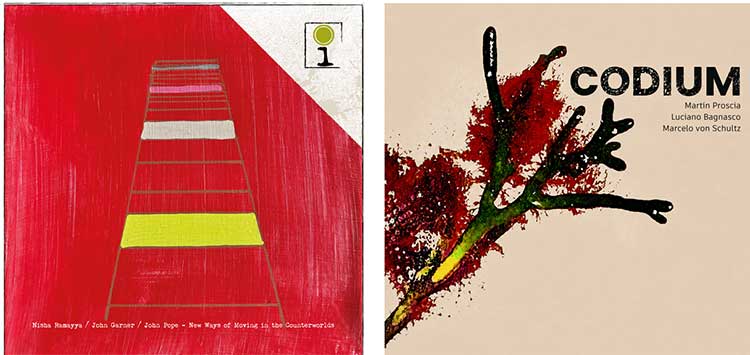
New Ways of Moving in the Counterworlds, Nisha Ramayya / John Garner / John Pope (John Pope)
Codium, Martín Proscia / Luciano Bagnasco / Marcelo von Schultz (Scatter Archive)
Manara 215CD (2026), Alya Al-Sultani / Pat Thomas / Khabat Abas (Discus Music)
Instantanés Détériorés 2, Jérôme Noetinger / Les Persécutions de Strasbourg (Scatter Archive)
LliFT#24 –Underground Allegories, LliFT (Recordiau Dukes)
New Ways of Moving in the Counterworlds brings together the regular duo of violinist and shakuhachi player John Garner and bass player John Pope, with poet Nisha Ramayya. Ramayya’s poetry is very much of the kind that, as Mallarmé famously put it, exists ‘donner un sens plus pur aux mots de la tribu’ (‘to give a purer meaning to the words of the tribe’), or, as Ramayya puts it, to ‘subvert the perversions of language,’ a language which, as it stands, admits ‘categories that kill’ and ‘stock phrases that legitimise decimation.’ It has a kind of permeable quality that, especially when delivered the way Ramayya delivers it, allows it to meld easily into a musical performance. Garner and Pope weave their music around this word-horde, the three performers creating, to quote John Garner’s website, a ‘music of shared influences from Alice Coltrane and Fred Moten to Ahmad Jamal and Don Cherry’. It’s a music that embraces simple, spacious tonal gestures (at one point in track seven, ‘Bad Dreams’, the music seamlessly incorporates a traditional Japanese cradle song), but which can, at times become more dense and complex (as in track five, ‘Giving, Scattering Trying to See’).
It’s a great listen and, if you’re unfamiliar with the artists, it’ll probably make you want to explore Pope and Garner’s other projects, not to mention Nisha Ramayya’s poetry.
Unless it’s a word you know, figuring out what’s behind the name of the album Codium takes some detective work. The cover art is, I quickly discovered, a picture of a frond of codium, a species of seaweed commonly known as dead man’s fingers. The word pops up in the track titles, too. Perhaps they were using collages made of images of codium as graphic scores? Perhaps its significance was less formal than that. It’s edible, so perhaps they’ve been snacking on the stuff. We’re not actually told, so probably don’t need to know. There’s definitely a gentle wit at work though and, on a more serious level, the way the stalks of the plant split off in new multiple directions as it grows, makes it a great metaphor for the way improvised music might come into being.
The musicians at work here are sax-player Martín Proscia, guitarist Luciano Bagnasco and drummer Marcelo von Schultz. There’s something about their way of working that reminded me of the early work of Iskra 1903, the way all three players keep the music moving, sustaining each other by constantly throwing fragments into the mix, like people frantically gathering up sticks and throwing them onto a fire, to keep it burning. There are seven tracks, three of which are entitled ‘Codium Collage’. The other four are assigned even more whimsical titles. I liked the political nudge in the longest, ‘Gibraltar un ir, un saltito’ (‘Gibraltar – just a quick hop away’). Again I was remind of the eponymous Iskra 1903 double album, the sleeve of which was peppered with slightly edgy – often political – quotes, ranging from Hugh MacDiarmid’s pithy observation that ‘All government has the monopoly of violence’ to the gentle entreaty to ‘watch the sunflowers’.
Codium is a consistent, endlessly imaginative album fans of free improv will want to listen to and keep coming back to.
Manara (the Arabic word for beacon) is a trio comprising of Alya Al-Sultani, a soprano and improviser from the city of Basrah in Iraq, Khabat Abas, a cellist, composer and improviser from Iraqi Kurdestan and Pat Thomas, a major figure on the UK improvised/experimental music scene, an initially classically-trained jazz pianist who went on to forge a style of his own out of new music, jazz and improvisation. Here, he’s playing both piano and electronics.
Between them they have created an intense, often lyrical (but unconventionally so) way of making music that draws on classical atonality, jazz, improvisation and Middle Eastern poetic traditions. For example, the second track incorporates the convention of the Āvāz, the recitation of a classical poem as an introduction to a musical performance, in this case drawing on the work of Khadija Muhaisen Dajani: his meditation on possible translations of the untranslatable Arabic word, qahr. As he says, ‘The dictionary says “anger” but it’s not. It is when you take anger, place it on a low fire, add injustice, oppression, racism, dehumanization to it, and leave it to cook slowly for a century.’ The third track incorporates a poem by the Palestinian poet, Dareen Tatour, who served time in an Israeli jail for writing it. Britain supports a country that imprisons people for writing poetry. That should give everyone pause for thought.
What these three musicians have forged between them is an honest, uncompromising way of making music that matches the clarity of vision they bring to their politics. What I would stress, though, is that this album is not merely a vehicle for those politics, important though they are: this is music that’s strong on integrity, both political and artistic. And to anyone who thinks musicians should keep politics out of music, I’d say this. Music, like politics – in the best (rather than the Westminster) sense of the word – is about what it means to be human and to think that politics can be kept separate from music is to deny the humanity of music. Lacking precise meanings, music can’t express views explicitly, but if you try to create music in a vacuum that excludes the state of the world, all you’ll get is a pale imitation of the real thing. Great music is not, on the whole, escapist entertainment. And it’s not just that: the desire to exclude politics from music, although it masquerades as merely a common sense opinion, is itself a political stance. Whether people like it or not, to demand that artists should remain silent is a form of complicity in whatever it is you don’t want them to allude to. How can one make great music that embraces what it means to be human without being prepared to acknowledge the pain so many humans suffer at the hands of others and calling for it to stop?
Christian Malfray (who also goes under the name Les Persécutions de Strasbourg) has been working in electronic and experimental music since the late 1990s. Jérôme Noetinger has been similarly involved since the 1980s and, until 2018, has been the director of La Cellule d’Intervention Metamkine, the French experimental record label, mail-order distributor, and live-performance collective. Both work with analogue synths, reel-to-reel tape recorders and various other bits of electroacoustic paraphernalia plus a few household objects (and, in Noetinger’s case the odd bit of home-brewed electronic gadgetery). They’ve been working together since 2021 and came together last year to improvise together and record the material that became Instantanés Détériorés 2.
Malfray describes what he’s doing on this album as manipulating ‘filters and oscillators within a carefully arranged feedback loop to make various resonators ring out and sing.’ Noetinger is working in a not dissimilar way. And I guess that’s one secret of making original improvised electronic or electro-acoustic music: if you patch together the same old modules in predictable ways and make the same old manipulations – or variations thereof – you can’t expect what comes out to be strikingly original. However, if, like Malfray and Noetinger, you devise new processes to explore, you create new possibilities. The end result is what I can only describe as some extreme classy electronic music!
If, like me, you think it’s a great listen, do check out the links in the album notes to other manifestations of their work together and other projects. They’re well worth a delve.
LliFT, the free improv and experimental music group that operates in North Wales, continue to put out albums documenting the music they make at their regular meetings in Bangor. (I’ve written extensively about them before). The latest, LliFT#24 – Underground Allegories has just been released on the Recordiau Dukes label (where, if you delve, you’ll find the others). The musicians who feature here are three LliFT regulars, musician and artist Dave Hopewell, musician and producer Gorwel Owen and guitarist Ash Cooke.
I can’t find any explanation for the title on the album’s Bandcamp page, but to me, the music has something of a subterranean feel to it which is perhaps all the explanation one needs. Do have a listen!
.
Dominic Rivron
LINKS
New Ways of Moving in the Counterworlds:
https://johnpope.bandcamp.com/album/new-ways-of-moving-in-the-counterworlds
Codium:
https://scatterarchive.bandcamp.com/album/codium
Manara 215CD (2026):
https://discusmusic.bandcamp.com/album/manara-215cd-2026
Instantanés Détériorés 2:
https://scatterarchive.bandcamp.com/album/instantan-s-d-t-rior-s-2
LliFT #24 – Underground Allegories:
https://recordiaudukes.bandcamp.com/album/llift-24-underground-allegories