
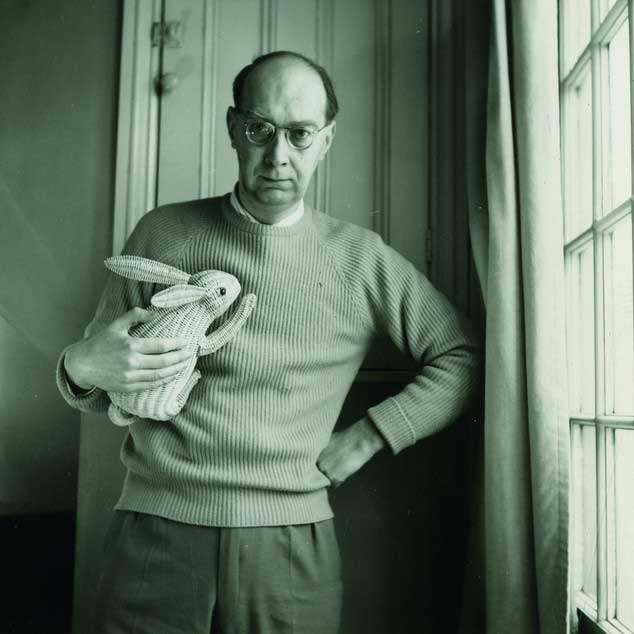
The Grammar of Lowering: Irony, Pragmatics, and Defamiliarisation
The poetry of Philip Larkin (1922-1985) constitutes one of the most radical laboratories of twentieth-century lyrical desacralisation. His writing assaults the conventions of the sublime through a compositional apparatus grounded in irony, bodily materiality, understatement, and the collision of linguistic registers. Larkin constructs a universe in which everyday experience progressively loses its apparent innocence: family, work, sexuality, religion, and ageing become linguistic and social institutions observed through a distorting lens. The result is a bitter comedy in which laughter exposes the hollowness of collective promises without yielding any genuine prospect of emancipation. The first mechanism concerns the relationship between ostranenie and defamiliarisation—namely, the removal of the object from automatised perception. The toad in “Toads”, published in The Less Deceived (The Marvell Press, 1955), transforms work into an animal, viscous, and invasive presence: “Why should I let the toad work / Squat on my life?” The image produces an immediate defamiliarisation: productive activity, normally legitimised by the lexicon of responsibility and respectability, takes on the consistency of a parasite. The metaphor does not merely embellish the concept; it alters its perception, converting an economic abstraction into a corporeal presence. In “Toads Revisited”, collected in The Whitsun Weddings (Faber & Faber, 1964), this pressure becomes tangible: “The toad work / Squats on me”. The verb to squat introduces a posture of occupation and domination, while the personal pronoun converts social conflict into somatic experience. A pragmatic approach helps specify how these images operate. Following J. L. Austin in How to Do Things with Words (Oxford University Press, 1962), the poetic utterance must be regarded as a speech act: the metaphor of the toad re-evaluates its object and steers the reader towards a judgement. Through the categories of H. P. Grice in Studies in the Way of Words (Harvard University Press, 1989), understatement and the violation of conversational expectations generate implicatures that exceed literal meaning. Comedy arises from the disproportion between the apparent banality of the situation and the violence of its formulation. The reader recognises the ordinary referent while simultaneously perceiving it as alien. The same technique targets the institution of the family. In “This Be the Verse”, published in High Windows (Faber & Faber, 1974), the opening line acts as a veritable pragmatic assault: “They fuck you up, your mum and dad”. The choice of an obscene verb shatters lyrical decorum and introduces a colloquial voice capable of turning a reflection on intergenerational inheritance into an indictment. Larkin continues: “Man hands on misery to man”. The sententious structure assumes the form of an anthropological maxim: generational repetition becomes a transmission of suffering. The sequence culminates in the injunction: “Get out as early as you can”. Formally simple, the imperative carries an illocutionary force of expulsion: halting the reproduction of misery appears to be the only imaginable solution. Larkin’s irony may also be interpreted through Simon Critchley’s On Humour (Routledge, 2002): “Jokes tear holes in our usual predictions about the empirical world” [1]. Laughter disrupts expectations and renders conventional constructs visible. In Larkin, however, this disruption takes a negative turn. The subversion of expectations does not inaugurate an alternative order; it exposes the inadequacy of the existing one. Roger Scruton, in “Laughter”, included in John Morreall (ed.), The Philosophy of Laughter and Humor (SUNY Press, 1987, 157), locates the philosophical interest of laughter in its intentional character: “It is not laughter, but laughter at or about something that interests the philosopher”. This clarification allows us to read Larkin as a writer whose laughter has a distinct target: familial conventions, sexual morality, work, religion, and the illusions of modernity. “Church Going”, in The Less Deceived (The Marvell Press, 1955), stages a desacralisation through an ordinary action: “Once I am sure there’s nothing going on / I step inside”. Entering the church follows a negative verification, as though the sacred site were a space to be inspected. The religious institution is subjected to a procedure of empirical observation, while the poetic voice preserves an ambiguity suspended between curiosity, scepticism, and attraction. When the speaker utters a liturgical formula aloud – “The echoes snigger briefly”- the architectural space itself seems to participate in the derision. The verb snigger introduces a muffled, clandestine laugh that converts the church into a theatre of embarrassment. Sacrality survives only as a cultural residue and an anthropological problem.
The Grotesque Without Regeneration: Body, Death, and the Crisis of Community
Engaging with Bakhtin requires a fundamental distinction. In his theory of carnival, articulated in Rabelais and His World, the bodily grotesque participates in a collective dynamic of lowering and regeneration. The open, unfinished, alimentary, and sexual body temporarily dissolves hierarchies and restores existence to the material cycle of life. Larkin employs analogous mechanisms of degradation, yet alters their outcome: the body becomes the site of vulnerability, ageing, isolation, and death. His carnivalisation remains incomplete because laughter never restores the subject to a renewed community. “Annus Mirabilis”, in High Windows (Faber & Faber, 1974), exemplifies the desacralisation of sexual liberation: “Sexual intercourse began / In nineteen sixty-three”. Chronological hyperbole reduces a cultural transformation to a paradoxical date. The subsequent references to the lifting of the ban on Lady Chatterley’s Lover and the arrival of the Beatles situate sexuality within a sequence of media and commercial shifts. The sexual revolution appears as a historically circumscribed event, observed by a voice alternating between curiosity and disenchantment. In “High Windows”, the scene of young lovers is framed through a provocative image of paradise, while the conclusion shifts attention towards an image of empty transcendence: “Rather than words comes the thought of high windows”. The window opens a visual space beyond ordinary communication, yet the landscape revealed through it guarantees no salvation. The grotesque takes on a radical dimension in “The Old Fools”, also collected in High Windows. Ageing is stripped of consolatory images of wisdom and biographical continuity: old age appears as a progressive loss of recognisability and autonomy. The body does not celebrate its expansion; it registers its dissolution. From this perspective, black humour becomes a form of negative knowledge. Peter Sloterdijk, in Critique of Cynical Reason (University of Minnesota Press, 1987), notes the existence of “powerful traditions of laughter in satirical knowledge” [16]. Laughter operates as an instrument of unmasking capable of destabilising ideological representations. Larkin retains this cognitive function, focusing it upon anthropological vulnerability and the fragility of individual illusions. The most radical manifestation of this process appears in “Aubade”, first published in the Times Literary Supplement on 23 December 1977 and later included in Collected Poems (Faber & Faber, 1988). The opening introduces death through a temporal formula:“Unresting death, a whole day nearer now”. Everyday time is converted into units measuring proximity to the end. Death possesses neither a heroic nor a religious dimension; it coincides with the progressive narrowing of the possibilities of existence. The meditation on annihilation concludes with the line: “And shall be lost in always”. The phrase lost in always deforms temporality, transforming always into a condition of definitive loss. The neuroscience of perception offers a further interpretive layer. Comic surprise depends on the violation of cognitive expectations, the construction of incongruities, and their subsequent resolution. The reader anticipates an elevated lyrical or moral register and instead encounters a corporeal, obscene, or bureaucratic lexicon. This discrepancy generates a cognitive and emotional response that may be accompanied by laughter. The framework developed by Matthew Hurley, Daniel Dennett, and Reginald Adams in Inside Jokes: Using Humor to Reverse-Engineer the Mind (MIT Press, 2011) allows comedy to be understood as a process of detecting and correcting expectations. In Larkin, however, the resolution of incongruity leaves a residue of unease: the reader grasps the joke while simultaneously recognising the painful truth embedded within it. The psychology of art illuminates this interplay between aesthetic pleasure and disturbance. Larkin constructs a formal distance that renders painful experience observable without turning it into immediate sentimental confession. Metrical precision, stanzaic regularity, and syntactic control operate as devices of containment. The contrast between formal order and existential disorder generates a distinctive tension: the text appears disciplined even as it depicts subjects incapable of governing their own lives. Poetic form does not resolve the crisis; it organises it perceptually. On a sociological and anthropological plane, work, family, and religion function as institutions that reproduce behavioural norms. John Gray, in Straw Dogs: Thoughts on Humans and Other Animals (Granta Books, 2002), writes: “This is faith, not science” [3], referring to the conviction that the human species can master its own destiny. This remark invites comparison with Larkin’s disenchantment: promises of progress and control are scaled back by the concrete experience of finitude. The critique of compulsory happiness emerges as a critique of social narratives that present productivity, family, and consumption as natural preconditions for individual fulfilment. The political dimension of art manifests itself in its capacity to make visible the hierarchies embedded within language. Larkin’s poetry does not articulate a systematic political programme; rather, it intervenes at the level of representation, exposing the human cost of social conventions. Family transmits dispositions and suffering, work organises time, religion disciplines the imagination of death, and sexuality is absorbed into narratives of progress. The poetic subject records these apparatuses without being able to transcend them. In this sense, his grotesque serves a critical function while arriving at an anthropologically pessimistic conclusion. Engaging with Byung-Chul Han’s The Disappearance of Rituals: A Topology of the Present (Polity Press, 2020) helps clarify the problem of community. Han writes: “Rituals create a community of resonance capable of harmony, of a common rhythm”. The erosion of rituals weakens the symbolic structures that make shared experience possible. In Larkin, the church in “Church Going” preserves a trace of this communal function, even as the contemporary subject proves unable to recognise himself within it. Desacralisation produces both awareness and disorientation, leaving open the question of any possible collective belonging. Larkin scholarship has extensively debated the relationship among biography, ideology, and vocal construction. Andrew Motion, in Philip Larkin: A Writer’s Life (Faber & Faber, 1993), and James Booth, in Philip Larkin: The Poet’s Plight (Palgrave Macmillan, 2005), have helped define the relationship between lived experience and poetic craft. Critical assertions such as “The poems are autobiographical” and “All Larkin’s work is fundamentally autobiographical”, cited in John Osborne’s critical discussion in Radical Larkin: Seven Types of Technical Mastery (Palgrave Macmillan, 2014), should be read as interpretive stances rather than exhaustive definitions of his writing. Distinguishing between the empirical author, the lyrical persona, and the implied author remains essential to avoiding biographical reductionism. Stephen Regan, in his study of the Movement in The Cambridge History of English Poetry (Cambridge University Press, 2010), places Larkin among the central figures of that poetic grouping. The characterisation of Larkin as “the most distinguished poet among that group of writers known as the Movement” underscores his historical prominence. John Osborne, in Radical Larkin (Palgrave Macmillan, 2014), further observes: “An orthodoxy in aesthetics is a revolution in waiting” [1]. This formulation allows Larkin’s formal regularity to be interpreted as a mode of resistance against dominant aesthetic expectations. Meanwhile, invoking Lisa Jardine’s verdict – cited in critical discussions of Larkin’s politics – that he was “a casual habitual racist, and an easy misogynist” compels us to confront the tension between formal mastery, ideological positions, and the cultural responsibility of the author.
The Anti-Carnival: Laughter as Knowledge of Defeat
The category of the anti-carnival synthesises the specificity of Larkin’s writing. His poetry adopts several instruments of the grotesque tradition: the lowering of the sublime, the centrality of the body, the assault on symbolic authorities, the parody of conventions, and the deformation of everyday language. Yet the outcome diverges from the Bakhtinian dynamic of popular festivity. Laughter produces no collective suspension of hierarchies and inaugurates no cycle of regeneration. It remains individual, intermittent, and accompanied by an awareness of powerlessness. Its function lies in exposing the precariousness of the institutions and illusions through which individuals organise their lives. Larkin’s poetics should be read as an inverted form of negative capability: the subject inhabits contradictions without succeeding in transmuting them into a higher harmony. Irony acts as a device of distancing, parody interrupts the solemnity of institutional discourses, and the grotesque renders the materiality of existence visible. Everyday speech becomes an instrument of critique. The reader is drawn into a process of recognition in which laughter coincides with the discovery of a shared predicament. The outcome carries political significance. Social institutions sustain themselves through symbolic representations that legitimise work, family, religion, and progress. Larkin dismantles their idiom, exposing the gulf between normative promises and lived experience. His poetry enacts a critique of ideologies of happiness and self-realisation. Sloterdijk’s formulation of laughter as satirical knowledge receives a distinctive inflection here: unmasking an illusion does not automatically amount to dismantling the apparatus that produced it. The dialogue with Han clarifies the communal dimension of the problem. If ritual constitutes a structure of resonance and belonging, its erosion leaves the individual exposed to the fragmentation of experience. Larkin depicts precisely this condition: the subject observes the institutions that once organised collective life and perceives their weakening, without being able to replace them with shared forms of meaning. His laughter becomes a practice of disenchantment. The theoretical conclusion is clear: Philip Larkin deploys irony, invective, and the grotesque to strip ordinary life of its consolatory masks. Family transmits suffering, work occupies the body, religion loses its self-evidence, sexuality is historicised, and death remains the definitive horizon of existence. His poetry generates lucid knowledge through comic deformation and formal precision. Laughter momentarily frees the gaze from conventions without freeing the subject from the conditions that sustain them. Herein lies its specificity: an interrupted carnival, a lowering without rebirth, a comedy that illuminates the human condition while leaving it substantially intact.
.
Ivan Pozzoni
Picture Larkin and ‘Veronica,’ a wicker rabbit, in 1964
.