
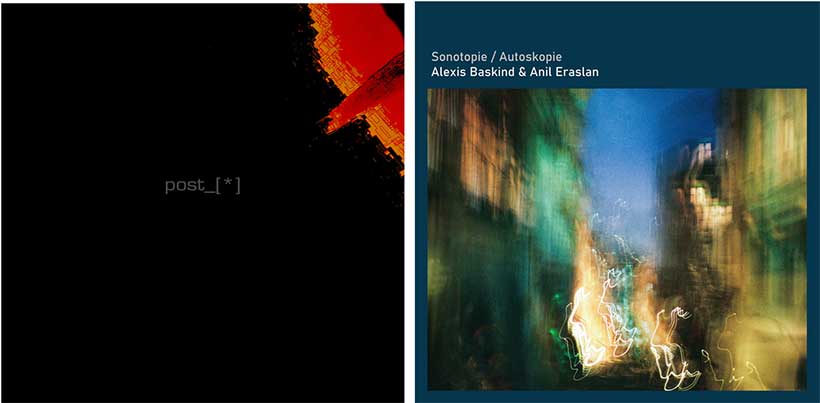
Post_[*], Inclusion Principle (Discus Music)
Sonotopie / Autoskopie, by Alexis Baskind & Anil Eraslan (Scatter Archive)
It’s always – well, usually – interesting to wonder what musicians mean by the titles they give their instrumentals, and the titles of the tracks on Martin Archer and Hervé Perez’ latest Inclusion Principle album, post_[*], caught my eye even before I started listening to the music. I knew enough to realise the first three are Buddhist-inspired, but not enough to fully understand the references, so I checked them out. The three daughters of the first track, I’m guessing, refer to the three daughters of Māra, the personification of the forces of temptation, illusion, and death, who were sent to tempt Gautama Buddha and deflect him from his path to Enlightenment. They failed, of course. The track itself could be heard as pretty programmatic: you could see the thoughtful, controlled harmonic progressions of the pitched, wind instruments as being in Buddha-like contrast to the more Māra-like frenetic (though static) percussion, but you don’t have to, and I suspect Archer and Perez take a more impressionistic view. The second track, ‘the collapse of marpa’s tower’, refers, I imagine, to the task given to Milarepa by Marpa, to build towers with his bare hands and knock them down again. The story has shades of the Sisyphus myth about it, only in this case, we’re to imagine Milarepa not happy (as Camus said we should Sisyphus) so much as purified. And then – track three – the Dharma (the Buddha’s teaching) disappears: the world is reduced – track four, ‘point and line’ – to geometry and science, and we find ourselves (track five) ‘between the sheets of quantum lovers’. At least that’s how I read it.
Despite the possible musical symbolism of the first track, what we have here, rather than a story told in musical pictures, is a suggestion of one that mirrors a musical process, one of paring down musical language to create an authentic music that takes its time and doesn’t allow itself to be sidetracked, be it composed or intuited, into importing overused formulae (although there are, inevitably, unavoidable conventional shapes, gestures and turns of phrase – to avoid them would, itself, constitute a form of convention), music that seeks to focus not on external demands, but on the demands of its making. If anything stood out for me, it was the aforementioned ‘between the sheets of quantum lovers’. It’s the longest track and it builds, without you really noticing, into a serene expanse in which everything seems to be happening without it feeling in the least frenetic.
Post_[*] follows the release over the course of 2025 of several shorter Inclusion Principle EPs. It consist of a single electronic improvisation, edited by Perez into what we get on the album, with both composed and improvised additions by Perez and Archer. The idea of improvising a layer and then composing material that fits with it not only sounds like a great way of working, but also – when done well, obviously, as here – sounds great when you listen to it. In addition, on this occasion – something they’ve had in mind for a while – they’ve invited a number of other guest musicians to participate in the performance. The musicians they draft in do a great job: Adam Fairclough on drums, Chris Sharkey on guitar, Samuel Ehrett-Pickett on trumpet and John Pope on bass all manage to be inconspicuous in a good way, by which I mean they all seem to have imbibed the principle of inclusion to the point where they sound as if they’ve been a part of it all along.
Anyone who has been following Inclusion Principle’s journey since its inception – or, like me, through its series of 2025 EPs – will want to hear this. If, on the other hand, it’s all new to you, do check it out.
Sonotopie / Autoskopie is, as the album note explains, a spin-off of Anil Eraslan’s film, Sound Dreams of Istanbul, which was shown at the 2025 Istanbul Film Festival. It’s a documentary about the free improvisation scene there. In it, Eraslan has musicians ‘recite their sonic dreams and stage them as musical performances, the film [evolving] into a phantasmagoric portrait of Istanbul, shifting between dream and reality.’ Unfortunately, so far, I’ve only got to see the trailer, but I’m itching to see the rest.
As for the album, it features Eraslan himself on cello and electronics, with Alexis Baskind, who also worked on the film, on double bass and electronics and, on one track, the voice of Merve Senegar, who co-produced and appeared in it. The title incorporates two intriguing words which, if you don’t know them, you’ll probably want to hang onto (it never works, though, unless you use them regularly, does it?). A sonotope is a place defined by its sound patterns, as in ‘the museum incorporates a number of sonotopes, from the main hall with its murmuring voices and the echo of footfall on its tiled floor, to the more muffled café, with its sound of crockery and cutlery and more animated voices’. Autoscopy is the experience of seeing one’s surroundings from a viewpoint outside of oneself. In the album notes, we’re invited to think of the music as ‘a protean musical portrait of an imaginary megalopolis’, the ‘sonotopie’ of the title being an exploration of its various acoustics and sound-worlds, the ‘autoscopie’ being a view from inside the ‘entrails’ of the city itself.
If, by this, we’re being invited to think of the music as an imaginary soundtrack to an adventurous documentary film made about an imaginary city, I totally get it (and the second track, ‘Part 2’, with Senegar’s evocative voice, is certainly a good way into listening to it like this). I can also relate to the idea more generally. Recording improvisations with a friend, recently, I was struck by vivid impressions of objects we were uncovering as we played, shapes for which there were no words. I was very much put in mind of qntm’s novel, There Is No Antimemetics Division, in which ‘antimemetic’ anomalies, once you’ve encountered them, erase themselves from your memory and become imperceptible. The idea of antimemes started out as a thought-experiment taking the idea of passwords and other ‘self-keeping secrets’ as its starting-point only for it to expand into being a metaphor for the truths about reality we constantly try to displace in preference for more comfortable narratives: one could almost say the original antimeme was the ‘elephant in the room’. One could also say the book is a story of a surreal war between the humans and the room-elephants, in which the elephants’ great advantage is the human subconscious’ desire to forget uncomfortable truths only to suffer the pain – or worse – of rediscovering them. To discover and confront the truth of reality may be to erase our identity.
But I digress. The point is that, at the time, I was struck by the similarities between qntm’s antimemes and the kind of vivid, if elusive and intangible structures music can create in one’s mind while you’re making it or listening to it. (Okay, you might remember that they existed but, if you’re improvising, unless you record what you’re doing, you’ll never encounter them again. You can go back into the room where you were playing or listening, but, obviously, they’re no longer there). And what I’m getting round to saying is that, in the case of Sonotopie / Autoskopie, it’s great its creators share their thoughts on it being the sound-scape of a city, what with it being a kind of spin-off from a film, as it’s easy to underestimate just how vivid such impressions can be, when you’re making or listening to music. On one level it could be said that ‘a protean … portrait of an imaginary megalopolis’ is, for many people, a good way to describe what the experience of making and listening to music often creates in the mind. However, it may be fanciful but, although everyone listening will create their own megalopolis, there’s something extra about Sonotopie / Autoskopie, a sense of the visceral presence of people, of a culture seen from a distance, that goes beyond this.
.
Dominic Rivron
LINKS
Post_[*]: https://discusmusic.bandcamp.com/album/post-217cd-2026
Sonotopie / Autoskopie: https://scatterarchive.bandcamp.com/album/sonotopie-autoskopie
Homepage of Sound Dreams of Istambul: https://www.sounddreamsofistanbul.com/