
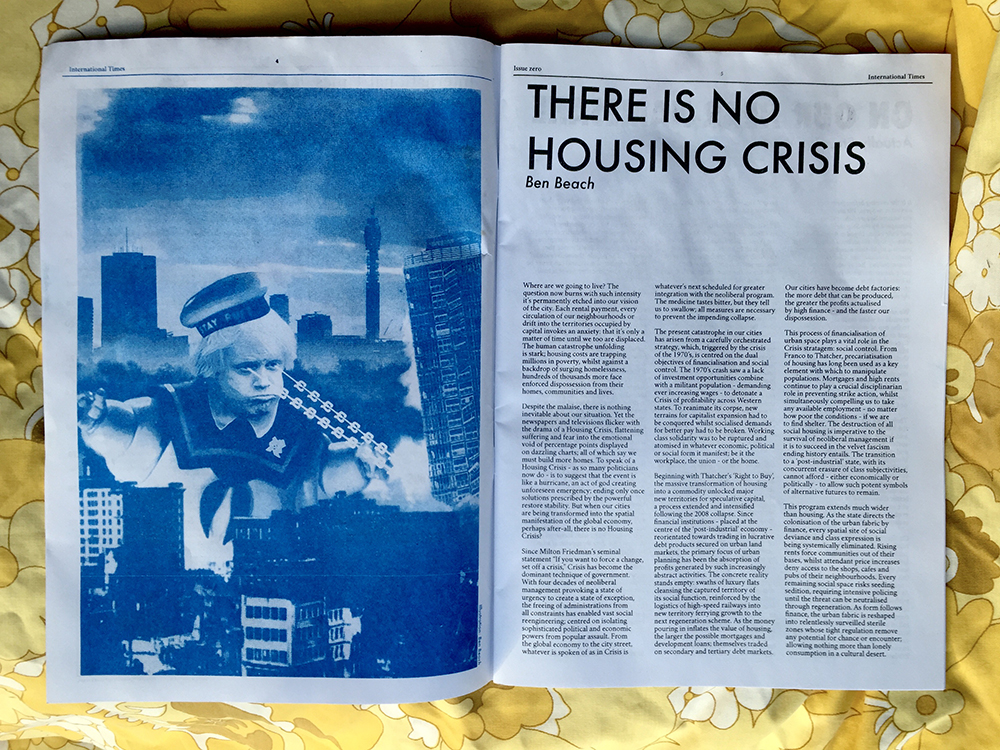
A mistakenly truncated version of this article was originally published on January 16th
in ‘issue zero’ of the newly launched print edition of the International Times.
The rest of the articles will be online on a new IT website soon.
A limited number of copies can be bought from artist Darren Cullen’s online store here:
https://www.etsy.com/uk/listing/264543463/international-times-issue-zero
Where are we going to live? The question now burns with such intensity it’s permanently etched into our vision of the city. Each rental payment, every circulation of our neighbourhoods or drift into the territories occupied by capital invokes an anxiety: that it’s only a matter of time until we, too, are displaced. The human catastrophe unfolding is stark; housing costs are trapping millions in poverty whilst, against a backdrop of surging homelessness, hundreds of thousands more face enforced dispossession from their homes, communities and lives.
Despite the malaise, there is nothing inevitable about our situation. Yet newspapers and televisions flicker with the drama of a Housing Crisis, thus flattening people’s suffering and fear into an emotional void of percentage points displayed on dazzling charts. And all of these say we must build more homes. To speak of a Housing Crisis – as so many politicians now do – is to suggest that the event is like a hurricane; an Act of God that creates unforeseen emergency, with stability only possible once the powerful prescribe their solutions. But, with our cities being transformed into spatial manifestations of the global economy, perhaps, after all, there is no Housing Crisis?
Since Milton Friedman’s seminal statement “If you want to force a change, set off a crisis,” crisis has become the dominant technique of government. With four decades of neoliberal management provoking a state of urgency to create a state of exception: the freeing of administrations from all constraints has enabled vast social reengineering, centred on isolating sophisticated political and economic powers from popular assault. From the global economy to the city street, whatever is spoken of as ‘in crisis’ is whatever’s next scheduled for greater integration with the neoliberal programme. The medicine tastes bitter, but they tell us to swallow; all measures are necessary to prevent impending collapse.
The present catastrophe in our cities arose from a carefully orchestrated strategy which, triggered by the crisis of the 1970s, centres on dual objectives of financialisation and social control. The 1970s crash saw a a lack of investment opportunities combine with a militant population – demanding ever increasing wages – to detonate a crisis of profitability across western states. To reanimate its corpse, new terrains for capitalist expansion had to be conquered and socialised demands for better pay broken. Working class solidarity was to be ruptured and atomised in whatever economic, political or social form it was manifested; be it the workplace, the union – or the home.
Beginning with Thatcher’s ‘Right to Buy’, the massive transformation of housing into a commodity unlocked major new territories for speculative capital, a process that extended and intensified following the 2008 collapse. Since financial institutions – placed at the centre of the ‘post-industrial’ economy – reorientated towards trading in lucrative debt products secured on urban land markets, the primary focus of urban planning has been the absorption of profits generated by such (increasingly abstract) activities. The concrete reality stands empty: swaths of luxury flats cleanse captured territory of its social function, reinforced by high-speed railways ploughing into new territory, ferrying growth for the next ‘regeneration’ scheme. As money pours in, inflating the value of housing, mortgages and development loans increase; loans which are traded on secondary and tertiary debt markets themselves. Our cities have become debt factories: the more debt produced, the greater the profits actualised by high finance – and the faster our dispossession.
 This process of financialisation of urban space plays a vital role in the crisis stratagem: social control. From Franco to Thatcher, precariatisation of housing has long been used as a key element with which to manipulate populations. Mortgages and high rents are crucial disciplinarian forces in preventing strike action. Simultaneously, they compel us to take any available employment – no matter how poor the conditions – in order to find shelter. The destruction of all social housing is imperative for the survival of neoliberal management; if it is to succeed in the velvet fascism ending history entails. The transition towards a ‘post-industrial’ state, with its concurrent erasure of class subjectivities, cannot – economically or politically – afford to let such potent symbols of alternative futures remain.
This program extends much wider than housing. As the state directs the colonisation of urban fabric by finance, every physical site of social deviance and class expression is systemically eliminated. Rising rents force communities out of their bases whilst attendant price increases deny residents access to their local shops, cafes and pubs. Every remaining social space risks seeding sedition, and so these threats are intensively policed until they can be neutralised through ‘regeneration’. As form follows finance, urban fabric is reshaped into relentlessly surveilled sterile zones whose tight regulation removes any potential for chance or encounter; allowing nothing more than lonely consumption in a cultural desert.

Nowhere are financialisation and social control more apparent as dual outputs of the Housing Crisis than in the scheduled demolition of homes of participants in the London riots, supposedly to create ‘density for much-needed new homes’. It should come as little surprise that Cameron has explicitly stated he will override tenants’ concerns about “fairness” to “minimise political and financial risks to investors”. Thus, rebellious inhabitants are safely scattered and maximum profitability assured. The medicine tastes ever more bitter as Cameron tells us that the high prices of these new units are good, as they “unlock the homes we need”. Within the logic of the Housing Crisis, social cleansing is not just necessary, but common sense.
With these huge programmes of urban re-engineering forming a spatial representation of class warfare, we would be wise to consider all current development a threat. Yet, this built manifestation of finance leaves the system that created it vulnerable and exposed by creating sites of value in the territories we control. And from these very territories we should consider immediately planning our counterattacks. The image of inevitability the Housing Crisis promotes is designed to promote a sense of hopelessness and depression. But with urban organisation functioning to provide secure environments for the continued circulation of capital, disrupting these flows through blockades of strategic nodes provides potential for us to articulate immense power.
Regeneration schemes depend on complex supply chains and logistical sites; minor disruption of these can heavily impact projects. Key sites should be identified and selectively challenged: blockades of construction yards and concrete plants even for a few hours lead to thousands of pounds in delays, and knock on effects run for days. Construction sites themselves, as demonstrated by heroic occupations at Sweets Way and Aylesbury Estate, are vulnerable to capture. Architects and developers produce their work from well advertised offices which are easily accessible and depend on a quiet environment.
Seizure of space has been well utilised to hold territory: the innovative social housing project of Focus E15 successfully forced partial repopulation of the Carpenters Estate. The circulatory systems of the city itself are vital if the Housing Crisis is to function effectively and, as such, obstructing these should be an urgent priority. Street parties – as Class War have identified – offer an excellent form through which to find each other and conspire on the nature of the resistance, whilst forcibly stating our territorial claim to our environment.
One of the most versatile and powerful nodes is rental payment: this is the moment when value is extracted from housing as a functional enterprise and fed up into the financial system. The Bank Of England regularly reports on the threat posed to the entire UK banking sector by the astronomical mortgage debt secured on Buy-to-Let property. Rent strikes offer the capability to break the financial production lines, allowing us to provoke crisis in both the landlords and their masters. The tactic has proven highly effective, with recent experiments at UCL winning a sweeping victory that yielded over £500,000 in compensation. Given the widespread distress of tenants and increasing talk of escalation, it seems highly likely rent strikes will become increasingly common in 2016.
When neoliberal urbanism intends to make safer spaces for capital though socially cleansing the city, removing any trace of class and its antagonisms, there is no ‘Housing Crisis’. Instead, we have a permanent state of exception, developed and refined by generations of technocrats in a long-term political strategy. If the language and discussion of ‘crisis’ benefit only the capitalists and their managers who profit from such urgency, perhaps its time to leave the crisis of the present for demands for the future – a right to the city asserted not through defence but through attack. Modern political power no longer arbitrated through town halls, but through logistical networks whose nodes are hidden in plain sight within our neighbourhoods. If we can build commonality through mass collective disruption, the city and its urban commons could be ours: if we want to have a future in our homes, we must first reclaim the streets.
Words and graphics: Ben Beach
.
A very interesting and timely article. I enjoyed (and would like to hear more about) the discussion of how the trade in lucrative debt products is secured on urban land markets. This completely explodes the crap we hear from politicians about supply and demand, which is economics from the dark ages. And, as always, it’s important to hear solutions based on analysis, and the ones this article puts forward are ones we should consider.
One point, though. You messed up the printing; the least you can do is get a proof reader in for the online version, because this has a dozen typos, and the article deserves better.
Comment by Simon Elmer on 28 January, 2016 at 8:33 pmIt’s similar to Thatcher closing the mines, another example of barbarism, this time in a housing capacity. An end to both an inhuman way of earning a living and a dark time in recent environmental damage, by burning coal, was the upside. The downside was, and is, a lack of any kind of plan or intention to replace them with some benevolent solution where communities thrive and succeed.
The swathes of redundant miners and their offspring could have been channelled into a renewable energy industry to rival the likes of Denmark, which produces so much electricity from wind power it sells it on to other countries. A massive opportunity lost in the ’80s from sheer class snobbery,spite and greed on the part of Thatcher and her lack of vision and patriotism to her own country.
It’s similarly the great failing and lack of patriotism of this Tory vision in their social cleansing scheme. Act now, dont think about the huge social problems which are waiting down the line as a result. Fairly cheap and environmentally and communally friendly replacements could be built without problem for those who will lose their homes. We could make garden communities which could be an example to the world. We could eradicate the idea of a class of people who are hopeless and helpless by working from the bottom up to integrate them into a genuine “We’re all in it together” idea of Britain, not David Cameron’s fake one. Remember, its rarely the rich that create anything.
So instead the whole lot will be sold to property developers for maximum financial gain for the few. They are making a mistake which will potentially cost the whole country dearly in future years.
Comment by Editor on 31 January, 2016 at 8:16 am