
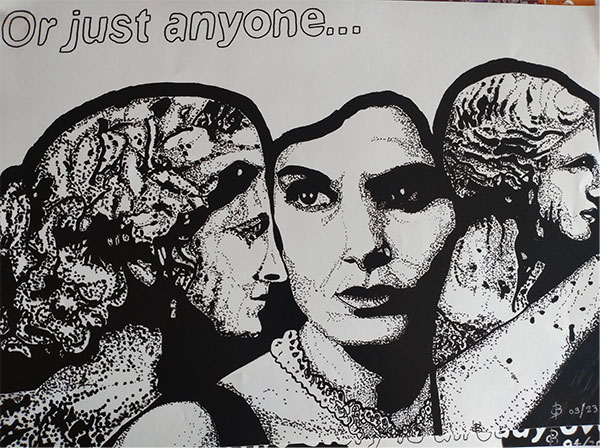
next time you meet someone (okay so
you may do this already) take note of
the smell not only of their breath (not always unpleasant)
but of the chemicals they choose to spray on their bodies of
the way they move the muscles pulling the bones
of the skeleton this way and that all under
the covering of the skin
& the subtle movement of their faces
all of which taken together (along with
their choice of clothes) is (to varying degrees) contrived
to create an impression (anything from
sophistication to studied nonchalance)
yet can betray so many things
& then (if that wasn’t enough) of all the words
enclosed by inverted commas stacked into paragraphs
of autobiography which so often leave you wondering
(if you wonder about such things) what it is
they’re leaving out & you never know but
they might even afford you (if you’re lucky) a chance
to get a word in edgeways
& then there’s all the stuff they don’t even know
they know the stuff that never gets out e.g.
words spoken at a time they only think of as
a memory of a dimly-lit interior a half-remembered face
the movement of a hand a tone of voice
it takes time to get used to it
all this socialising although
I guess I could quite easily since
it could be worse
.
Dominic Rivron
Picture Chris Bill
* Johari Window: created by Harrington Ingham and Joseph Luft in 1955, the Johari Window is a matrix which contains everything you and others know (or don’t know) about yourself. There are four panes in the window: what only you know about you, what only others know about you, what you and others know about you and, finally, things about yourself nobody – not even yourself – knows about.
.
Brilliant poem Dominic.
Comment by Malcolm Paul on 8 September, 2026 at 10:05 amA real pleasure to read.
Thanks Malcolm.
Nice to see you and my artist friend Chris Bill
sharing a space.
Malcolm.