
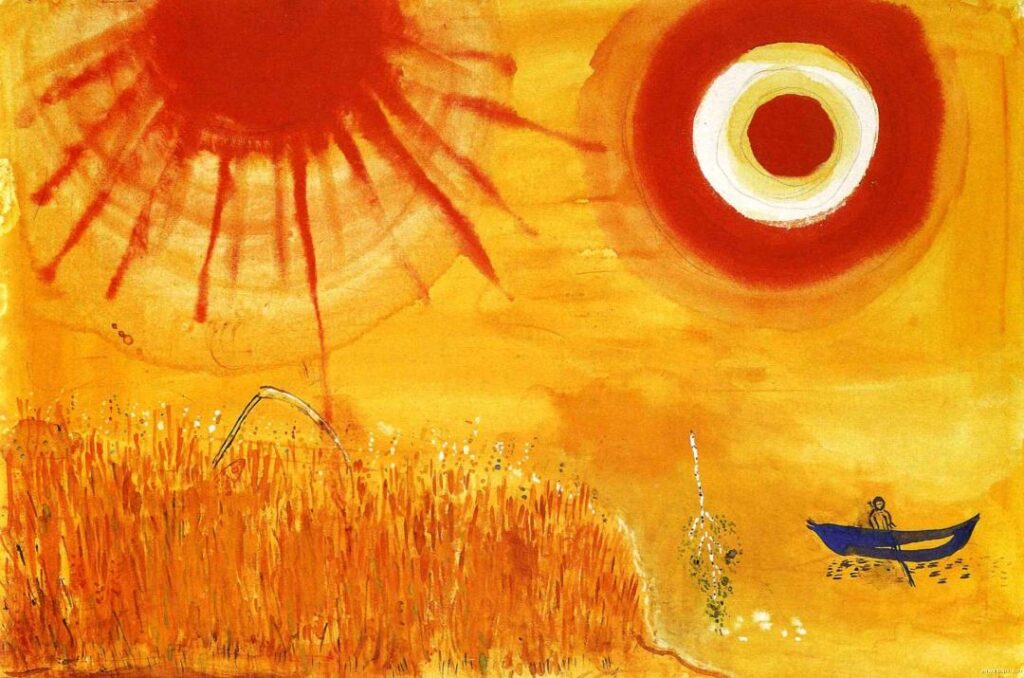
A Wheatfield on a Summer’s Afternoon, 1942 by Marc Chagall (1887 – 1985)
gouache, water colour and pencil.
Museum of Modern Art (MoMA), New York.
https://www.wikiart.org/en/marc-chagall
In the second lost summer
第二个失去的夏季 🌞
Even the birds fail to recognise me
But I still recognise the cuckoo. Though I hear her only once.
The sun’s exit is through the spaces of the leaves
And in the spaces of the words I cannot leave
We wear her through the window
Death is not here, but the warmth of the sun is lost to me, behind the glass
She is rising and resurfaces
Higher than the window
And now the day is backwards without her
Light with her and not me
I have the irons of darkness
Every year is like this
This is my age of darkness.
I turn the page only to remember that
the route in paper white has no exit either.
I suspect that the summer calves have been taken for slaughter
The land is writing me, in heavy strokes after the thunder.
My footsteps bring the thunder mud along the path
Does mud remember its past?
Why do we always expect dark things to be lifeless?
I see the calves by the river
Brown and living creatures
They and I both know this precious sunlight,
We outlive our purpose in the spent yellow, quietly and passively,
Only the cuckoo is singing again from the other side of the wood,
I hear a single finch and think it is a lark.
10th June 2026
this summer I have to edit many Chinese translations, last summer I had cancer
Response Poetry By Helen Pletts 海伦·普莱茨
Response Poetry Translated by Ma Yongbo 马永波
‘I wrote ‘in the second lost summer’ on my phone, while walking Sasha, slowly appraising the natural world around me and the joy of being. I especially like to see the small calves too.
This poem is unchanged apart from a few wrong key depressions when the lead was tightening.
Yongbo divided it up when he created his translation.
This is the sustained care that he brings to all poetry in translation and I am very grateful for his kindness. I am unable to successfully edit my own poetry because it is written in the moment. Yongbo is my first reader, I send him everything I write.
Cuckoos are the most amazing sound. Before I first heard them in the wild, and only in the last couple of years, I had only heard them as a recorded feature of one of those bird clocks where each hour is marked by a different birdsong—I have one in my kitchen that my parents bought me.’
Helen Pletts 海伦·普莱茨, 19th June 2026
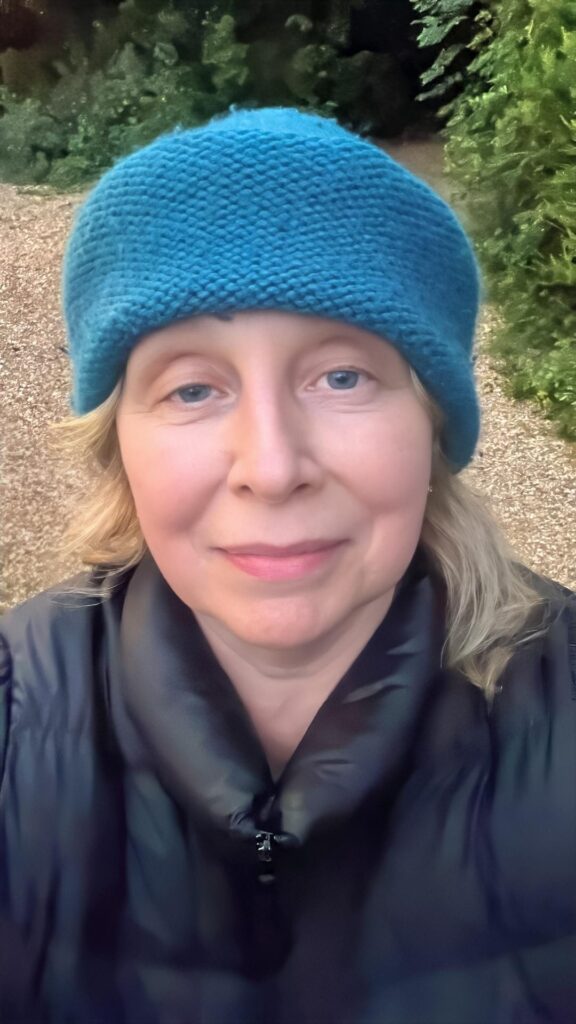
Helen Pletts 海伦·普莱茨, 14th June 2026, Cambridge, Planet Earth, The Universe
第二个失去的夏季
In the second lost summer
飞鸟已然认不出我的模样
但我依然认得布谷。尽管只听过到它一次。
太阳的出路在于穿过枝叶的缝隙
而字句的夹缝之间,我无从脱身
隔着窗户,我们一点点把它耗尽
死亡不在此处,可暖阳再也无法触及,玻璃后面
它正在升起,再度浮现
扶摇高出窗棂
没了它,此时的白昼便是倒退
光明在它,而不在我
黑暗的铁镣牢牢把我锁住
岁岁年年皆是如此
这便是我的至暗之年。
翻过一页纸,才幡然醒悟
白纸铺就的前途,同样没有出路。
我猜想那些夏犊早已被牵去屠宰场
惊雷过后,大地以重笔将我写入诗篇。
我的脚步裹挟着泥泞一同前进
泥泞是否还记得它的来路?
为何我们总是笃定幽暗之物必定毫无生机?
我看见河畔的小牛
棕褐色的鲜活的生灵
它们与我,都懂得这日光何其珍贵
在褪尽光华的昏黄里,我们默默顺从,熬过了既定宿命
唯有布谷在树林的另一端再度歌唱
一声鸣啭,让我以为那是一只云雀。
海伦·普莱茨
2026年6月10日
今夏我要校订大量中文译稿,
去年夏天,我确诊了癌症。
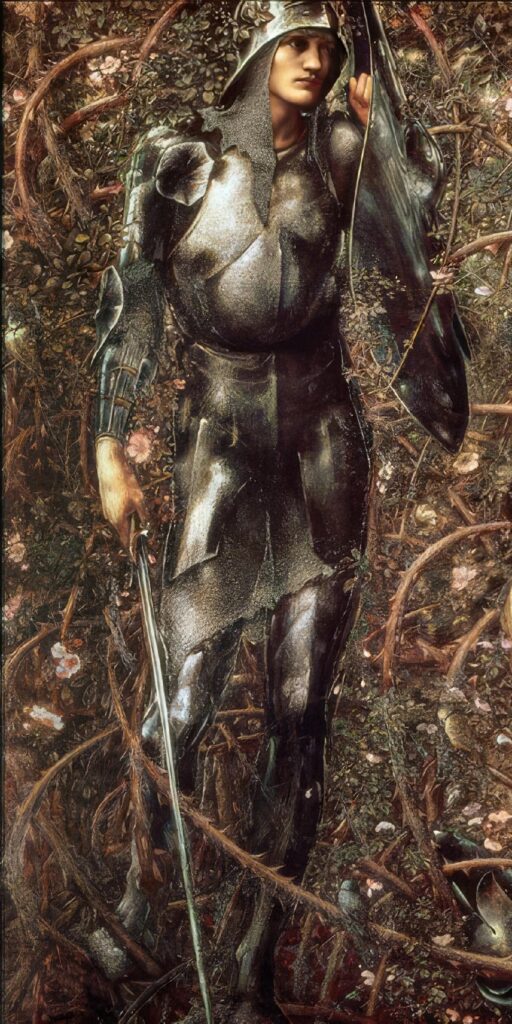
detail from painting by Edward Burne-Jones (1833–1898)
“The Briar Wood” from the “Legend of Briar Rose”
The Second Lost Summer—A Reply to Helen
第二个失去的夏季——答海伦
Yes, we lost a summer, an entire summer
and all the glories and ghosts it carried.
A spaceship from outer space landed on the treetops,
releasing invisible particles that pierced our chests.
Before the pain could spread to our foreheads,
it vanished without a trace,
like a rain shower that has just stopped,
leaving only the sound of water echoing in a thousand mountains
and ten thousand valleys.
This may be a conspiracy, originating from an unknown force;
fate, or chance. Suddenly we realise that life is nothing more
than mud left by a sudden rainstorm on rolled-up trouser legs,
on sticky tires, even on futilely swinging windshield wipers.
While what boils in the radiator is nothing more than the swarms
of mosquitoes and flies that breed in large numbers after rain.
With no way out, we had already embarked on a path of no return.
This applies both to life itself and to the words themselves,
the possibility of survival is as limited as visibility on a foggy night.
Turning back may not lead to shore; the light shining through the trees
may only be a ripple on stagnant water.
Perhaps a black swan sings its own lament.
Because neither life nor poetry can be perfect, nor even finished.
Every unfinished self is simultaneously walking on every path in the world,
like a hero, in the twilight of life, using his tattered uniform as his banner.
However, crisis is the best time for salvation,
for with Him, there is no more death; He has conquered this world.
Death is merely a harmless rehearsal,
making us accustomed to the paths of parting and reunion,
the roads we come from and the roads we go to, midnight and noon,
were originally just two sides of a blank sheet of paper, rather than an abyss
of mutual gazing.
June 12, 2026, morning.
Response Poetry By Ma Yongbo 马永波
Response Poetry Translated by Ma Yongbo 马永波
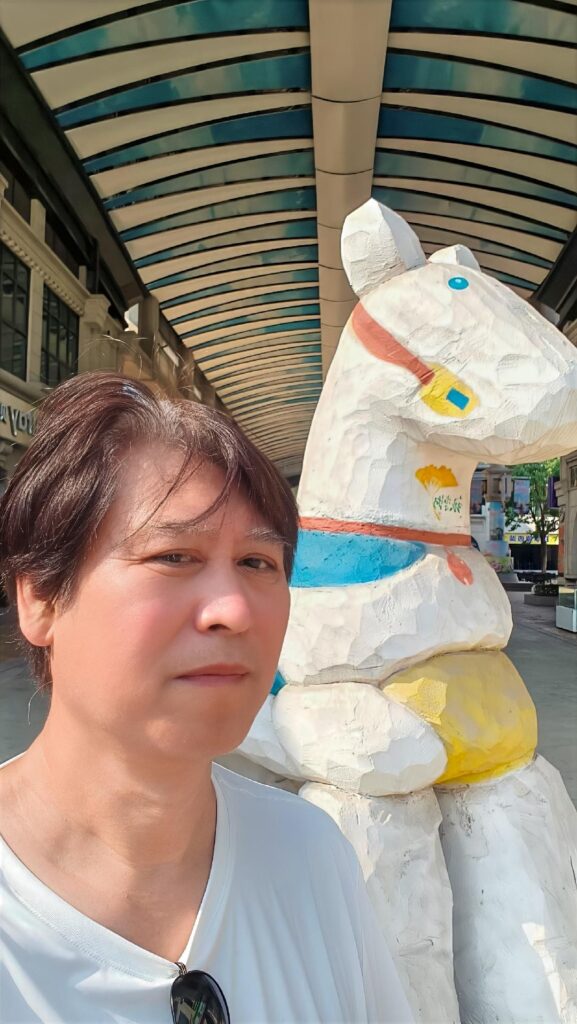
Ma Yongbo马永波, 3rd June 2026, Nanjing, China, Planet Earth, The Universe
第二个失去的夏季——答海伦
The Second Lost Summer—A Reply to Helen
是的,我们失去了一个夏天,一整个夏天
以及它所携带的所有光荣与幽灵
一艘来自天外的飞船,停落在树梢
释放出一些无形的粒子,穿透我们的胸膛
未等疼痛蔓延到前额,它便消失无踪
仿佛阵雨初歇,唯有千山万壑依然回荡着水声
这也许是一个阴谋,来自未知的存在
宿命也好,偶然也罢,它终归让我们惊觉
生命,原只不过是一场骤雨留下的泥泞
在卷起的裤腿上,在粘滞的轮胎上
甚至在徒劳摆动的刮雨器上,而水箱里
沸腾的,不过是雨后大量滋生的蚊蝇
没有出口,我们原本就踏上了一条不归路
无论在生活本身,还是在词语之中
幸存的可能性都是大雾之夜的可见度
回头未必是岸,树林那端透出的光芒
也许只是一片死水的微澜
也许有一只黑天鹅,在吟唱自我的挽歌
因为生活和诗歌,都不可能完美,甚至完成
每一个未完成的自我,都同时走在天下所有的道路之上
像一个迟暮的英雄,以自己破烂的军服为旗帜
然而,危机便是获救的最佳时机
因为有了祂,从此便再无死亡,祂已胜了这世界
死亡不过是一场无害的演习
让我们习惯,离别与重逢
来路与去路,午夜与正午
原本不过是一张白纸的两面,而非互相凝视的深渊
2026年6月12日晨
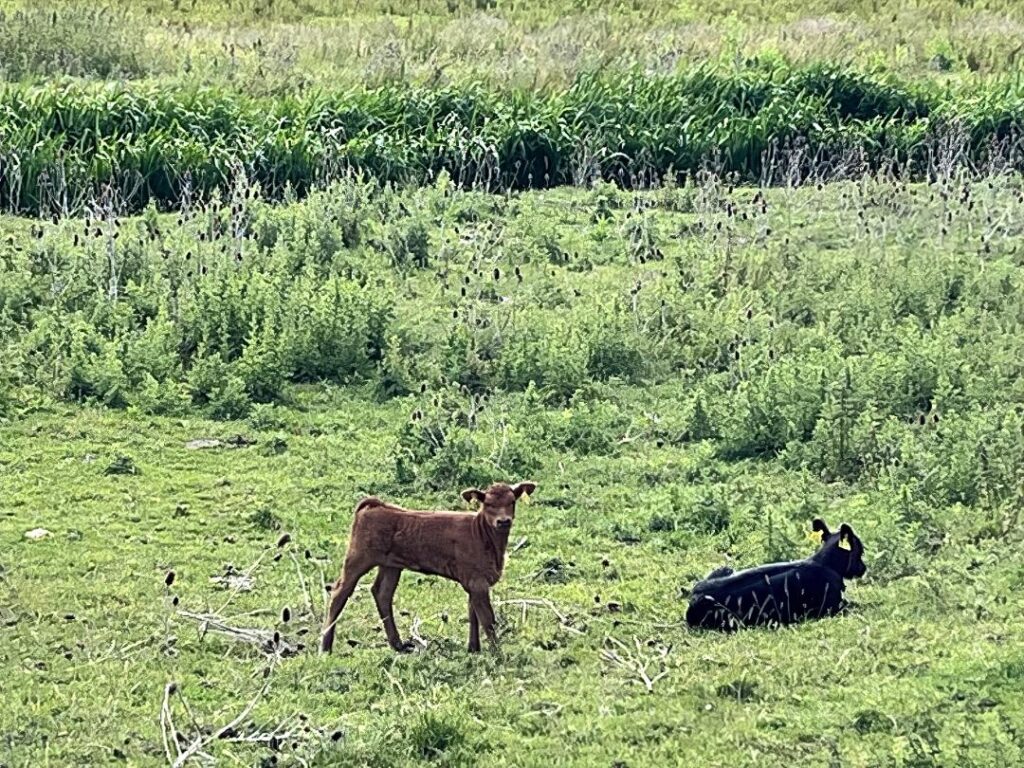
The lovely calves, 10th June 2026, Cambridge, Planet Earth, The Universe
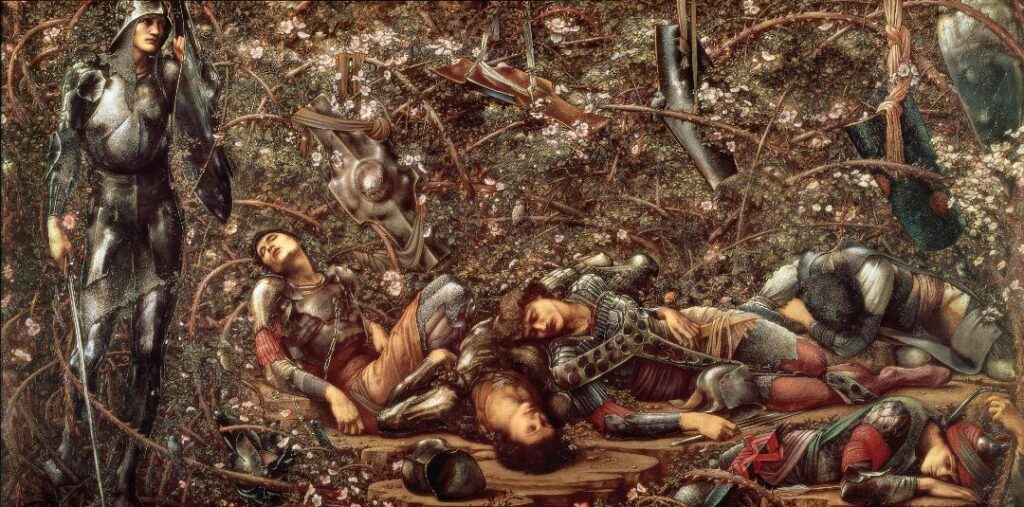
Edward Burne-Jones (1833–1898)
“The Briar Wood” from the “Legend of Briar Rose”
Buscot Park, Oxfordshire
The painting depicts the discovery of the sleeping soldiers by a Knight. In their slumber they have become completed entwined by the barbed thorns of the Briar rose
Inscription:
“The fateful slumber floats and flows
About the tangle of the rose;
But lo! the fated hand and heart
To rend the slumberous curse apart!
Burne-Jones drew his inspiration for the Briar Rose cycle from the ‘Sleeping Beauty’ fairy-tale, which had been retold in the eighteenth century by Charles Perrault in his Contes du Temps Passé and by Tennyson in his 1842 poem Day Dream.
All photographic images and poetry under individual copyright © to either Ma Yongbo 马永波 or Helen Pletts 海伦·普莱茨
.