
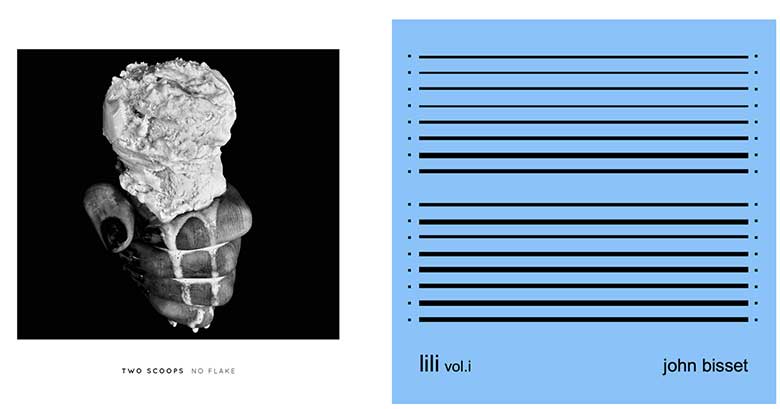
No Flake, Two Scoops (Adventurous Music)
lili vol.i, John Bisset (John Bisset)
Asking for two scoops with no flake requires a willpower I’ve never been able to summon. No-input artist Andrew Leslie Hooker and violin/modular synth player Ed Wright are obviously made of sterner stuff. No Flake, their latest album playing together as Two Scoops, is an uncompromising search for non-standard ways of structuring sound: it’s music, but not as we know it, Jim, as Leonard H McCoy might’ve put it. Those of us who listened to such masterpieces as Stockhausen’s Hymnen back in the day – and, indeed, still listen – are pleased to know there are still artists hanging in there, working on and developing the same, rich vein.
The first track, ‘Hazed and Confused Core’ incorporates chopped up, transformed Chopin piano music into Hooker and Wright’s electronic conversation. This is intriguing, as it changes the unwritten rules we use to process Chopin when we listen: it becomes less an emotional journey and more simply another sound source. Indeed, it draws attention to the different ways we listen to Chopin on the one hand and Two Scoops on the other. The second track (‘Fresh Georgia Peach’) is really quite special, I thought. It begins with spoken voices receiving similar treatment to the Chopin, before solidifying into a monumental, luminous wall of sound. This, in turn, gives way to a more brutal soundscape, in which distorted, unrecognisable, musical artifacts are tossed around as a cat might toss a cat-toy, in an environment otherwise characterised by harsh, abstract electronics. As we approach the end, there’s a long section of low, violin tremolos set against fractured, pulsing sounds from Hooker which ends with a fleeting return of something like the luminous wall. The third track, ‘Cherry Garcia’ is named after a Ben and Gerry’s ice cream flavour I’m unfamiliar with. Apparently, it’s packed with cherries and dark chocolate fudge flakes. As I’ve been told I have to watch my cholesterol, I think I’ll stick to the Two Scoops version. This time, rather than Chopin or spoken voices, it’s a jazz saxophone that gets processed and embedded in the mix – not unlike dark chocolate fudge flakes, perhaps. And, indeed, perhaps this is why Hooker and Wright go for the ice-cream theme: their approach to musical form is very much like the way irresistible, exotic ice creams are put together. Everything gets thrown in and stirred up. Do the job well and there’s no need to stick a flake in it. The fourth track is packaged as a bonus track (it’s described as a rehearsal tape). It is, perhaps, a little lighter and more whimsical than the others, but it certainly earns its keep. I guess they wanted to share it while drawing attention to the fact that the first three tracks hang together as a musical statement. I’m pleased they did.
And Ed Wright’s album notes deserve a mention. They’re a detailed, forensic examination of the process of improvising as a duo with the wildcard ghost in the machine that goes with no-input music-making thrown in. As he says: ‘This album stands as a record of … shared attentiveness: two musicians meeting in real time, negotiating the space between intention and accident, and allowing something larger than either of us to briefly come into focus’.
I name-checked Stockhausen earlier, but it would be wrong to suggest that what’s happening here is some sort of nostalgia trip. No Flake is very much music of its time. As I hear it, it’s an edgy and relevant sound-track to the worlds we live in. If, like me, you’re the sort of person who worries that capitalism is involved in a project to kill culture and carve up the remains in order to redistribute it as ersatz entertainment that exists in some sort of synthetic, everlasting present, the music of Two Scoops and musicians like them is cause for hope.
Lili vol.i is the latest solo release from lap-steel player John Bisset. In the album notes he describes how it came about. In an effort to explore the possibilities of the lap steel, he, as he says, ‘invited friends to give me tunings. The response was terrific and I have many curious patterns to explore. Here’s the first batch, using a 12-tone row from Rhodri Davies, and Jem Finer’s tuning from his harp.’
Listening to it, something György Ligeti said about the musical predicament he found himself in came back to me. As he famously put it: ‘One wall is the avant-garde, the other is the past. I want to escape’. John Bisset’s is a music without walls. Yes, if you wanted to provide pointers you could name-check Satie or English Minimalism, but to do so would be to imply a self-consciousness to the music that just isn’t there. It speaks for itself. And as soon as you think you’ve pinned it down, it’ll go and contradict you, so don’t bother. Just listen. Perhaps the way to escape the confinement of imaginary walls is not to try to break them down, but simply to stop imagining them. John Bisset has acknowledged a debt to Stockhausen (him again!), although in this case we’re thinking more Tierkreis than Hymnen. I’ve not paid such analytical attention to all the pieces here (I was too busy listening to them) but I have spotted him using – in the track, ‘Old to you, new to me’ – an approach used by the German composer: you work with a tone row, but, rather than strictly rotating the notes in it, you allow each note in the row to be freely used once it has first been stated. Here though, I should stress, the approach is more intuitive than formal.
Lili vol.i is an enthralling listen. I look forward to vol.ii.
.
Dominic Rivron
LINKS
No Flake: https://adventurousmusic.bandcamp.com/album/no-flake
lili vol.i: https://johnbisset.bandcamp.com/album/lili-vol-i
.