
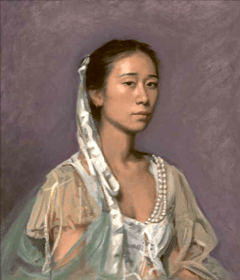
Ellen by Emily Rogers
Sam Burcher attends the National Portrait Gallery for the Herbert Smith Freehills Kramer Portrait Award 2026 for a close look at the finalists.
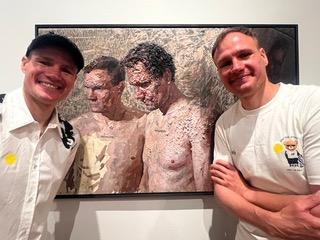 The launch of this exhibition at the NPG provides a unique opportunity not only to see a variety of great contemporary portraiture, but to meet many of the artists and sitters in front of their portraits.
For instance, there are the Gataveckas twins, Aligirdas and Remigijus from Lithuania, who naturally gravitated to making the double self portrait Genealogical Deformation (2025). I’m not sure which one of them told me “We’ve always done everything together, so why not painting.”
Their mischievousness and warmth in life is a sharp contrast with the patches of whitish metal on the canvas and prodigious layers of oil paint making blistering and bumpy flesh tones, evoking a sense of coldness and contagion.
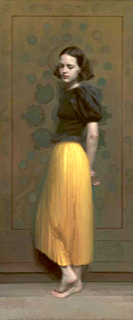
There is the barefoot sitter or rather stander in the full length portrait Turning Thirteen (2025) by Frances Bell. Her daughter Flora is a shy, but captivating figure in the gallery dressed as she was in her portrait. One year later her hair is longer and her long pleated skirt is a darker shade of saffron under the artificial lights.
Emily Rogers & Sight-Size
Ostensibly, I’m here to meet the young artist Emily Rogers 29, one of the 51 finalists. She was introduced to me by Fenella Lockyer, the founder of Portfolio London, a leading portrait commissions and bespoke fine art business representing Emily amongst a number of Britains most talented established and emerging fine artists.
Emily’s portrait Ellen was chosen from 1,474 entries from 63 countries, all competing for one of the biggest prizes in portraiture of £35,000, She confidently described her use of “sight-size” to paint her friend Ellen from life and to scale in natural light over six or seven sessions.
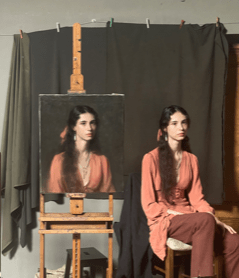 Sight-size is a measuring technique developed by the Old Masters who placed the canvas side by side with the sitter. The artist, in this case Emily, walks back to observe both from a distance, then walks forwards to make her marks, sometimes just one on each approach. She then walks back to the same spot to look again and walks forwards to make another mark, and so on, often covering many miles in one sitting.
Acquiring the skills to represent an accurate likeness of a subject has taken several centuries to develop and this evolutionary process continues at the Charles H. Cecil Studios founded in Florence in 1991 and housed in the city’s oldest Atelier where Emily completed her training in 2022. She returns to the Studios throughout the year to teach and maintain her portraiture practice.
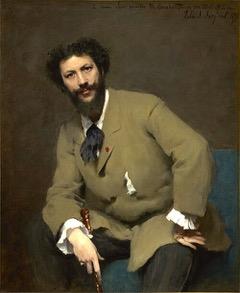
Charles Cecil was taught by a pupil of the Florence born artist John Singer Sargent, who produced around 900 portraits, including the notorious Madame X (1884), The Blue Boy (1890) and Theodore Roosevelt (1903). One step further back is Sargent’s teacher the brilliant portraitist Carolas-Duran, the first winner of the gold medal at the Paris Salon in 1879. (Singer’s portrait of Carolas-Duran pictured below right). Going forwards, it’s Charles Cecil’s mission to keep this lineage of master-pupil alive into the future.
In its truest tradition dressing up remains an integral part of portraiture. And, it’s evident that Emily enjoyed painting Ellen, who was easily persuaded to swap her casual clothes for diaphanous fabrics, a cascading hair ribbon, a white bodice loosely laced and draped in pearls. The clever interplay of colour, light and shadow cocoons the sitters exquisite skin tones and expression.
Light and air emanates from Ellen’s violet background where the paint was kept thin in parts to allow the canvas to “breathe.” The variety of bold brush marks on the costume speak to me of the great portrait painters, with Emily citing Van Dyck and Velázquez as her influences. When mastery is combined with her fresh, fun feel, the image imparts an unshakeable faith in what a portrait actually is. Not just a fleeting moment of someone’s likeness, but a meticulous portrayal of their underlying character, or dare I say it, soul.
Portraiture is enjoying something of a renaissance, consider the popularity of television programmes such as Portrait Artist of The Year, on which Emily was seen painting the writer Richard Curtis in 2023. She also recently completed a wonderfully life-like portrait of King Charles III for an historic private members club in London, has exhibited at The Royal Society of Portrait Painters, and The Society of Women’s Artist 2024-2025 where she won the Karen Walker Young Artist award.
The Influence of Charles Cecil
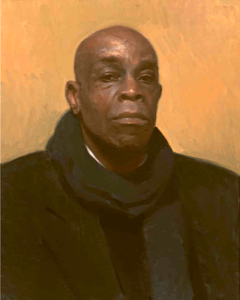
The winner announced on the morning of the NPG launch was Marc Dalessio, a former Charles Cecil student. Marc had recently returned to portraiture after a ten year break and his imposing portrait of his neighbour Jean-Denis (2005) displays the perceptible qualities of sight-size, with dozens of carefully considered tiny daubs of paint highlighting the black skin and bald head of his sitter
When Jean-Denis knocked on his door in southwest France to request his portrait Marc was excited because he observed him going off to his “bureaucratic work” in Toulouse each morning, elegantly dressed in a dark overcoat and scarf with his white shirt just visible underneath; the sliver of which became a focal point of the painting, and intrigued the judges.
The space and light in his studio was perfect for using sight-size and Marc stuck closely to Charles Cecil’s method of a restricted four colour palette of white, ochre, red and black oils, sometimes with a red lake for glazing. He set Jean-Denis in a gold background for maximum impact.
Curiously, I am drawn to the portrait by another former Charles Cecil student, in much the same way as I was to the work Emily Rogers, whose eye-catching portraits I had come across for the first time by chance only weeks earlier.
When I asked Frances Bell about sight-size she said it is a method she often breaks, yet for Turning Thirteen (2025) (pictured) she had used it, “more or less as Charles would like me to.” She describes it as a tool rather than a philosophy to gain proportion, accuracy and a depiction of the light over the sitter.
It’s a technique she loves and combined with some “fairly punchy” cadmium oranges and yellows, then hunting out the reds and greens from the seemingly mono dimensional colour of Flora’s skirt was fun. And, by keeping a cool background of bluish naturalistic forms, Frances has created an irresistibly compelling portrait.
Two more outstanding portraits influenced by the methods of the Charles H Cecil Studios are the mesmerising Rominha with a Red Earring (2005) in ruffles by Margaret O’Hare and Sahara (2026), and an intentionally muted life size, full length portrait of fellow artist Sahara Longe by Isabella Watling.
Artists & Sitters
Over time portraiture has proved itself to be resilient and, so far, resistant to the often capricious advancement of technology. The empathic connection between artists and sitters that produce naturalistic and realistic portraits demonstrate a timeless visual language used well has a truly enduring appeal.
But what’s it like sitting for a portrait? Apparently, sitting for an artist is a reciprocal relationship. Emily said Ellen, who is a professional photographer, at times returned her intense gaze by photographing her going about her painterly actions.
Marc played Jean-Denis podcasts to keep him entertained. Whilst Jean-Denis did Marc a great service by commissioning the winning portrait, because until then he only had his wife and children to practice on having recently moved into the studio he renovated from a tumble down building.
Martin Jessops has taken the same art route as me, first to Camberwell, which we both loved and then to Farnham, where he found the teaching less inspiring. In his portrait Diane (2025) who sat for him after a chance meeting at a vintage market in Bristol wears her own richly patterned clothes against a textured yellow background. This joyful representation of an older woman is appreciated by visitors. Next he will paint her scientist husband after receiving a commission from his employers.
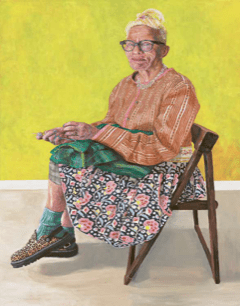
Martin cried when he received the email from the NPG saying Diane had been selected. This was after he delivered her to a warehouse in central London where all the entries were carefully considered by a panel of judges, with no other information about the artists who painted them at all.
Flora has been sitting for Frances her whole life so for her it’s very much a predictable activity. She always agrees, so her mother thinks she enjoys it. Flora is interested in art and gets to keep the clothes, which she likes.
Frances believes that successful portraits are portals that have been cracked open to allow us instant access into a familiar yet intriguing painted world where there is something so innately attractive that it seems quite transcendent. She added, “I think that I and many others like me decided without hesitation to study in a classical tradition and now have fulfilling careers, proves that traditional interpretations of portraits are alive and well – they may go slightly outside of popular culture, but they are still thriving.“
Fenella Lockyer, who founded Portfolio London in 2023, is well positioned to support the flourishing of gifted artists such as Emily Rogers. She works closely with clients looking to commission a portrait or bespoke painting matching them with the very best artist to meet their specific requirements.This leaves the artist is free to do what they do best, which is to paint. And surprisingly, a bespoke portrait or painting is not beyond the reach of customers wanting a timeless artefact to mark any occasion.
Besides taking commissions across Britain, Fenella also organises an integrated art experience combining the creation of a painted portrait with an immersive stay in Florence. Clients typically sit for Emily for two and half hours each morning, leaving the remainder of the day free to explore the beauty of the city and the surrounding Tuscan countryside with insider tips from the artist.
Portraits Tell Powerful Stories
According to the NPG, portraiture reveals qualities in human nature, records the beauty and diversity of human experience whilst telling a powerful story.
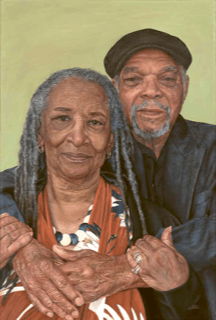
A perfect example is Chloe Cox, the runner up and winner of £12,000 for her double portrait What’s Mine Is Yours (2024) a hyper-real and harmonious rendering of married couple Marva and Lionel Warmington, who have fostered over 200 teenagers
Chloe has an English degree, but trained herself to express paintings that “reflect a story that might otherwise go unrecognised.” Her portrait of the former RAF mechanic Alford Gardner 96, was shown at The Queens Gallery, and commissioned by the King to celebrate the 75th anniversary of the Windrush Generation, which Chloe’s grandparents belonged to. The portrait is now part of the Royal Collection.
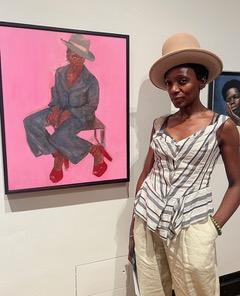 Another vivid storyteller is Anji Richards, who is wearing the best hat in the gallery. Her self portrait Red Shoes (2026) explores the evolution of black style and identities through female dandyism, a fashion movement rooted In resistance across Europe and the Americas. She is seated in front of an acrylic bright pink background poised in a tailored grey suit paired with red platform shoes, and of course, a great hat.
The third prize of £9,000 went to Michael Slusakowicz. His mysterious portrait of Charlie and Magda (2006) was highly influenced by his passion for magical realism and the colourful palette of Fauvism – a short lived avant-garde movement originating in France at the start of the 20th Century. What began as an unfinished painting was transformed by subjects, foliage and blending bright oils to produce a neon effect. He said “I love colour, but the idea always comes first; I need to know what story I want to describe.”
Thinking about painting portraits I am reminded of Oscar’s Wilde’s novel The Picture of Dorian Gray, who locks his portrait in the attic as it becomes ever more monstrous whilst he retains the flawless glow of youth captured by the painter. Dorian kills the artist when he sees the true likeness of his sitter.
Perhaps Wilde’’s story is a metaphor for what was shamed, suppressed and had to be hidden in Victorian Society. But, today the compelling portraits at the NPG are representations of people from all backgrounds, ages and orientations which metaphorically sing a celebration of the diversity of life in all its glorious forms and colours.
The exhibition is free for all to visit until 7th October 2026, Floor 2, National Portrait Gallery, St Martin’s Place London, WC2H 0HE
Links
https://www.npg.org.uk/whatson/exhibitions/2026/hsf-kramer-portrait-award-2026/
Fore more about Emily Rogers https://www.emilyroserogers.com/about-1
To commission a bespoke fine art painting or portrai,t or immersive stay in Florence https://www.portfoliolondon.com
For information about courses with Charles Cecil https://charlescecilstudios.com
For more about Frances Bell https://www.francesbellpaintings.co.uk
Photos of portrait artists with thie portraits by Sam Burcher
.