
As a ‘first-generation digital native’, Michael Takeo Magruder has been using Information Age technologies and systems to examine our networked, media-rich world throughout his career. A residency in the Department of Theology and Religious Studies at King’s College London resulted in De/coding the Apocalypse, an exhibition exploring contemporary creative visions inspired by and based on the Book of Revelation. Imaginary Cities explored the British Library’s digital collection of historic urban maps to create provocative fictional cityscapes for the Information Age.
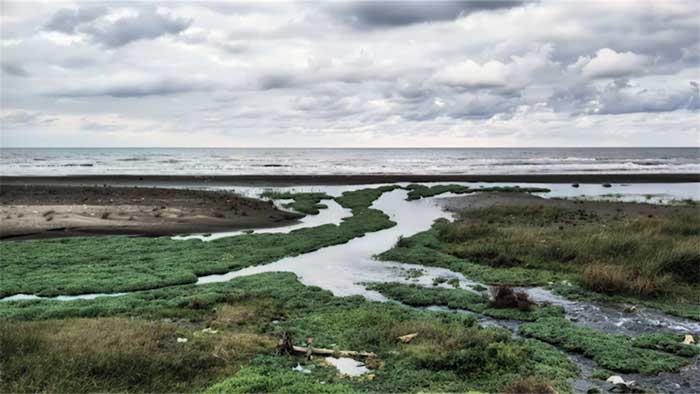
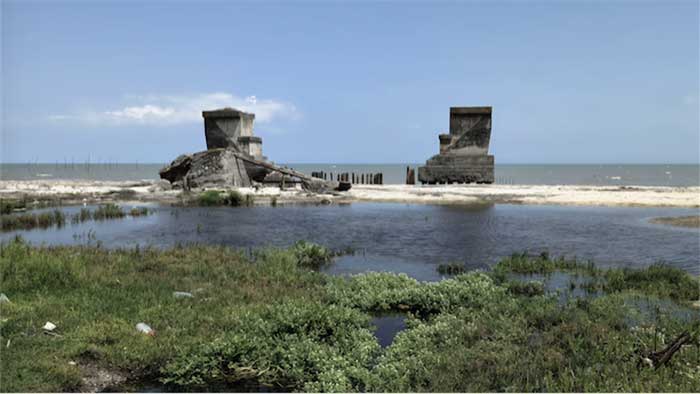
Compared with such projects, his Reconstructed Landscape{s} series seems, at first, to be a step back in time and ambition. The series presents views of specific locations in images that connect closely to traditional landscape art. Four of the exhibited works are from Sleeping Rivers, Vanishing Seas, a new body of work exploring Azerbaijan’s culturally significant and environmentally fragile landscapes through the lens of climate change, digital imaging, and emerging technologies. One is from re:Generated Prairie, an exhibition that explored the renewal of the world and human interconnections between nature and technology by considering our relationship to the prairie, from the annual controlled burn to the subsequent restoration of the grasslands. The final image is from Reconstructed Landscape{s} – Great Falls, a series reproducing the natural beauty of the Great Falls on the Potomac River through digital prints that are manipulated segments of original photographs taken using a smart-phone.
These works initially appear still in the way that traditional landscapes freeze-frame a moment in time. On closer inspection, with the exception of the digital print, the images are moving; whether leaves blown by the wind or diminished water courses struggling to flow through ravaged river beds. These video works have been generated from the artist’s own field recordings captured on his Google Pixel phone and then recursively processed multiple times using traditional digital production tools and the latest generation of AI models. This back and forth between tools controlled by the artist and machine learning systems controlled by AI results in the reimagining and reimaging of the unique vista of each scene of natural beauty originally captured by phone. Takeo’s fleeting personal experiences of locations captured in the field recordings result in meditations on micro and macro perceptions of specific places by being subjected to his editing processes. In this way, the works are of considerable interest both for the images themselves and the process that has led to their creation; on various levels both aspects of the works speak to our contemporary world.
The distance travelled between the original scene, the images recorded on the phone, and the final looped videos displayed in the Gallery raise fascinating questions about what we see and how we share those visions in art and through technology. By explaining his process and sometimes showing aspects of it (alongside Reconstructed Landscape{s} – Great Falls (It-A) is the original image from which a segment has been taken, with the segment marked on that image), Magruder is clear that all sight and insight is mediated, either by a human being or by AI. It is vital that we understand what mediation has been undertaken, how and why, if we are to respond with agency and not simply as the mediator intended.
More than this, Takeo also assists us in reflecting on our own mediation in the environment. It is not just that we interpret and shape what we see as we see it, it is also that we change the environment for good or ill through our presence, sight and insights. Reconstructed Landscape{s} – Green Oaks.prairie (iteration i) shows us a verdant landscape from the Green Oaks Field Research Center of Knox College in Illinois, USA. This is mediated land which has been managed by indigenous Americans for centuries through controlled burns, a practice that continues to this day for historic and environmental reasons. The result is the lush landscape seen in this image which is an ecosystem supporting biodiversity, especially those species which are lost to the area when the prairies are not maintained.
In Azerbaijan, where the work has been supported by the British Council’s Connections Through Culture programme in Azerbaijan, Takeo has sought out locations which reveal the impact of our interventions in nature. He finds deep beauty in decaying industrial landscapes by contrasting the stark limitations of transactional architecture with the organic adaptive forms of the natural world. He also highlights the vast expanses of dried-up river beds, contrasting the breadth of the original beds with the trickle of waters currently moving within them.
His works, therefore, manage the complex and tricky task of relating, at one and the same time, to the landscape tradition in art history, debates about the development and uses of AI, and the science documenting the increasing fragility of environments impacted by climate change. That six works in a small, dark, basement room can open out into such expansive terrain is a huge achievement that is reflective of the way that Takeo combines creativity and vision with an integrity of process that is consistently driven through the detail of his designs.
Paul Luckraft, curator and Head of Program at Gazelli Art House, has written that, through his landscape-based works, Takeo is demonstrating that landscape as a genre ‘can be approached afresh with the image-making tools of today’ and that, within this context, Takeo is inviting us ‘to look closer and more deeply at what surrounds us, whether natural or human-made’.
.
Jonathan Evens
‘Michael Takeo Magruder: Reconstructed Landscape{s}’, 29 June – Sat 1 August 2026, Gazelli Art House Project Space
IMAGES:
(Top) Reconstructed Landscape{s} – Azerbaijan (Qazmalar Yalama vignettes), 2026
(still from 8K video sequence)
(Middle) Reconstructed Landscape{s} – Azerbaijan (Siyavar vignettes), 2026
(still from 8K video sequence)
Images copyright and courtesy of the artist
.