
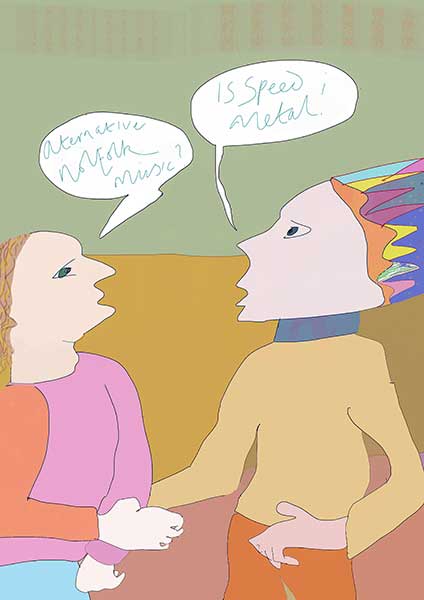
Speed provides the one genuinely modern pleasure.
– Aldous Huxley
The history of Norfolk speed metal is usually traced to the late 1970s, when a small network of musicians scattered across Norwich, Great Yarmouth, King’s Lynn, and the market towns of the county began pushing traditional heavy metal to increasingly frantic extremes. Isolated from the established rock scenes of London, Birmingham and Manchester, Norfolk’s metal enthusiasts relied on tape trading, local record shops, and word-of-mouth connections. This relative isolation helped foster a distinctive regional sound that blended the raw energy of punk, the technical ambition of heavy metal, and a fascination with the landscapes and folklore of East Anglia.
Most historians identify the Norwich quartet Iron Fen as the movement’s first major catalyst. Formed in 1978 by a group of college friends, the band became known for rehearsing in a disused agricultural warehouse on the outskirts of the city. Their performances were notable not only for their speed but also for their unusual lyrical themes, which drew inspiration from fenland legends, abandoned churches, and the harsh weather of the North Sea coast. Their independently produced 1980 demo tape, Harvest of Steel, circulated widely through Britain’s underground tape exchange network and earned a reputation as one of the fastest heavy metal recordings of its era.
Iron Fen’s success encouraged the formation of numerous local groups and by 1981 a small but active scene had emerged. Among the most important early bands were Fenfire, whose twin-guitar attack became highly influential; Cromer Fury, known for combining surf-town imagery with aggressive speed metal; and The Black Turnstone, whose darker and more atmospheric sound anticipated later developments in extreme metal. These groups regularly performed in village halls, youth centres, working men’s clubs and university venues throughout Norfolk and neighbouring Suffolk.
As the scene expanded, a network of dedicated supporters developed around it. Independent promoters organized all-day concerts, local fanzines reviewed demo tapes, and specialist record shops imported obscure metal releases from Europe and North America. The county’s remoteness encouraged cooperation rather than rivalry. Musicians frequently shared equipment, exchanged band members, and collaborated on recordings. This sense of community became one of the defining characteristics of the Norfolk scene.
The movement reached its creative peak between 1983 and 1986. During these years, the annual East Coast Metal Rally attracted audiences from across eastern England. What began as a small gathering of local bands grew into a significant underground event, featuring marathon performances and showcasing new talent. Many future musicians later recalled attending the festival as a formative experience.
The Metal Rally in Norfolk wasn’t just an event – it was an experience. We shared
stories, made new friends, heard amazing bands, and left with memories that will
last a lifetime and remind us why we love this music.
– Dave Grinstead, “Windmills, Water and Wigout”
The most successful band of this golden era was Storm Lantern. Formed in Great Yarmouth in 1982, the group combined the speed and aggression of the local scene with unusually sophisticated songwriting. Their landmark 1984 album, Wind Over the Wash, became a cult classic and remains one of the most celebrated recordings associated with Norfolk metal. Contemporary reviewers praised its rapid guitar work, dramatic melodies, and vivid evocations of East Anglian landscapes. Although the album sold only modestly, later generations of fans and collectors came to regard it as a forgotten masterpiece.
Several other notable groups emerged during the same period. Wrecker’s Moon developed a more melodic approach, while Saltmarsh Reaper experimented with increasingly complex song structures. The Norwich-based outfit Red Beacon gained attention for theatrical stage performances which incorporated maritime imagery, fog machines and elaborate lighting effects inspired by lighthouses. Together, these bands broadened the stylistic range of Norfolk speed metal while maintaining its characteristic intensity.
By the late 1980s, however, the scene began to fragment. Some musicians moved toward the emerging thrash metal style, while others embraced more commercial forms of hard rock. Changing musical tastes and the closure of several important venues further weakened the movement. Many of the pioneering bands disbanded, leaving behind only a small catalogue of recordings and a devoted following of enthusiasts along with some critics:
Norfolk Speed Metal is now only performed by overweight men with greasy hair
who stomp around the stage like it’s a muddy field, striking their instruments and
shrieking as though somebody has drunk all their cider or stolen their sheep.
– Kevin Gilbert, The Aylsham Gazette
Despite its decline, Norfolk speed metal continued to exert influence. During the 1990s, younger East Anglian bands rediscovered the old demo tapes and independently released records. The so-called “Second Wave” groups, including Marsh Viper and Cathedral Storm, openly acknowledged their debt to the pioneers of the previous decade. Reissues of classic recordings introduced the scene to international collectors, who were drawn to its unusual blend of speed, atmosphere, and regional identity.
Academic interest emerged in the early 2000s, when music historians began examining local metal scenes that had been overshadowed by larger national movements. Norfolk speed metal attracted particular attention because of the way it transformed the county’s geography and folklore into a distinctive artistic language. Rather than imitating urban industrial imagery, Norfolk bands wrote about estuaries, windmills, sea defences, ancient earthworks, and coastal storms. This gave their music a sense of place that distinguished it from many contemporaries.
Today, Norfolk speed metal is regarded as one of the most intriguing regional movements in British heavy music. Although it never achieved mainstream recognition, its combination of technical ambition, underground independence, and East Anglian character has earned it a lasting reputation among collectors, musicians, and historians. Annual tribute events, reissued recordings, and continuing scholarly interest have ensured that the legacy of the scene remains alive. What once seemed like a small and isolated local phenomenon is now remembered as a unique chapter in the wider history of British metal.
.
Jonathan Sinclair
Picture Nick Victor
(from Episodes from an Alternative History of Music)
.