
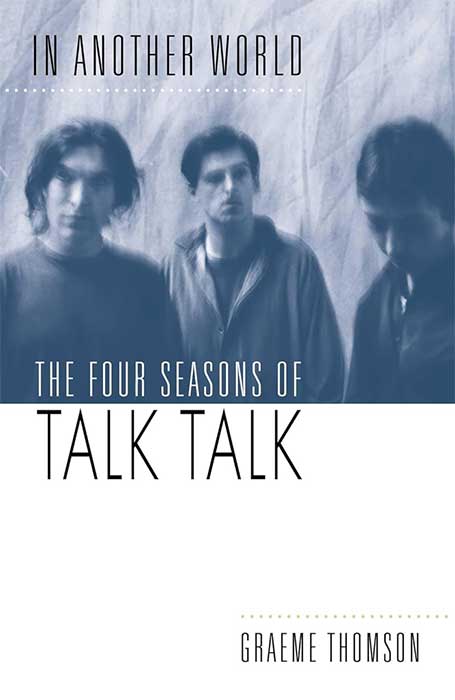
In Another World: The Four Seasons of Talk Talk, Graeme Thomson (New Modern, 2026)
Early rock ‘n’ roll was recorded quickly with raw energy and emotional feel being prioritised over technical perfection. Some musicians, such as Bob Dylan, retain a preference for capturing songs quickly in the studio, often recording a live track with their band on the first or second take. However, as recording techniques developed, the scope for achieving technical perfection increased with a consequent expansion in the time it took to record an album.
Please, Please Me, the debut album by The Beatles, was recorded in 13 hours. By contrast, the studio experimentation and sonic developments involved in Sgt. Pepper’s Lonely Hearts Club Band required approximately 700 hours of recordings. According to Guinness World Records, David Axelrod’s self-titled album holds the official record for the longest time to complete; 32 years and 123 days, having begun in May 1968 with the final remixing only completed in October 2000. The length of time famously taken to record Talk Talk’s Spirit of Eden pales into insignificance by comparison!
The approach to recording used on Talk Talk’s classic series of albums – The Colour of Spring, Spirit of Eden and Laughing Stock – and Mark Hollis’ self-titled solo album were an unusual combination of both approaches. Contributing musicians were asked to perform spontaneously to basic backing tracks but their performances were generally not used as whole performances. Instead, the most interesting elements of the sounds they created were collaged together with clips from other recordings to, over considerable time, form the soundscape of each song.
Graeme Thomson’s In Another World: The Four Seasons of Talk Talk documents the recording of these four albums through the recollections of those involved (a mix of interviews at the time and later conversations), exploring the relationships of those involved and how these developed, approaches to recording, the significance of the songs, the impact of the albums on release and later, and evolving histories of those involved.
Hollis is the creative centre but is reliant on close collaborators, for whom collaboration proves to be demanding as Hollis intuits his vision as it develops, rather than being able to articulate it in advance. In this Hollis is similar to Dylan – who commonly starts songs expecting his musicians to react and respond and who will abandon strong material if he doesn’t sense it gelling in the way he expects – while using approaches to recording that are essentially the reverse of one another.
Hollis, having reached a high degree of commercial and critical success with The Colour of Spring, rigorously and relentlessly pursued his vision in the face of diminishing corporate support and Thomson provides a compellingly exploration of the reasons why he did so, the legacy achieved through these four albums, and the cost involved from those who collaborate with him.
Thomson tells this story well focusing on each of the four albums chronologically but stepping back in time (often through Interludes) to also tell the back story and broadening out to explore music made beyond the parameters of Talk Talk and mutual influences, such as those with Kate Bush. This structure means that the book never gets bogged down in the minutiae of recording techniques or schedules and is always moving in a new and intriguing direction.
While the story of their making and influence is fascinating, Thomson is also adept at describing the music on and the achievement of these albums. He understands and describes both the feel and the technicalities of the music. Just to give one example of the vivid way in which his descriptive prose neatly fits the music it evokes, here he is on ‘Living in Another World’: ‘The song is built as a hairpin ascent, a Jenga puzzle, an ‘Escher staircase’. We climb with the music as the key keeps rising … Hollis … sings of finding a way ‘through this maze’. It is a song where the sound is perfectly expressed in the words.’
At the heart of the unique achievement of these albums are two key elements. One is a move towards space and silence through the influence of aspects of classical and jazz music (including Morton Feldman, Tōru Takemitsu and Giacinto Scelsi). The other is a tapping of the feel and language of Gospel music. The combination of both brings to the music the sacramental and transcendent qualities that have marked these albums out as possessing new and different qualities in the history of rock music.
In describing Hollis’ co-writing with Phil Ramocon of ‘The Colour of Spring’ for Mark Hollis, Thomson describes one moment when these differing influences coalesce: ‘Ramocon was at the time heavily influenced by Ravel and Debussey, and he combined rich chord progressions suggestive of both composers with those from a ‘gospel-music’ tradition. All the music came from him, with Hollis acting a kind of musical spirit guide. I’d play him chords and he would say, “Can you take me from that chord to that chord but without those others in between?” … Again, elimination and essentialism.’
Hollis’ lyric for that song could be viewed a manifesto for his life experience:
I’ve lived a life for wealth to bring
And yet I’ll gaze
At the colour of spring
Immerse in that one moment
Left in love with everything
Entering and remaining within that contemplative moment is in many respects where these albums seek to take us; just as Hollis, himself, had experienced in listening to Van Morrison and ‘Summertime in England’ in particular:
It ain’t why
It just is
That’s all
That’s all there is about it.
It just is.
Can you feel the light?
I want to go to church and say.
In your soul
Ain’t it high? …
Can you feel the silence?
Thomson deals well with the spiritual strand found in these albums, noting both the ‘prevalence of Christian language and imagery’ in the songs and ‘the sometimes jarring disconnect with the sweary bloke [Hollis] ranting about Sol Campbell in the pub’. He quotes Bradley J. Birzer in this regard: ‘there’s a huge continuity of Christian lyrics in what he [Hollis] sings. He might not mean them. He might not have lived them out in his own life. But he clearly strove for something greater than himself.’ Hollis said, ‘In my lyrics is my life’, claiming that they ‘represent the values I believe, on a humanitarian level’. He couldn’t think of another way of singing a lyric unless he could feel it by believing ‘in what I’m singing about’. That, he says, ‘goes back to the Gospel thing’; it’s not that ‘all lyrics have to be about religion but … there must be that kind of thing in it.’
As Thomson notes: ‘it hardly matters whether Hollis used religion only as a writing tool rather than as a lifestyle. The effect is what endures.’ He then, helpfully, references the conversations that Nick Cave had with Sean O’Hagen, collected in Faith, Hope and Carnage, to speak about the ‘deeply spiritual space’ in Hollis’ work as ‘an “impossible realm” where glimpses of the preternatural essence of things find their voice’. In addition, it is also worth noting that the roots of rock music are to be found in a merging of gospel, blues, and country (the latter two both also having a gospel strand within them). As a result, those who, like Hollis and Cave, open up streams of spirituality in their music are, in reality, only returning the music to its roots.
In Another World: The Four Seasons of Talk Talk is a biography of four records. In the case of Hollis and Talk Talk it is not really possible to write a full biography of the musician or the band as so many of those involved cannot or will not talk about their experiences. That leaves the music, which is Thomson’s main focus and, also, where our focus should ultimately be. He wisely leaves the last word to Hollis: ‘Sometimes I don’t know what to say when I get asked all these questions, because for me the music says it all’. The greatest recommendation of this book is that in it the music speaks again.
.
Jonathan Evens
.