

Black Bag, Luke Kennard (John Murrays)
Black Bag is a perverse campus novel where the self-obsessed narrator, an out-of-work actor who has taken part in too many murder mystery events at hotels and parties, gets an odd role as a silent black bag in Doctor Blend’s psychology lectures and seminars. It is unclear why or what for but since Blend produces wads of £20 notes in addition to putting his employee on the institution’s payroll, our narrator mostly gets on with the job.
Black Bag is a book about degredation, self-regard and daydreaming. Whilst Blend talks and the students discuss, our narrator turns to his inner and imaginary life, creating a number of scenarios and characters to allow him to escape, at least mentally, the confines of his role. Of course, he has made the role both his own and worse by travelling in his bag and choosing to be naked in it. He adds d.i.y. interior pockets for his travelcard and journal, so he can truly be the bag. Method acting.
Black Bag is a manual for entrepeneurism and monetization. The narrator’s friend, Claudio, appears to be a kind of Canute, able to extract wealth from gaming, friends and contacts, abstract concepts and – like all the most succesful rich people – complete bullshit. Of course, he has little to spend it on except for new games to play and stream to his demanding audience, takeaway meals, drugs and drink. He is obsessed, permanently tired, and a kind of metaphor for addiction and ambition. He also appears to be a generous and true friend.
Black Bag is about male ambition and self-delusion, desire and subjugation. The narrator is sexually abused by Justine, a professor at the university, who makes him the ultimate faceless fetish, something she can project her own fantasies on. ‘Professor Justine Pearce could maybe pass me off as her Trauma Animal,’ he thinks, as she proposes taking him to a BDSM club where he will fit right in. Claudio holds forth about young men who have lost their identities, about art and ambition. He cares, he really cares, but it is time to clock on to the internet again and show his customers how to work their way through the latest online game.
Black Bag is hilarious, laugh-out-loud comedy; but it is also sad and unnerving. The only character in the book who actually speaks any sense is the narrator’s parents’ dog, Elliott (who is of course ventriloquized), when taken for walks to escape his parents whenever the narrator visits. Otherwise the narrator simply plods along, accepting what happens, taking turns to be pathetic, lustful, hopeful and content. Mostly though he seems lost inside himself, unable to control the associative chains of thought that the everyday triggers.
Black Bag is ludicrous. Like the narator’s stories, jokes, puns and asides, the novel is mostly populated by people who are mostly incoherent and irresponsible. The narrator’s information dumps and statistics are conjured from thin air. He is erudite and literate but in a stupid way: lines from poems are decontextualised and inserted into already incoherent sentences. They are a little bit like classes given by worn out university lecturers. ‘I thought I could help people find meaning in their lives,’ says Dr Blend, ‘We’re supposedly the finest minds in our respective disciplines but we’re required to spend most of our time boring hungover teenagers to sleep.’
Black Bag is a riff on an actual experiment that was done at Oregon State University in 1967. It is an extended riff, with variations and asides. It is about lonelines and selfhood, friendship and failure. It is about the collapse of society, the move from analogue to digital, from the 20th Century to the 21st. It is about bewildered, lonely, people – especially men – who are uneasy in this world where they do not know who or what they want to be, and cannot be who or what they want to be anyway. Except, of course, our narrator in some strange way achieves some of his ambition: wealth and an audience. It may not be enough in the long run but it’s the least he deserves.
Black Bag is surreal but also true-to-life, which I guess is what surrealism does: take things to extremes to show how amusing/ridiculous/silly/dangerous our world is. The book’s narrator sometimes feels too close for comfort in the way he tries to navigate the world and escape himself. He is a privileged, educated buffoon whose privilege and education are no longer fit for purpose, just as Dr. Blend’s knowledge is out-dated and holds no interest for his students. Adapt, mutate, survive. ‘I wish to be alive, to continue to live, even should that mean a state of constant deferral,’ says our narrator towards the end of the book. ‘Our only assumption must be that everybody else’s life is more meaningful than our own.’
Black Bag, however, shows that nobody’s life is any more meaningful, everyone is as foolish, deluded and funny – funny peculiar and funny ha-ha – as everyone else. Perhaps Elliott has the right attitude and knows best: I would do whatever was asked of me in the moment to survive. Basic instinct. Survival of the fittest. Satire. Parody. Spoof. Facetiousness and witticisms. Kennard has done it again. Black Bag is superb.
.
Rupert Loydell
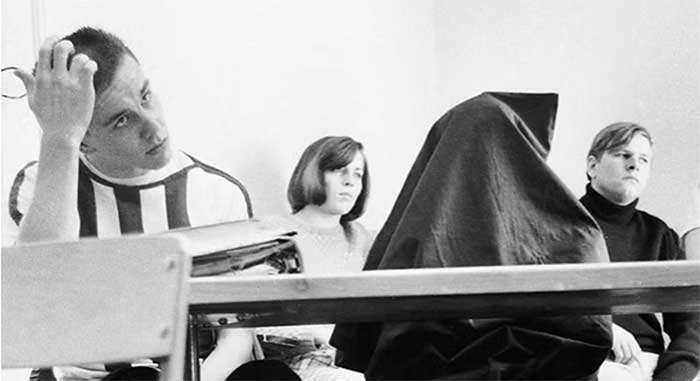
Oregon State University, 1967.
.