
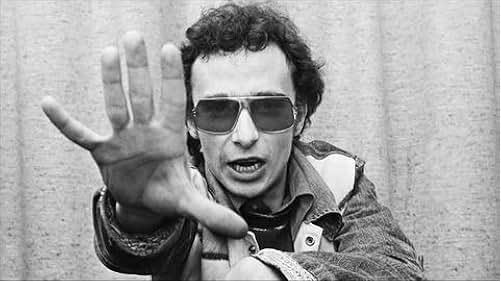
When I was trying to think of a title for this interview I was wondering if I should include the word Rumour. Just in case anyone reading Graham Parker needed a searchlight to find their way into the interview and be enlightened as to who I was talking to within the next fourteen pages.
No, I think we can just put Graham’s name up there – imagine them in lights if it helps – and let’s just get on with him sharing his thoughts on life, books, lyrics and music. Probably in that order but overlapping and still stretching into the future as Graham is just about to embark on a solo tour of the USA, which will be followed by the one in the UK.
After reading my mini memoir I’ll best step back and let the legend that’s Graham Parker speak for himself. I quote this bit from the interview where his music and lyrics first came into my life many years ago:
“As I said in one of the emails I sent to you – I first heard an album by you back in 1976. I was working in an Asylum (as they were called) and I was probably sitting around in a mate’s flat chilling out, no doubt smoking joints and drinking, and this guy puts your album Howlin’ Wind on and I’m like: “Wow, the music’s fucking great” and then like the aftershock that follows an explosion, there was a second wave and then the lyrics hit me…”
Over to you Graham
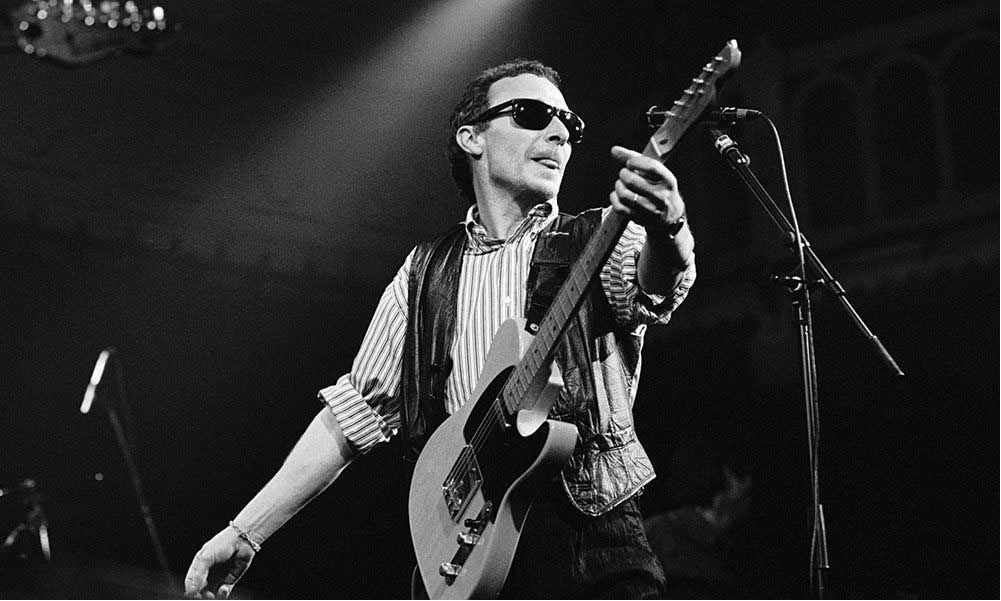
MP) I just spent a Bank Holiday reading your book of short stories Carp Fishing on Valium and your novel Thylacine Lair. I enjoyed them both, especially Carp Fishing on Valium.
The Thylacine Lair was a literary freakout, which made my head spin a bit even though I was sitting in the shade.
I was surprised because when I sketched out a plan for this interview I didn’t expect to be reading books by you and I would be just concentrating on Graham Parker’s lyric writing and music.
Am I right in thinking you had a great time writing it?
GP) I wrote the Thylacine’s Lair first, then got a taste for writing and having enjoyed the results so much I continued and came up with the short stories which were first published by St Martin’s Press whose offices were in the famous Flatiron Building in New York, near where I lived in Manhattan at the time. The novel began with just a chapter, “An Unsound Man” which I thought was a short story in itself but gave me the idea for a complete novel. I was possessed with this method of creativity, thoroughly enjoying not having to put music to the words and make it rhyme. It suddenly felt like a man’s work, and songwriting was just a boy’s work. Very odd!
The Thylacine’s Lair was published by Thunders Mouth Press under the name “The Other Life Of Brian.” Not unexpectedly, both my literary agent and the publishers baulked at the original title. When I got the rights back to both books my website manager who had started a small imprint named Tangible Press published them, and I gave the novel its original name back. “Carp Fishing On Valium” is the superior book, but “Thylacine” gave me the most laughs. It’s quite silly, frankly!
MP) You have said in another interview that you liked “having fun with words”. In what way? Could you say more about that?
It certainly comes across that way, since both books were written when you were in your fifties – post 2000 – it makes me wonder if you were thinking: now I can just get the typewriter/pen out and have some fun.
What was going through your mind when you decided you wanted to write books at that stage in your life?
GP) Writing, whether songs or prose, seems to make me much more intelligent than I really am. I’m a recipient of the British Class System education, but unlike many people I still know from childhood, I did not become a victim of it. I was always good at writing and if a teacher got us to write essays or poetry, I’d always win the top spot. Academically, of course, the secondary modern school I attended didn’t leave me with much, apart from my innate talent. I was just naturally good at writing from a young age and always got pleasure out of it.
Both books essentially began on a Swedish tour in the 90’s when I had lots of days off between gigs and filled the time sitting in a hotel in a weird residential area of Stockholm. I continued the work when back in New York, and was off and running.
No idea, really. I’ve always read a lot, but I think I was just going through yet another wave of creativity that I couldn’t ignore, very much like before my career began and throughout my actual career. When I was still doing working class jobs, the last of which was petrol pump attendant at a filling station just around the corner from my parents house where I was living and had the time and peace to write song after song, the songwriting still did not seem enough, so I sat in the petrol station between customers and wrote an entire comedic sci-fi novel called “The Great Trouser Mystery,” an inner and outer space fantasy. Many years later – in the late 70’s, I met an illustrator who called himself Willy Smax and got him to illustrate the book, which was published by Wyndham Press. It was a coffee table type book, large, and packed with colourful illustrations by Willy. It might still be found on eBay for an extortionate price.
MP) Is that something you might feel with your music, as well as your writing – ‘I’m just going to do Ska/Soul or Blues whatever, because that’s what I feel like doing, so now I’m going to write a couple of books.’
Perhaps you are still writing stories/books? Any comments?
GP) My literary agent who represented me for “Carp Fishing” and “Thylacine’s” has been prodding me lately to write a memoir, but I’m not biting. In some ways, I feel I already did that with “Carp Fishing,” I just fictionalised it – much more fun! But all the characters in both that and “Thylacine’s” are composites of characters that I’ve known at various periods of my life, and experiences I’ve gone through. It’s not that different from songwriting whereby I take a grain of reality and blow it up out of proportion. It’s all a lot of hot air, really!
MP) Are you an impulsive creator?
GP) I’ve slowed down considerably – we get old, and that’s that. It’s not urgent to me now, I’ve done enough. But, having said that, I’ve got the makings of enough mostly unfinished songs to make an album, but feel no urgency to pull the trigger on them and make them whole.
MP) Is it more a restlessness or a focused way to create? There is plenty of evidence that musically throughout your career and most recently with your latest album The Last Chance to Learn The Twist you don’t believe in getting boxed into doing the same thing creatively or any variation on the same. So what goes down on paper or musically could be whatever you fancy doing. Would you share some thoughts on that?
GP) I have little control over the matter for the most part. I do exactly the same as I’ve always done: mess around with a guitar, sometimes with a few vague lyrical ideas to give me a launching pad, sometimes not. Much of the time it goes nowhere, but enough of the time I feel there’s something there, some slight adjustment to the phrasing or chord structure that I’ve accidentally arrived at by persistence or luck, some rhythmic quality that has excitement to it that pushes me on. It’s more often the feel of the groove that gets to me, more than the lyric. The words grow into that groove and then the real grunt work comes into play – adjustments, minor or major shifts in the words, trying to figure out what resides in a fragment of the possible lyrical bent of the song.
It’s not uncommon for me to have two or three different lyrics to the same piece of music – sometimes whole songs emerge and then I lean into which version appeals to me the most.
It’s still a mystery. I don’t know what I’m doing, I’m just doing it.
MP) Have you gone through life consciously thinking I don’t want to be labelled or is it instinctive to the way you think and feel?
GP) Well, I wanted to be known as a “moody boy” when I was 15 and I wanted to be known as an enthusiast of cannabis and acid and a real “freak,” a “head,” when I was 18. I was fine with tribal differences in those respects and in other periods of my life regarding what could be called, in narrow terms, “fashion statements.” But by the time I finally had the right songs written and was hell bent on making an album and therefore becoming a professional singer/songwriter/musician, I had so many influences that contributed to those 12 songs, and indeed my life, that any labelling would be a careless and lazy way to evaluate what I’d put forward into the public domain. Of course, music journalists have very little to work with if they can’t express their opinions in the form of labelling, and therefore cannot help themselves but try to box things up neatly for the reader. That’s understandable – print isn’t music.
I’ve always felt like a variety act, from the first album. It was all there, from one song to another, from “Lady Doctor” to “Don’t Ask Me Questions,” and everything in between. Labelling doesn’t cut it for me. For sure, I’m not about to come up with anything that sounds like Kraftwork!
You can tell some of my influences of course, that’s a no-brainer. I grew up in the 60’s and 70’s, simply put, and I had no intention of leaving that behind – I wouldn’t know how to, it’s in my blood.
MP) Do you feel free to do whatever you want to do in your life and work?
GP) As far as making records is concerned, I owe nobody but myself anything. I always do my very best to continue to release high quality work, whatever way the songs and records lean lyrically, musically and texturally. As for my life, I have great interest and curiosity from one day to another, mostly in ways that have little or nothing to do with my career. I could spend the rest of my life without picking up a guitar with no end in sight to the possibilities outside of work in music. None of it’s going to make a living for me, though, like music has done, but in these days of streaming rates and pathetic record sales for the vast majority of us, producing albums isn’t going to make a living for me either!
MP) What was your relationship with the publishers? Did they give you a lot of freedom and not interfere in the editing too much?
GP) I was signed to St Martin’s Press in New York by a guy named John Cunningham. He was a bit of a fan and my literary agent got the manuscript of “Carp Fishing On Valium” for him and he loved it. I got a nice advance and when the hard copy sold over 10.000 in America they published it in paperback. Scribner picked it up in the UK and also paid about the same advance money, but I knew it wouldn’t get off the ground in Britain. We have a press here that longs to crush artists for going beyond their realm. I think I saw one “review,” if you could call it that, in the Daily Mirror, or the Sun maybe, a place where I would have never expected to see it mentioned.
The lady who “reviewed” it actually only reviewed the blurb, which of course I didn’t write! She took extreme umbrage at the line “Parker has rocked our world for 40 years” etc., or something on those lines. Apparently, I had never “rocked her world” ever, so she killed the book just for that! America, as always for me, was much more favourable and I got a fantastic write up in Publishers Weekly, the bible of literary agents and publishers.
As for the editing, Laurie Fox, my agent from the Linda Chester Agency teamed me up with a writer who worked very well with me – in fact he called me “The Mark Twain of the English suburbs.”
That’ll do nicely, I thought! We were in a literary sense simpatico and nothing was Americanised at all, just either trimmed or expanded on here and there.
MP) Do you think the same could be said when it comes to record companies?
GP) One thing I found frustrating with book publishing companies: after the book is released, the phone stops ringing. They could learn a lot from even the smallest Indie labels about how to promote a creative product, even those with not much of a budget. Perhaps it’s improved in these digital days, I don’t know…
I’ve always from the start had complete control over the records. Producers, musicians, the studios I’ve wanted to work in, everything.
MP) What was going through your mind when you decided to break away from the style of writing you use in your lyrics and start writing books?
GP) Nothing in particular, I was as usual reading a lot before I got stuck in and wrote both The Thylacine’s Lair and the Carp Fishing On Valium stories. Much of the work was done in a hotel suite in a rather suburban part of Stockholm. I did a number of tours there with a Swedish promoter who also had a backing band. I got wind of this set-up from none other than guitarist Mick Ronson. He was living in the Woodstock area of upstate New York when I was living there and we met by chance at a barbecue. He came up to me and said: “Graham, I’ve been looking for you!” Then he explained the Swedish connection and said he actually played in the Swedish backing band. Mick Ronson, in my backing band? Count me in! Mick was living in the Promoter’s flat in Stockholm part time. Mick unfortunately was diagnosed with cancer by the second tour we did over there, but I carried on with the Swedish set-up after Mick couldn’t do it anymore and one of those tours wasn’t picking up too many gigs so I had all these midweek days off and plunged into writing prose like a man possessed. I got a great deal done and once back in New York State continued at a fair clip.
MP) It’s been suggested somewhere (Goodreads perhaps) that reading your books is a good place to get to know Graham Parker better – the person behind the music/lyrics and the on stage personna. How would you react to a comment like that?
GP) In some ways perhaps that holds a bit of water. Some of the stories in “Carp Fishing” recall my youth, especially the first story of the collection, “The Sheld-Duck Of The Basingstoke Canal,” which was based on the truth, just fictionalised, but not all that much. People seem to be amazed at my love, study and knowledge of nature. They seem to think I’m some kind of “street-wise” bloke, but I grew up with the Surrey countryside all around me and spent my happiest times out in the woodlands and heathlands, immersed in the natural world.
MP) Do you feel exposed when you write, especially when you write personal lyrics? Does it make you feel vulnerable?
GP) There is an element of vulnerability in songwriting, but like prose, I fictionalise song lyrics to some degree, even if the original idea sprung from something personal. It keeps it interesting to me and I don’t want to come over as being maudlin or in the “oh, woe is me” syndrome.
MP) As I said in one of the emails I sent to you – I first heard an album by your album back in 1976 –. I was working in an Asylum (as they were called) and I was probably sitting around in a mate’s flat chilling out, no doubt smoking joints and drinking, and this guy puts your album Howlin’ Wind on and I’m like: “Wow, the music’s fucking great” and then like the blast that follows an explosion, there was a second wave and the lyrics hit me.
All the songs are absolute dynamite:
“White Honey” – 3:33
“Nothin’s Gonna Pull Us Apart” – 3:21
“Silly Thing” – 2:51
“Gypsy Blood” – 4:37
“Between You and Me” – 2:25
“Back to Schooldays” – 2:54
“Soul Shoes” – 3:13
“Lady Doctor” – 2:50
“You’ve Got to Be Kidding” – 3:30
“Howlin’ Wind” – 3:58
“Not If It Pleases Me” – 3:12
“Don’t Ask Me Questions” – 5:38
I just thought they were so good that they seemed to cut deep through the loud punchy music. They just ride along on the music perfectly. I wasn’t sitting there like they tend to do now and stick labels on the type of music that you were making.
Does it amuse or annoy you the way the music press is running around trying to put you in one musical category or another?
GP) As stated earlier, categorisation is normal when it comes to the press or just plain people come to that, when they try to describe any kind of music to someone. It can’t be helped, and if you tell a friend that you’re really into an artist you’ve just heard and you try to give them a reference point in the general style of this artist, you’re most likely to mention other musical acts for comparison. In any event, they’re most likely to ask, “what’s he/she/they like? What kinda stuff do they do?” If they haven’t heard them before they’re going to ask you to describe what the music is like, and you’re probably going to have to make a comparison or two. It’s just the way it goes.
MP) Pub Rock, Pre Punk, Punk, Blues and R&B were all evacuees like you, that needed a tag around your neck so you wouldn’t get lost when you got off the train. Any comment on your relationship with the music press?
They didn’t exactly back you up much when you went solo with Another Gray Area. Did you feel they were being unfair?
I think in the following years the critics as opposed to the listeners seem to have become more accepting of your musicDo you feel that way as well?
GP) When it comes to Another Grey Area, the Americans didn’t even blink. They took me for what I am – a creative artist who is not going to repeat themselves or try to regurgitate older work. It got really good reviews in fact. The British were bound to complain and say I’d gone “soft” or was “desperately” trying to be more A good deal of American fans still see Another Grey Area as a good piece of work and to more than a few it’s up there with my finest. I take that particular record at that value, from people who liked it and still mention it to this day.
MP) Back to the lyrics. They always struck me as being like vignettes – short stories that paint a very distinctive picture of people going about their lives trying to deal with all kinds of shit like damaged emotions and broken relationships. You yourself in a band and dealing with being a Star, all the pressure. Was/is writing songs a big pressure valve? Do you feel that’s a fair observation?
GP) I’m fine with your assessment above, it’s not far off I suppose. In some ways every album is a bit like opening the valve and letting a bit of pressure There’s a bit of a cathartic release going on.
MP) You used to be branded as an ‘angry man’. To me it sounds like an artist just telling it the way it is, as if you are in a pub and you realise you’ve had too much too drink but you are just going to tell it anyway, without giving a fuck about what the rest of the bar thinks.
Are you aware of being fearless in saying whatever goes through your mind and fuels your imagination? Do you sit back afterwards and think – that’s a load off my chest?
GP) In 1976 there weren’t any latent contenders for the angry young man slot, so I didn’t mind that much, even though it’s obviously limiting. Back To Schooldays for instance was a great critique of British class system education, as I’ve mentioned before. It turned out, though, that I was not a victim of it. I think as far as getting a load off my chest is concerned, or being fearless, actually getting a record deal and making an album and seeing the reactions it got was more a relief than writing the songs. I wanted them to be heard by people.
MP) I used to think your songs were like ‘Kitchen Sink’ mini-novels and short stories updated to Raymond Carver’s Short Cuts (film and book) perhaps.
It’s definitely lyrics that the ordinary working class people in the street are going to identify with. Problems with a partner – hassle at home – at work. If all those tensions make you/anyone angry then I think you succeeded in getting a message across to listeners. That must make you feel good when the people turning up at the gigs were sending out a message that they could relate not only to the music but what you were singing about. How does that make you feel?
GP) They way I see it, once my songs are out in the public domain, they’re fair game. Fair game to be understood by the listener in whatever way suits them. Fair game to be criticised or loved, for whatever reasons. The way people interpret what they hear in my lyrics I usually find so way off target it’s not even funny. I have all kinds of fans – they’re more of a mixed bunch than just working class, most in fact I find to be much more sophisticated in their thinking, but they still come with their own personal way of processing it and it’s often not in the way imagined.
MP) Is it like Blues/Soul songs telling a story just in the few minutes that are allocated to your average track?
GP) Well, the discipline I was adhering to on Howlin’ Wind and mostly from then on, was to make three minute pop songs. No jams or fillers, everything concise and interesting with one song using a different style from the last song but all working towards the same end.
MP) I was listening to Sam Cooke’s albums the other day and I thought that the lyrics were like a book of short stories. They are compact but they are not just the same old love songs with no story, which don’t create a picture in your head of any kind – not like you get with Blues and Motown/Soul in general. An author friend of mine (Michel Faber) when I discussed my ideas for the interview with him, sent the following email. Do you think it’s a fair comment?
“I’m generally wary of big generalisations. I think some Soul and Blues songs are “story” songs, and others are just repetitions of exhortations and catchphrases. I personally would not be confident to assert that a songwriter like Graham Parker was channelling the “narratives” in Soul and Blues songs he admired in his formative years. He must’ve admired all sorts of stuff in his formative years. He might be channelling Paul Simon’s The Boxer or Paul McCartney’s She’s Leaving Home for all I know.”
GP) That’s not bad. I was expressing myself, not trying to express Otis Redding or a Holland Dozier Holland song, etc. That would be merely the work of a stylist or copyist. I was always going to be an original in that sense. And for sure, I was and still am – for want of a better word – “channeling” more than any one single genre in song after song.
MP) Which was ironic because at the same time in another interview with the Welsh born author Rachel Trezise I asked her about what kind of music she had in the home growing up in the Rhondda Valley, especially what she was listening to and she said this:
“There was some Shirley Bassey! And lots of Tom Jones. Yes, what my house lacked in books it made up for in music. My brother was really into punk, so I inherited a lifelong love of The Clash from him. And my mother loved country music; Dolly Parton, Bobbie Gentry, Tammy Wynette, Loretta Lynn, Johnny Cash, Kenny Rogers, Conway Twitty, all of those huge names from the 70s. I loved that there were stories in that kind of songwriting. The songs had plots and twists and real narrative drive.”
I know you are quoted in interviews, talking about the music you used to listen to and your early influences. Do you think there is this connection Rachel talks about when she lists her mother’s listening and the way you yourself write songs through your writing career?
GP) In as much as every piece of music a songwriter hears throughout their lives is taken in and both absorbed and observed, yes. I was doing this before I ever picked up a guitar, hearing all those 50’s tunes and earlier acts. My writing was of course based more closely on the period of time when the beat groups appeared just as I was twelve years old, going on thirteen. Simply put, the Beatles and the Stones and all those so-called beat groups. The Bing Crosby and Doris Day music from that previous general era that I heard on the “wireless set” was all taken in and appreciated when I was very young, it just wasn’t likely to be any overt influence, unlike hearing “Please Please Me” or It’s All Over Now” when I was about thirteen. Now that was going to make me want to play guitar and possibly, one day, write songs.
MP) Some of your song lyrics are as good as any poetry I’ve read over the years.
No More Excuses
Hey no more excuses I made them enough
I said hey no more excuses it’s time to get tough
Every step is another chance every moment slips through our hands
Every kiss is another flame I don’t want to put out
Every night when I fall asleep I know I never want to wake up
Into a world where you’re not around can’t let you down
Watch The Football Moon Coming Down (hang on where did you get “Football Moon” from?!
Very funny anyway!)
In this dirty town there’s nothing going for me
No shows going down that I would want to see
Nothing but the midnight train
In this shady street on a top floor flat
Women take their sheets down to the laundromat
And as the night falls on this town
I’m going to watch the moon come down
Watch the moon come down
I’m gonna watch the moon come down
Watch it come down
If there was a crack between your lyrics and poetry I wouldn’t be able to get a playing card in.
Do you consider yourself a poet as well as songwriter, novelist, musician and performer?
GP) I generally find poetry incomprehensible, but I don’t mind the use of the word “poetic” at all. My lyrics could certainly be described as that. But I just can’t help but see it as integral to the chord structures, melodies, delivery and rhythm, and I don’t detach them.
I’m thankful though that you can appreciate them in that way, that’s good.
MP) I interviewed Liverpool poet Brian Patten once about his poetry and the poetry of the Mersey poets (Roger McGough and Adrian Henri) and I asked him about his and their influences.
He said this in response to a question:
Me) Did you think poetry was being communicated in a different way back then? Perhaps with a bit of help from the radical immediacy and simpler writing approach of the Beats?
Brian) I would say that our language was common speech and our audience in the early days were not really students, but the working young.They would come to our gigs one night and go to the Cavern the next. We even did occasional gigs at the Cavern ourselves.
How important do you think it is to keep close to the folks on the street? Is there still some of the EastEnd Londoner in you?
GP) I was only in London for the first four years of my life but grew up in what I think of as a fairly bucolic environment in Surrey. I’ve lived in America more than I’ve lived in London, so I don’t see being a born Londoner as any influence at all. There again, now that I think of it, there were many Christmases and holidays and other events when I’d be in the presence of my mum’s side of the family (lots of aunties!), common as muck Londoners who thought everyone else was as common as muck, but not them (!), so that surely had an effect. Not to mention that all the working class kids and some of the more middle class kids that I grew up with in Surrey spoke like London yobs, really harsh and crude in fact. Maybe Deepcut was closer to London than I thought. I probably choose to recall being surrounded by nature, as I was, and being immersed and sometimes obsessed with it as my overriding impression.
MP) I’m sure I read once that you were compared to Bob Dylan and Bruce Springsteen – I don’t know if they were just talking lyrics or music – perhaps both. Lyric wise probably no more so, than anyone else writing songs and coming out of the 60s influenced by Dylan. Any comments on these speculations and comparisons?
GP) I didn’t listen to an entire album by Dylan until “Blood On The Tracks” which I think came out the year my career began. I’d heard plenty of Dylan from his beginnings, either on radio and other sources like films, TV shows, places where his work might have featured and of course endless covers of his songs by so many acts, but strangely, I can’t think of one single group of people who I would get together with to listen to records ever putting on a Dylan album. Very weird, I find that. Still, I would only have to hear any Dylan song anywhere to take in a lot of influence from his work. “You’ve Got To Be Kidding” from my first album yells Dylan influence, so powerful is his work, but I never immersed myself in it like I did with Van Morrison. Van’s work is much more influential to me because I listened to a lot of it around the time my best songwriting kicked in in the three or four years leading up to my career. Dylan has long been supportive of my work to some small extent. Inviting me and the Rumour to appear on the mighty Blackbushe Festival in 1978 and in 1991 getting me to open solo for him on a European tour.
MP) If you were going to be compared to any songwriters, who would you be comfortable being compared to?
GP) I’m a multi-influenced pop songwriter, but I’ll take Dylan, Van and Jagger/Richards and Lowell George if you want to compare me with anyone, even though they’re all on a whole other level than me. Nobody’s that good, to this day.
MP) One of the many powerful lyrics you have written is – there are many – You Can’t Be Too Strong. I have to ask whether you would play this song in America where you live in an era that saw Roe V Wade overturned by a right wing – Pro Life Supreme Court?
GP) It’s an observation of an event that is bound to have some complicated weight attached to it. I play it from time to time in my sets – I did so in fact on a tribute show to our keyboard player Bob Andrews after his death. I sing it on some tours in America. Much more relevant is my fairly recent song “Coathangers” from “Three Chords Good.” Even when I wrote that song I was just referring to the fact that every time the Republicans get in a tight race against the Democrats they love to pull the abortion morality theatre script out in an act of desperation, but I never in a million years thought it would ever happen…and then came Trump and three evangelical Supreme Court justices, and there it was.
MP) I don’t know how much you were reading when you were young. Was reading an early habit, and did you grow up in a reading environment?
GP) My parents were not far from illiterate but I took to reading very early on. I’ve still got the “Observers Book Of British Birds” 1963 edition which I read frequently at age 12 or 13 and I was always good at English at any age and in every school I attended, although I’ve never learned the rules in any technical basis, but if there was an class essay competition I’d win it. Also, circling back to poetry, when the English teacher called for a poem from everyone, I’d win that, too. I was just good at words and skilled at putting them together. I didn’t need any classes in English, I was a natural, so I read a lot.
MP) You said in that delightful interview you had with Logan (watch that young man go places) that you always had three or four books on the go. Is that still true?
GP) Quite often I do. I use a Kindle mostly – they’re great for the touring musician – so it’s portable and I’ll often download and start a new book whilst reading another one or more.
MP) Was there music in your home? If so, what kind of music?
GP) We had one of these giant old wooden radio sets with the drinks cabinet underneath and music was often on, especially before we got a TV set. It was mostly American stuff with a few old English music hall tunes mixed in. Doris Day, Bing Crosby, Danny Kaye, Nat King Cole, Duke Ellington – all that great stuff. A good deal of my occasional jazz influenced tunes like “Lady Doctor” on Howlin’ Wind shows clearly how all that stuff on the radio crept into my musical consciousness.
MP) You don’t seem to have been impressed by school. You didn’t seem to think it prepared you for the “horrors” of the real world. True?
GP) Well, “Back To Schooldays” makes it pretty clear that I realised at some point that I was doomed for the bottom end of the class system education and was born to be kept there. There were some good teachers at Chobham Secondary Modern School,they did good work, but the curriculum was designed to funnel boys into being mechanics or working in factories and girls were heading into “the typing pool” where being a secretary was seen as a high point.
MP) You seemed to be more keen on dressing up as either the Beatles or The Rolling Stones and mimicking them despite none of you being able to play a musical instrument. Does that seem a bit odd looking back? Like playing air-guitar or something?
GP)No, that seemed typical at the time. Once those beat groups arrived the fashion statement was more important than learning to play, which was a good deal harder than just looking cool!
MP) Was there anything in particular that you didn’t like about school or you just wanted to get out and do other things? I was expelled at 16 for doing all kinds of rebellious stuff – especially my written work – so I could understand why school could be a problem. Is that why you headed off to Guernsey and picked tomatoes at a friend’s uncle’s place? (which didn’t work out).The upside of being in Guernsey according to Wikipedia is you bought a guitar and began writing songs/lyrics that were ‘psychedelic‘. So it was a positive experience in other ways?
GP) I went to Guernsey because I thought at age 18 that was what you should be doing – getting out in the world and expanding your mind. The suburbs/country had become boring and stifling and working at the Animal Virus Research Institute in Pirbright – my first job when I got out of school – became sickening to me and I couldn’t see anything good about staying there. Yes, I was introduced to psychedelic experience in Guernsey which was profound, and I needed to express it through words in some way or other. Being naturally musical I really started to knuckle down and learn to play guitar, and songwriting came with it. I was ready by then and wrote like a fiend from then on, finally developing my own take on it and finding my style, which I’ve always thought was multi-influenced and was inclusive of everything I’d absorbed since I was a little kid. It all came into play, still does.

MP) Then to a factory making rubber gloves, purposefully living away from your parents. Were you building up towards the ‘Big Break’?
GP) I was never completely sure of what I was after, other than writing songs and learning the craft as well as I could without much experience in live performances. After my Guernsey period I moved to Chichester to live with a cousin and his wife and son. I couldn’t stay for long in Surrey at my folks house because after Guernsey I was restless for new experiences and there was a place to stay in Sussex and the job I got was at the Chichester Rubber Glove Factory. Then I went back to Surrey and got other factory work with the express intention of saving up enough money to get my Moroccan trip off the ground. I just had to do what some of the beats did and the pop acts that followed their lead, and off I went.
MP) You did contribute a written piece to Rolling Stone’s Beat Generation anthology – which covered these years. But you don’t seem to have considered yourself as a Beat. Can you clarify that?
GP) I read some William Burroughs and Jack Kerouac but didn’t really study the form and always thought of the beats as something from the past that wasn’t as relevant as rock & roll anymore. But still, it had that wayward imaginative nature that more than anything made me want to get out and travel a bit. Maybe I knew then that travelling and living in totally different circumstances than being stuck in my own country would inform my musical work to some degree, and it did.
MP) At the end of the Rolling Stone article you seem to backtrack a bit by saying: “To this day I derive inspiration from this powerful source and from that period in my life most affected by it.”
GP) Maybe that’s a bit of an exaggeration on my part! Rock‘n’roll was far more influential than the writings of the Beats.
MP) You read Kerouac and Burroughs at 19. I believe you were given a copy of Junky (Junkie) which as you explain later you couldn’t relate to at all i.e Burrough’s heroin habit. Did you like the writing style?
GP) One of the lads I went to Guernsey with had a copy of Junkie but the Kerouac book came later, after Guernsey. It wasn’t “On The Road,” though. It was a mishmash of some of his books called “Lonesome Traveler” which I absolutely loved and helped solidify my determination to get to Morocco.

MP) But it was Kerouac that was the reading material when you decided to leave England – visit Paris – hitchhike around Europe – work in Gibraltar, singing and playing guitar in bars while unloading frozen food off boats as a day job. The songs you were writing at the time you described as ‘psychedelic’ – as you were flying the ‘freaks flag’. I don’t suppose any of those lyrics or tunes still exist? Do they?
GP) There’s a few songs on the demo album “That’s When You Know” released quite some years back on Universal that are tunes written a few years before I hit my stride with the material that made it to my first album. After I’d made Howlin’ Wind Dave Robinson got me into the studio at Marble Arch in London which was owned by Phonogram (or Phillips, the company that owned Phonogram) because it was free to use for a signed act. He got me to record solo all the tunes I had to see if anything popped up that might be useful for my next album. I didn’t actually record everything because there were a lot of tunes that were just plain out of date and of no relevance to 1976. Still, a couple of the song titles on this demo album give you an idea – “It’s Alright Children It’s Alright” and “Hey There Believer.” They have a bit of the freak ethos going on. There’s others, too. See if you can find that record, it’s probably online for streaming.
MP) After Gibraltar you went to North Africa – in particular Morocco where you played gigs until returning to England in 1972.
GP) No, I went to Morocco first and traveled all over the place there. I was running out of money and other freaks said just go to Gibraltar. I did, and immediately got a job working on the docks unloading frozen food that came from the UK (lots of Birdseye products) and found a place to crash. I met some local musicians in a bar who heard me play a few tunes and then I found myself joining up with them and jamming. I had my acoustic guitar with me and the lead guitarist lent me a spare electric guitar. We played one gig in Gibraltar and then decided we should take the band to Morocco, a completely mad idea! It didn’t work, of course. We got a gig in some Tangier restaurant or whatever it was that had a room downstairs and played a few times to no more than two people. Back we went to Gibraltar and not long after, I took my first ever plane flight back to England. This was probably around 1971.
MP) I am not really supposed to be butting in here, but after I had all these problems at school, at home, etc. I took off to Europe/North Africa/Morocco and the India road on and off from 1974 to 1979. It was a period in my life (looking back) when I can say that I never felt freer, like I was away from all the shit, living the way I wanted to live and experiencing an awakening as an artist, in a way that I couldn’t experience in England at that time.
GP) Same thing for me with both Guernsey and Morocco/Gibraltar. Simply, it had to be done. The English suburbs were not going to give me enough. I needed the stimulation and challenge of all the ingredients that comes with traveling, and that did not involve a package holiday! It all had to be a moving target with the freedom to choose whatever I wanted next or roll with the circumstances I found myself in and immerse myself in it and absorb it all. It’s simple, like that old adage that says – “travel broadens the mind.”
MP) I think I have asked a lot of questions and I would like to end on a musical note. Throughout writing the questions for this interview I have been listening to your albums. The early ones right through to my present listening The Last Chance To Learn The Twist which I think is a great album with so much to find musically in it. In Goldmine they write about your ‘great level of maturity‘ and ‘self comfort‘ as an artist. I personally think your music is always new and exciting and I have always looked forward to the new albums and you never let us the listeners down. Thank you for taking time to answer all my questions.
For anyone who is interested in reading more about Graham’s early life and music and the making of the album Howlin’ Wind there is a really excellent book that he co-wrote with Jay Nachman entitled Graham Parker’s Howlin’ Wind. Despite it coming out just as I was beginning this interview, Graham kept to his word and the interview went ahead. When I asked him if he had any comments to make about the book he gifted me with an irresistible quote.
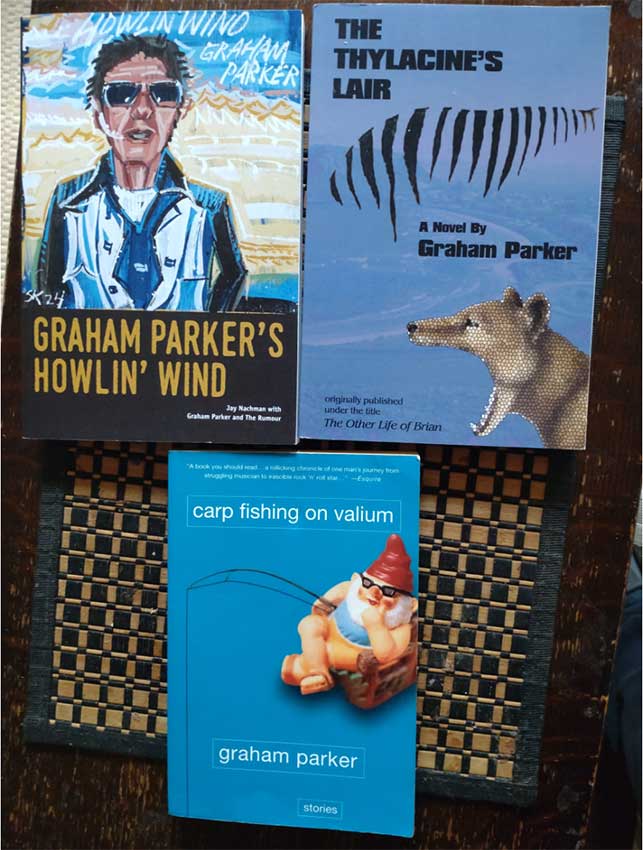
“The book is almost like a memoir I didn’t have to write, which is good, because I don’t want to write a memoir, lazy bugger”. GP
Thanks, Malcolm. I just arrived in America, flew in today in fact. I had quick read of the beginning of the interview and it’s really looking good. Will read the rest once acclimatised and will spread it to the socials. Cheers mucho.
Email from Graham Parker
.
Malcolm Paul
.