
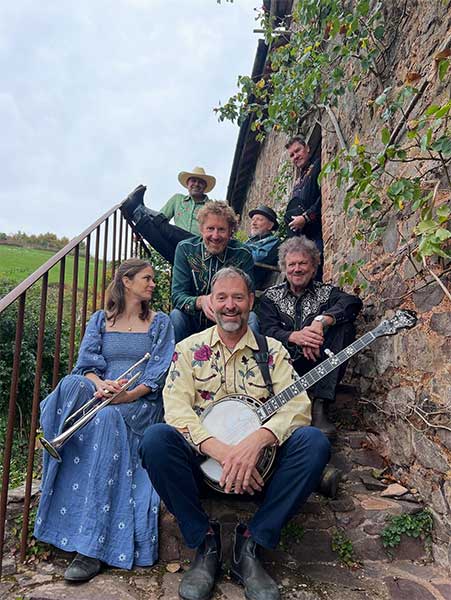
Our loyal and trustworthy police dogs do a wonderful job.
So, what about the band called Police Dog Hogan?
Their reliable press release informs us that, The Light At The Top Of The Stairs is a record of emotional articulacy and resonance. As vocalist-guitarist James Studholme says, it’s the record I’ve always hoped we’d one day make. We’ve tried to put into the songs all the multi variegated wisdom, joy, disappointment, defiance, grief and stoicism that the rollercoaster of our life experience has granted us. It’s the most emotionally powerful LP we’ve made, and we couldn’t be prouder of it.’ The rousing, skittering ‘Run Towards the Fire’ reflects that life asks you, now and then, to hot-foot it towards trouble, whether you want to or not, while ‘Flight 5A’ could be a Glen Campbell creation as a restless wanderer, unlucky in love, finds himself heading back home ‘with half of nothing.’ The narrative, piano-driven ‘Sister Louise’ is a mesmeric exercise in Tom Waits-style pop voodoo, yet the record saves its killer punch for the end. The potent hauntology of ‘The Truth About Ghosts’ opens with a gentle, scarcely-there strum, over which James Studholme murmurs, ‘I have ghosts, not all of them dead…’
The band was formed by James and fiddle player Eddie Bishop, who were joined by mandolin player Tim Jepson and guitarist Pete Robinson for the band’s first gig. By the time of the band’s first recording session in 2009, drummer Michael Giri, formerly of The Lilac Time, and banjo player Tim Dowling had been added to the line-up. The seventh member to join was bass guitarist Adam Bennette. Robinson and Bennette left the band after the recording of the Westward Ho! album. Bennette was replaced by Don Bowen (bass), and trumpeter Emily Norris also joined the band. In 2014 Shahen Galichian (piano, keyboards, accordion), formerly of the Golden Manor Medicine Show, joined the line-up. The band have appeared at festivals such as Larmer Tree, Bestival, Kendal Calling and Glastonbury.
Their second album, From the Land of Miracles (2012) was produced by Eliot James. The third and fourth albums, Westward Ho! (2014) and Wild By The Side Of The Road (2017) were produced by Al Scott whose production credits include Oysterband and The Levellers. It includes the macabre ‘Tyburn Jig’, marking in grim humour the place where executions were carried out for the most trivial crimes, one ‘habitual recidivist’ hung for the crime of stealing a wheel of cheese, where the hangman is employed to ‘teach me to dance the Tyburn Jig’ on the end of a rope.
The band’s EP, ‘Hard Times Coming’ (2019) was also produced by Scott. When the band returned from a hiatus in 2020, drummer Giri had been replaced by Alistair Hamer, ex of Folktronica Sweet Billy Pilgrim – named for the character in Kurt Vonnegut’s Slaughterhouse Five. In May 2024 Police Dog Hogan went to the Devon Middle Farm Studios to record with producer Peter Miles, with no firm plans other than to try and record some ideas they had floating around. Miles suggested recording live sessions direct to two-inch tape, with minimal overdubs or edits. They ended up recording eleven songs in three days. Forming the core of their sixth studio album Lightning Strike. The title-song video features a fine old typewriter, matched to the message ‘no technology post-1971 was deployed in the making of it’ (the album)…
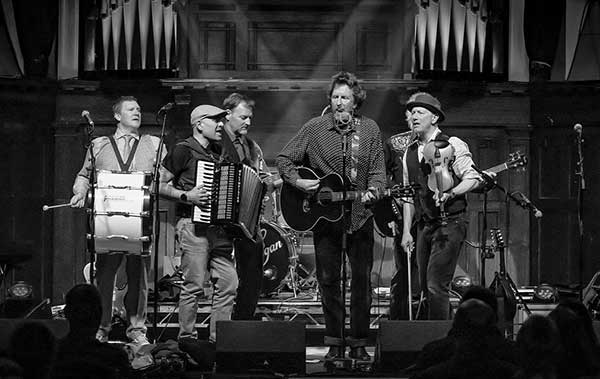
And now there’s The Light At The Top Of The Stairs…
Talking to Police Dog Hogan….
Andy Darlington: Hello James, how are you?
James Studholme: Very well indeed, thank you. There are mountains out the window behind me. I’m in a place called Wānaka in New Zealand, (a popular resort town in the Otago region of New Zealand’s South Island, known for its stunning lake, proximity to Mount Aspiring National Park, and outdoor activities like hiking, skiing, and biking, serving as a gateway to alpine adventures and featuring famous spots like ‘That Wanaka Tree). That’s why we’re doing this at an odd hour, for which I apologise. It’s thirteen hours difference (he laughs). It’s eight o’clock in the morning for me and seven o’clock in the evening for you.
Andy: Is your New Zealand trip Police Dog Hogan related, or do you have other motives?
James: No, it’s not. It’s escaping the English winter for a few weeks, and I’ve got a lot of family here.
Andy: I can quite appreciate the logic of that. It’s drab, overcast and drizzling here in Yorkshire.
James: I hear there’s been a lot of snow as well, and big storms and stuff too (runs his fingers through his spiky hair). Keep me in touch!
Andy: Congratulation on a fine album with The Light At The Top Of The Stairs. You must be very pleased with this album.
James: Oh, thank you. We’re really pleased with it. It’s been a sort-of long gestation this particular record, which has some advantages, ‘cos we started recording the songs – or the earlier part of the songs, nearly three years ago. And then we made what we call an ‘accidental’ record in between. We went down to this place called Middle Farm in Devon with the intention of recording two songs, but we agreed… we submitted to Pete Miles’s – who runs the studio, his suggestion that we should record on tape. He had a lovely two-inch tape machine that he was very proud of. We didn’t really think it through. We said ‘yeah, that sounds like a great idea.’ And we’d forgotten that when you record on tape, you can’t change anything! What goes onto tape, that’s it! (he holds his hands up I dismay). That’s done, you can’t fiddle about, there’s no… erm… computer messing about, y’know, you can just about add a tambourine and a bit of backing vocals, and that’s it. So, on the first day, on the Friday – we had three days booked, we’d recorded the two songs that we had prepared by eleven o’clock on the first morning. So we were like –‘Oh god’, so we just kept going, and by the end of the Sunday we’d made an album. So that kind of…
Andy: And that was Lightning Strike (October 2024, Major Tom MTLP011).
James: Right, that was Lightning Strike, so that sort of inserted itself into, it demanded that we needed to do something with it there and then, so, in fact, it basically delayed this record. And when we came back to doing this record… which I think was an advantage, we listened to what we had, and what we thought worked, what was good, and then we recorded a few more songs which had emerged in the meantime, one of which is a very important song to us which is ‘How Did It Get To Be So Late?’, which is the first song, and ‘Passing Through’, and we also re-recorded ‘Go Down Fighting’ which we’d improved in the meantime. So – yeah, it was quite good news for us to have a second bite of the cherry, normally – when you make a… and also, it gave us the opportunity to think about what we wanted the record to be. We wanted it to be an emotional record, probably the most emotional record that we’ve made, that very much spoke to us and our audience and where we are in life now. And what our concerns are. And generally, historically, when we’ve made records, you just go in, you’ve got your bunch of songs, your bag of songs, and you record them, and then you decide which of those are the best songs, but you don’t really… I don’t think very often you get a chance to think about what you want the album to be, and feel like, overall. Does that make sense?
Andy: It makes perfect sense. The ‘Lightning Strike’ song-video shows a fine old typewriter.
James: Oh yes. Well, Pete, he’s quite an eccentric guy, Pete Miles. And he owns the studio. He was very funny (laughter). Luckily our accordion player Shahen Galichian, found him amusing. But he could just as easily not have. He was quite truculent. He would say, if you said something like ‘could you turn the fiddle up a little bit?’ in the mix, y’know, he’d say ‘stand closer to the microphone’ or whatever. If there was a squeak on the floor… because it was a wooden floor, and he’d say ‘well, just don’t stand on that bit!’ (adopting stentorian voice). He was very very… he was quite tricky. And he had this old typewriter, so he would sit between takes, going… (his fingers operate an imaginary typewriter), ‘Take Seven, not very good.’ It was quite funny. It was quite Old School.
Andy: That policy is in keeping with the notice on the album that says ‘no technology post-1971 was deployed in the making of it’ (the album). So, no samplers, no sequencers, no-autotune. Isn’t that quite a Luddite attitude?
James: No editing! I feel that’s true, yeh, yeh. Well, it’s strange, ‘cos it’s actually turned out… ‘cos it’s quite ‘immediate’ and quite… I wouldn’t say rough exactly, it’s not as considered, the takes are the takes, you just choose the best one. There’s quite a lot of… at the end of the first day we were in bits really because we just thought the whole thing was a collection of mistakes, and that’s all we could hear, and after a good night’s sleep we went back and actually we’d forgotten the mistakes a bit, and we just enjoyed the effect. And it turns out that it’s the record, probably the record that our audience likes the most. So far… so far… (he brandishes a warning finger).
Andy: Your new album, The Light At The Top Of The Stairs, is actually your eight album, which is entering Beatles territory. The Beatles eighth studio album was Sgt Pepper’s Lonely Hearts Club Band.
James: Bloody hell! OK. Well, I hope it’s received as well as Sgt Pepper, that would be great! But yes, I think, the energy, the momentum in the band comes from new music. It comes from the excitement of the writing and the arranging and the recording, and the songs demanding to be dealt with. If you see what I mean? They appear, and you’ve got a bag of songs, and they force their way out into the world, somehow. That means that… yeah, there’s a record every two or three years.
Andy: There’s a wide diversity of styles within the Police Dog Hogan spectrum. How do you classify your music? That’s probably a stupid question and you’ll probably just say ‘it is what it is’…
James: Ah well, I think the best description so far I’ve heard was coined by Tim Dowling (banjo, guitar, harmonica, vocals, an American who is also a journalist for The Guardian), he described it as ‘Pop Music with all the wrong instruments.’ And I think that’s quite a good way of… I mean, it’s interesting ‘cos if you set up our line-up, our line-up is obviously banjo, mandolin, fiddle, accordion, trumpet (he counts off on his fingers) – there’s quite a lot of instruments in there that are… that people are quite divided on. You know, if you play banjo, half the world loves a banjo and the other half is committed to hating the banjo. Personally, I love the banjo. And I think the accordion, when we first started out we had a guitar player called Pete (Robinson) who was terrific, but he wanted to go and live in a different part of the country, so off he went, and Shahen who is completely brilliant keyboard-player generally, and musician and he… we had some songs, there was a song called ‘West Country Boy’ (on the 2014 Westward Ho! Album) that sort-of needed accordion at that time he joined the band, and he’s revealed all the other things he can do, but if you have an accordion on the stage when the audience comes into a venue you kind-of know that you’re in for a really fun evening. In a way that if you see an electric guitar on a stand you don’t necessarily, it’s not quite the same signifier. Erm… so, I think the by-product of what we do – unexpectedly, not that we set out to do it, is providing joy. That seems to be the thing that people feel when they come and see us. I don’t know why (he laughs), ‘cos – as you know, some of the songs that we play make people cry, they’re quite highly emotional and sad, but the overall effect is joy, so it’s Joyful Pop With All The Wrong Instruments. Something like that. What would you say, Andrew? How would you describe it?
Andy: To me, all the influences that you have experienced as a collective of musicians, goes into the blender, and gets swirled around, and is poured out in new configurations. That’s the way I understand it.
James: That’s exactly right. Yeah, that’s a rather better way of describing it. I mean, that’s exactly right. We’ve all heard a lot of music, and loved a lot of music, and the different people in the band… I suppose, where we all connect, is probably around… probably my songwriting. Which, y’know… songs, there’s no rationale to songs, they appear as they appear, and I don’t sit down and go ‘I’m going to write any particular kind of song,’ they come from an idea or a bit of tune. And then everybody in the band gets a chance to bring… as you say, to bring a bit of their musicality and what they love, and fragments of what they’ve listened to. So that’s spot-on.
Andy: Do you feel you are part of a movement, that there are other bands out there doing what you’re doing, which make you look over your shoulder at and think – ‘Wow, that was good’?
James: No. Well, there’s lots and lots of bands that I revere and admire… but, no – funnily enough, I sort-of feel almost like the opposite. I think that thing that you were just talking about there, which was the uncategorisability, I don’t particularly see that in too many other bands. One of our objectives… you know when you go and see a band that you’ve never seen before, you don’t know them, and they play two songs, maybe three songs, and you go ‘yeah, I’ve got them now, I know what’s coming, I know what my next hour-&-a-half is going to consist of’, and you’re either going to enjoy it or not or whatever, but you know the trajectory of the evening, and you know the landscape. Our goal is to do precisely the opposite of that (he stabs the air for emphasis). That, if you think you’ve got us pinned down… you haven’t, because if the first two songs are miserable, the third song should make you laugh and the fourth song might make to dance. I don’t know. But that’s the goal. Within obviously the musical landscape that we have. But to try… yes, to try and not bore the audience.
Andy: It always fascinates me the way bands operate in different ways. With Police Dog Hogan you are the primary songwriter, so does that mean you sit at home with your typewriter or your audio recorder, and then you bring the demo’s into the rehearsal studio where the rest of the band converge and add their own contributions. Is that the way it works?
James: Yes – often. And sometimes our recording process is that quite often we haven’t rehearsed the song at all. And we’ll take the song… and have an adventure in the studio, y’know? Know what the basis of the song is… a song like ‘Devon Brigade’ from a while back (a track on Wild By The Side Of The Road that is structured around a letter home from the warfront, dedicated to Second Lieutenant Paul F W Studholme, Devonshire Regiment, 1898-1917), is essentially just the song ‘as written’, it’s an acoustic guitar track with a little bit of decoration, something like ‘Kathleen O’Hare’ (an acoustic track on 2022 album Overground) – that would be like that, and then other things are a complete collaboration of people bringing riffs and completely changing songs often, that’s the other thing – it’s sometimes, because in fact, in that process once everybody is involved there’s a certain amount of extra truth that gets inserted into the song. Where we all go ‘that bits just not very good’ and you go ‘mmm, yeah, OK, fair enough’. And sometimes you have to take it away and fiddle with it and keep bringing it back until you pass the exam. And sometimes it just… other times, there are other songs that are handed to you. Like there’s a song… in fact, because we ended up putting a version on Lightning Strike, there’s a really nice version that could just have easily been on this record, of a song called ‘Tomorrow Will Be Better’ and that song was written in twenty minutes, backstage, like – ten minutes before we had to go on for a show at the ‘Bush Hall’. And really, that never got, that never had anything done to it at all, apart from a few little bits being added. But I like both processes. Shall we say.
Andy: So some songs come out of a jam situation?
James: A structured jam, I would call it. ‘Cos there is the basis of what the song is going to be like, and then just we start all playing it together, and it morphs a little bit, less of this, more of that, and if that doesn’t work, that is the best bit, why we don’t we do more, why don’t we put the bit at the end that you think of as the outro, that’s actually the intro, let’s put it at the beginning, oh… there’s something, it gets a bit boring in the middle, let’s come up with a middle-eight that’s going to be exciting, or whatever. I kind-of think of songs in a slightly linear mathematical way too (he draws an undulating line in the air with his finger), you want things to happen when you want them to happen, do you know what I mean? You kind-of go verse, chorus, verse, chorus OK, I don’t want just another verse now, I want something else to happen. It’s a bit nicky, I know…
Andy: ‘Devon Brigade’ is a very moving song, you’ve obviously been delving into your family history.
James: Yeah, well, it’s based on a letter that my great-uncle Paul wrote to my grandfather, who was his younger brother, with the profoundly stoic and tragic line, ‘I hope to see you soon, if I’m not pushing up daisies. I’ve got some leave coming up.’ And I extrapolated the ‘tell our mother that I love her’ bit, but it was based in that, and he was nineteen when he was killed. And I’ve got three sons, and the eldest son – during that period of the centennial, when consciousness of the First World War was everywhere, and I looked at the War Memorial in our village in Devon, and my great-uncle was on it. It was the first time that I was struck by the fact that he was exactly the same age, at that moment, as my eldest son was. And looking at my eldest son, who – frankly, was more of a boy than a man at that point, I was really struck by the tragedy of that. And they’d had quite a similar upbringing. So that was the genesis of the song. And yes – it was nominated for an AMA award for Best Song in its Year – whenever that was, which was incredibly nice. We didn’t win. That’s fine. And also I got to do it… and I’m doing it again this year in the Guard’s Chapel on Birdcage Walk on Remembrance Sunday. And that was very very moving for me, because my father was in the Guards. So there was a kind of squaring of the circle there.
Andy: There are strings on that track.
James: Yes. That’s a perfect example of what I was saying. So, I recorded it, and then you think, ‘oh god, it’s lacking some colour, or some whatever.’ And Eddie (Bishop), who is a beautiful lyrical melodic fiddle player came up with that bit of tune.
Andy: They are real strings, not synth-strings.
James: Oh no. I think you’ll be hard-pressed to find any synth-strings on our stuff, Andrew. We try and make everything as real as it can be.
Andy: You must have been asked this many times before, but was there a real Police Dog Hogan – in a movie, on TV or in a comic-strip or somewhere?
James: I’m afraid there was a real Police Dog Hogan. It’s a terrible story, ‘cos – as Tim likes to say, it’s a story with a death-wish! ‘Cos people say… what’s the story? And of course, you already know the punchline. How it originated was from – keep it short, but Eddie our fiddle-player, in his other life he’s a barrister, and when he was a young barrister, and you’re permanently exhausted as a young barrister, so that explains his brain-fade! But he was reading a Police Procedural about a riot, I think in Brighton, and there’s a long list of all the Police Officers who are put in the van to be taken to the riot… and for some reason that he couldn’t quite work out, PD Hogan was left in the van when everybody else was deployed. And he was thinking ‘Probationary Detective’…? Something like that. Anyway – the riot kicks off. And at some point PC Darlington (‘HaHa’!!!!) is sent back to the van to deploy PD Hogan. The penny has still not dropped! No, he’s thinking, they’ve gone back to get the Probationary Detective. The Probationary Detective is brought to the riot at which point he ‘vocalises’, lunges forward and bites the complainant. Now, for reasons that remain opaque to this day… we thought that was hilarious. And we needed a name. That’s the reason. The reason is that we had to have a name because we were recording our first EP. And we were going to play some shows, and people were going ‘what’s your band called?’ And that’s – I’m afraid, that’s the real story. I feel that we need to come up with some better stories for it… but that is actually the story. So – for a long time, on Twitter (now-‘X’) we were mostly followed by real serving Police Dogs…
Andy: Police dogs do a wonderful job, tracking missing people, controlling riot situations, sniffing out narcotics…
James: Exactly. There seems to be, as we’ve discovered, a whole world of Police Dog love. Unconnected to us.
Andy: Was there a favourite venue that you used to play when you were starting out?
James: Erm… well, we’ve always really enjoyed playing at The Half Moon in Putney, we played there for years, and we basically now have a sort-of Christmas residency that we do. We do two nights. I think next year we’re maybe going to do three nights. I’m not sure… they all have, we love – well, it used to be called ‘The Sage’ in Gateshead, one of our earliest shows – a very early show, was probably not far from you – in Grassington. They have a village festival. It was one of the very first shows we ever played. And we’d only really played in pubs where every time you stop playing and start tuning, everybody just starts talking. We played there, and the hall was full, which – first of all, that was a surprise to us, because nobody would have known who the hell we were, and after the first song there was polite applause and we started our normal round of tuning and looking at our feet, and there came a roaring silence as everybody sat there with their arms crossed wondering what was happening. So that’s when we first realised we had to talk to the audience. Which was quite a big breakthrough. No, I think that’s absolutely favourite venue… hmm, a very good question. The Victoria Hall in Settle. That’s a lovely place to play. St George’s, Bristol. That’s great. That’s been great to us. These are places that we’ve gone back to. A lot.
Andy: We should be talking about the songs on the current album. ‘Seven Kinds Of Rain.’ Mark my words, there are different terms for rain, a vocabulary of terminologies, it pours down, pelts down in torrents, drizzles and showers, in stair rods of precipitation. As James notes, ‘It’s quite cinematic, one of those songs that opens with a single image: a motel pool on the edge of a highway. But it’s really about isolation, about being an observer, forever stuck on the other side of the glass.’ Then there’s ‘Passing Through’ which is a Beat road-trip in which the singer-voice is more an observer than the participant. You opt out – ‘no Lone Ranger, no caped Crusader’. As a writer myself, I feel that’s an interesting structure, that’s an intriguing perspective. Does that make sense to you?
James: It does. It does. The lyrics. That’s an interesting one. The words were written by Tim, by Tim Dowling, who is an American. So he… it’s based on… I think he’s had it in bits for a long time, and it started with the actual observation of the girl painting her toenails blue by the swimming pool and I think that kind-of sent him off. And I had the tune and the guitar figure for a long time, and I just said ‘Oh! look, give me those words please, ‘cos I think they’re great.’ And I went away and stitched it together. Yes – I sort-of see it like… yeah, like a kind of Road Movie of this… I don’t know what sort of trauma has happened to this guy in previous lives, but he just doesn’t wanna, he doesn’t want to engage with his surroundings. So, I see – yeah, you’re right, it’s like I’m observing him, and he’s observing the world. So, yeah, I feel that it’s a bit like a movie landscape. You’re right, Tim is a very excellent writer, writing his columns and things for The Guardian, which is one of the reasons he doesn’t write as many songs as I do, as you’ll appreciate, as a writer, some of the itch and urge to write is taken care of in what you do every day. But when he does write – he wrote a song called ‘Barcelona’ on the last record (on 2022’s Overground), and ‘One Thing’s For Certain’ on the Lightning Strike record, he’s a terrific writer and actually he also completely wrote the song… its name kept changing, is it ‘Fight…705’?
Andy: It’s called ‘Flight 5A’
James: Yes, ‘Flight 5A’. I’m sorry. I haven’t got it all in front of me. (He laughs) I feel like I’m quite a long way away. Yes, he wrote ‘Flight 5A’… and again, that’s the same kind of thing. He’s got this sort of dispassionate, wry, lots of wonderful internal rhymes narrative style.
Andy: I was going to ask about ‘Flight 5A’, because in the lyric he’s ‘coming home’, but for Police Dog Hogan, America is not your home, only your spiritual music homeland. But I guess if Tim wrote it, and he’s American…?
James: Yes. Tim wrote it. But he’s not from Nashville, or the south, which is where I think he had in his mind. He’s from Connecticut, but I think he’s very comfortable with that. And I feel that your point, which is that ‘it’s not my musical landscape’… we’re OK. I try not to write songs about highways and too many American placenames and that sort of stuff. That was the genesis of a song like ‘West Country Boy’ (on 2014’s Westward Ho!), almost like an exercise in trying to write an English song, that had lots of placenames in it. ‘Cos they’re really difficult. English placenames do not lend themselves to being sung, y’know? ‘Midnight Train To Georgia’ would be different if it was ‘Midnight Train To Huddersfield’.
Andy: That’s the challenge, as a writer, to get some romance into it. ‘Get Your Kicks On The M62’. While Police Dog Hogan’s brand of Americana tends to unfold on the rain-swept greyscale of the A303 rather than the wide-open space of Route 66, the single ‘Passing Through’ is a notable exception. It follows a detached Wim Wenders-style protagonist as he glides through the American heartland, present yet somehow detached.
James: Exactly. So, we’re more taken with trying to write about our own… yes, if you go too far in that direction you become more-or-less a tribute band. You don’t want to be that.
Andy: I’m almost wary about asking about ‘One Last Trip Around The Sun’, which is intensely personal, about easing a loved one into death. It’s also a profound meditation on the passing of time, delivered by artists viscerally aware that they find themselves entering the autumn of their years. As James sings in his careworn, cracked drawl of a vocal on the opener ‘How Did It Get To Be So Late?’, ‘I’m older than my father ever got to be. Now it’s me, planting trees I know I’ll never see.’ But the album’s examination of mortality hits hardest on ‘One Last Trip Around the Song’. It’s a song about a dreaded yet inescapable mid-life rite of passage: bidding farewell to loved ones at the end of their days. Its hushed reverie will resonate deeply with anybody who’s ever sat next to a hospice bedside. Yet for its evident heartache, rather than sink into maudlin despair, it locates hope in the shadow of death.
James: Well, it’s about my Dad, and Eddie’s Dad. So ,the song came into being, my father died a long time ago, in 1990, but Eddie’s Dad died recently, and in a period when we were touring. So we were talking a lot about it, and one of the things that I think… now we are of an age where it’s terrible to note that a lot of people we know and have known have died. And being with people when they’ve died, as I was with my Dad. And I think there’s a thing that people don’t really talk about, or want to talk about. That is giving people permission to go, often times, people hold on, they’re not quite sure what they’re holding on for, it’s – like, intuitive, obviously. And in the case of my father – and Eddie was talking about his father in the same way, the key moment is that moment where you say ‘it’s OK. We’re going to be alright. You’ve done brilliantly. You’ve completed everything you needed to do. We love you. We know you love us. It’s all fine.’ And that idea of permission, is a theme that I don’t think people really talk about, or think about very much, because it seems antithetical, everybody wants the NHS, everybody tries to hold on to everybody for ever with all their might, and sometimes that’s just not always… the right thing. But anyway, you’re right. I just got a bit maudlin there, Andrew. But that was the genesis of it. It’s been an amazing song for us. We’ve been playing it live now for a year and a half, or maybe even longer, and it hits really hard. You never know when you write a song whether it’s going to land or not. But – Boy! – that song lands.
Andy: It’s something that touches everyone’s life at some point. When your parents die. So it touches a common nerve. But – at the other extreme, on the album there’s ‘Sister Louise’, which is almost a Brecht-Weill exercise as sung by Tom Waits.
James: HaHaHa! I love that. I’ll take that. I’ll take that. It was… ironically, it’s sort of based on a tea-towel. I know that sounds a bit odd. But I should explain what the tea-towel was based on. One of our tea-towels I should say. Our first one. Tim has collected over the years, he has a sort of collection of scraps of paper that he’s picked up, I think most probably in New York, maybe some in London, but those scraps of papers (he indicates the size by squaring his fingers), they are Schuster semi-religious claims of people saying ‘I was a terrible alcoholic, and my family kicked me out, and then I went to such-&-such place and I met this iconic preacher-person, and now I’m a businessman and I’m successful and I’m…’ so yes, that type of idea. If you get a chance to talk to Tim, I think he’ll explain better. If you get a chance to catch up with Tim he can give you a more under-the skin on the American angle (his hands illustrate two directions coming together). And we had all these scraps, and we thought they were very funny. This is a long time ago. And we made it into a tea-towel. And then, it’s been… the song, originally it was called ‘Sister Kathleen’, it’s absolutely an example of one of those songs that’s been a long long time in the gestation. It was originally called ‘Sister Kathleen’ and then we had a song called ‘Kathleen O’Hare’, so it couldn’t be that any more, so it became ‘Sister Louise’. And it’s taken us a really long time to get the structure of it right. And now it’s a mainstay in our live show, it’s a marvellous dramatic thing.
Andy: There used be the Rosicrucian’s adverts inserted in magazines and books offering the spiritual mysteries of self-transformation. Leonard Cohen wrote in ‘Dress Rehearsal Drag’ ‘on the back of every magazine there are those coupons you can send, why don’t you join the Rosicrucian’s they will give you back your hope…’.
James: Exactly that. It was exactly that. Terrible claims, it’s sort-of part of a long tradition that includes those emails that you get about somebody who’s stuck in Nigeria with thirteen-million pounds, and if only you could… and he’s probably a Prince or something, and his family have been taken… I don’t know. It’s that sort of style, isn’t it (he drinks coffee from a white mug).
Andy: It’s an example of the wide diversity of styles across the album The Light At The Top Of The Stairs. And from your back-catalogue, I loved the macabre ‘Tyburn Jig’ (on Wild By The Side Of The Road), which he dances on the end of the hangman’s noose. Was that a traditional song that you adapted?
James: Aaaah! Yes, it’s incredibly macabre. No, it’s probably got some traditional elements in it. We had that aah-aah. We’d seen that… there’s a song by – what’re they called? I’ll remember it. The brain’s not working fully. The Avett Brothers, there’s a song by The Avett Brothers called ‘Satan Pulls The Strings’ (on their 2016 True Sadness album), it’s about being possessed by the Devil anyway. And it’s got a great riff, like a very repetitive fiddle riff, and Eddie had this riff, I think that’s where it started from… ah-ahaaa ah-ahaaa, da-dahdaa da-dahdaa. And I was very taken with that. The Tyburn Jig was the description of what happened when people were hung, and their legs would go like this (he indicates wild spasming movement with is down-hung arms). At Tyburn. And people called it the Tyburn Jig. And it felt like a jig. So that’s the inception of the song. We love stories. Police Dog Hogan is a story-telling band, really. The majority of the songs, in one way or another are stories. That felt like an – albeit quite macabre story to tell.
Andy: Black humour. Literally Gallows humour.
James: Gallows, it is Gallows humour, yes. It’s got my favourite music videos. I don’t know if you ever saw the music video for it? It’s on YouTube. It’s pretty funny.
Andy: Does A Man Need A Shed? (the title of a track on 2014 album Westward Ho!). A Man-cave.
James: Yes. As it turns out. And as it turns out we’ve discovered over the years a lot of men have more than one shed! In some cases, they have several. I think a shed is part of, a place to be alone, and… what’s the line? ‘rusty tins and screws and other shit he’ll never use.’ That’s the line that seems to land with most people.
Andy: Just whizzing off at a tangent, you once supported Brian Wilson, is that true?
James: Yes, we did. At The Cropredy Festival, we were on before Brian Wilson at Cropredy. And that was quite a unique experience. Funnily enough, the last time I was in New Zealand – a very long time ago, 1979… 1978 even, and I remember going to see the Beach Boys as an eighteen-year-old. I went to see them in Christchurch. And I remember standing in the audience looking at the Beach Boys, who probably were still in their thirties or maybe just forty, and looking at them and thinking ‘Christ, they’ve not got long these guys, this is… you can’t keep doing this at that age, y’know, these old guys.’ And it’s fairly remarkable, fifty years later, or forty years later… and there’s Brian! He wasn’t in terribly good shape, it’s got to be said. It took him… it was quite difficult getting him to the stage. The band were incredible. His band were a band called the Wonder Mints, you probably know all this anyway? They were a Brian Wilson Tribute Band, and they were absolutely crack American Los Angeles session musicians. It was their particular pleasure to do absolutely perfect Beach Boys facsimiles. And so he hired them when he had to get out…. I think he lost all his money, I think he was robbed, he either… he needed money, the same as Leonard Cohen, so he had to go out on the road.
Andy: Was he doing the Smile material?
James: He was doing a… it was a sort of Festival set, so it was kind-of a bit of everything, and he had Al Jardine (from the original Beach Boys line-up), and there was a really funny moment. We were watching. You know Cropredy, it’s in the middle of the English countryside, it’s not really near anywhere famous. And there’s obviously a moment in the show, a very well-rehearsed show, where it’s Al Jardine’s moment to talk to the audience. And obviously he’s meant to say ‘Hey! Hello…’ whatever, insert as appropriate, Hellu Nuremburg, Hello Paris… and it crashes into a close-up on his face, as planned, and you can see he is completely covered in confusion, he has no idea where he is, you can see him starting to panic, there’s a long pause… and then he goes ‘festival, hello festival!’
Andy: That’s brilliant. Is there anything else you’d like to say about the album, that we’ve not already talked about?
James: Erm… no, I think we’ve covered a lot. We are – obviously, inordinately proud of this record. And that exact diversity that you’re talking about, you’ve put your finger on all of the issues and thoughts that we’ve got roaming around and we’re… no, I think… I’m just trying to think if I have something else to say, I’m not sure I have. Terrible, isn’t it…?
Andy: Anyway, I think we’re running out of time. Thank you, James.
James: We are good. It’s been a pleasure. I really appreciate it. Thank you for taking the time.
‘
BY ANDREW DARLINGTON
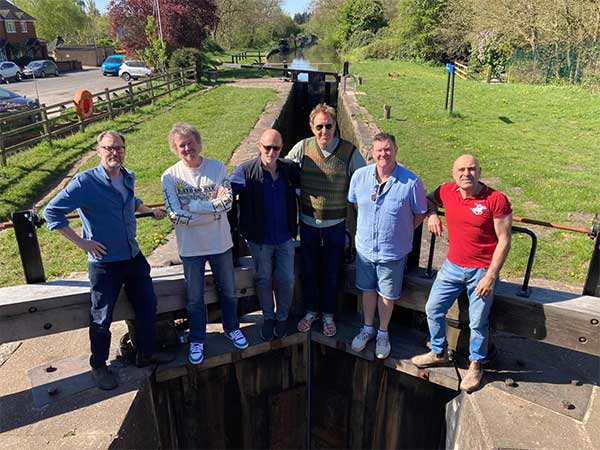
Police Dog Hogan Are:
James Studholme – lead vocals, guitar
Eddie Bishop – violin, vocals
Tim Dowling– banjo, guitar, harmonica, vocals
Don Bowen – bass guitar, vocals
Alistair Hamer – drums, vocals
Shahen Galichian – accordion, piano, keyboards, harmonica, harmonium, vocals
Emily Norris – trumpet, vocals
Discography
‘Fuzzy Fold Riot’ (2009, EP Major Tom Records) triple A-side with ‘Slingshot Round The Moon’
Fidelis Ad Mortem (2010, Major Tom Records MT003CD)
From The Land Of Miracles (2012, Major Tom label MTCD004)
Westward Ho! (2014, Union Music Store UMS007)
‘Moutarde! ‘(April 2015, EP Union Music Store UMS008) with ‘Rivers Of London’ and the Jamie Freeman Remix of ‘Home’
Wild By The Side Of The Road (2017, Major Tom MTCD005)
‘Hard Times Coming’ (2019, EP)
‘First Christmas Alone’ (December 2020) download single benefit for Crisis homeless charity
Overground (January 2022, Major Tom MTCD008)
Lightning Strike (October 2024, Major Tom MTLP011)
‘Pull Away’ (December 2024), digital single benefit for RNLI
‘Seven Kinds Of Rain’ (October 2025) digital single
The Light At The Top Of The Stairs (April 2026) digital, vinyl and CD formats
(1) ‘How Did It Get To Be So Late’ (5:14)
(2) ‘Go Down Fighting’ (3:54)
(3) ‘Just Breathe’ (4:02)
(4) ‘One Last Trip Around The Sun’ (2:54)
(5) ‘Run Towards The Fire’ (4:36)
(6) ‘Passing Through’ (4:36)
(7) ‘Seven Kinds Of Rain’
(8) ‘Sister Louise’ (4:41)
(9) ‘Flight 5A’ (3:34)
(10) ‘The Truth About Ghosts’ (3:59)