
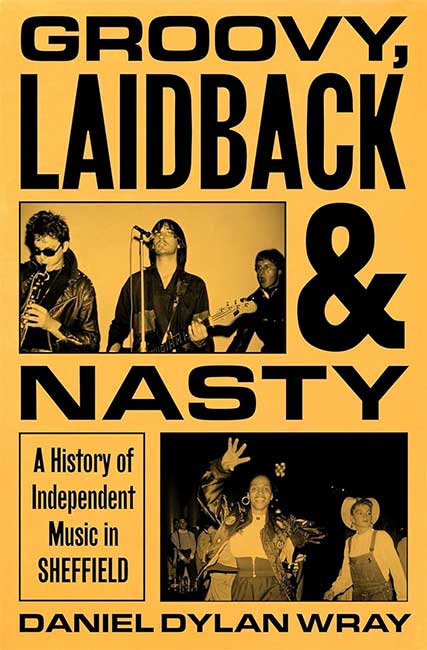
Groovy, Laidback & Nasty: A History of Independent Music in Sheffield, Daniel Dylan Wray (398pp, White Rabbit)
I’ve never been to Sheffield, but am – of course – aware of their post-punk bands, especially the likes of Cabaret Voltaire, Chakk and Hula along with The Human League and Clock DVA. In Groovy, Laidback & Nasty Daniel Dylan Wray takes a longer, wider view of things, starting with a quick section on the 1960s and the clubs and venues that sprung up back then, perhaps paving the way for later new music as the city’s industry declined, leaving areas of poverty, disillusionment and empty buildings.
It’s a truism but run-down cities allow the arts to flourish. You just have to look at New York back in the day: hiphop, graffiti, disco, minimalism, free jazz and improvisation, along with punk, all co-existed on the back of cheap rents and warehouse spaces. Ditto, it seems in Sheffield, and as in NYC bands didn’t arrive fully formed but spent hours trying things out, building or blagging instruments, recording themselves and playing low key concerts.
The mix of samples, heavy rhythms, weird treatments, early synthesizers and lo-fi noise that the above bands made would eventually of course mutate into dance and funk (The Cabs and co.), electro-pop (The Human League along with ABC, Heaven 17 and B.E.F.) and/or sonic experimentation (Clock DVA would move from art-terrorism to having a stab at making noirish pop music on a major label but then turn to stranger things under the moniker The Anti-Group).
Meanwhile bands such as Pulp were struggling to find and pull into shape their own individual form of music, with indie-rock definitely out of fashion and the arrival of drug-fuelled rave music, along with Sheffield’s acid house church The Nine O’Clock Service, changing the city, its fans and the club spaces in use. Then there was the sad retro-ism of Britpop and the over-hyped sound of Madchester. Somewhere in there, Pulp went massive and the gawky Jarvis Cocker had to learn to cope with superstardom, not least on the back of him mooning at Michael Jackson, which, along with ‘Common People’ remains his finest moment.
Later we are, or Sheffield was, into Arctic Monkeys and lad culture. Drugs and violence take their toll, as does the knock-on effects of more industrial decline and Thatcher’s policies. Wray falls into the trap of occasionally making lists, mostly of unheard bands; in fact unheard bands that when you google them and listen, are quite rightly unheard. Meanwhile various small record companies come and go, although Warp Records survives to become an important label for the outer edges of experimental dance music (sometimes without any dance factor).
I can see that Wray wanted to avoid simply being an encyclopedia of unknown bands and musicians, and also that he wanted to give readers a sense or portrait of the city itself, but to be honest I lost interest in this book halfway through the 1990s. Some of that was due to having recently read Jamie Taylor’s Studio Electrophonique (and reviewing it here), which covers similar ground in a more focussed way, some of it is simply failing to follow the links and relationships between unknown people, and some because I have little interest in mainstream dance music or, indeed, in experimental dance music until you get to where the likes of Seefeel and other groups hang out.
All cities and towns have a scene of some sorts, although many of those scenes remain purely local and often hidden. There was an indie music scene in Crewe when I lived there, fuelled by not only anarcho-punk bands but also Chrome, Cabaret Voltaire and Hawkwind, whilst when I moved to Exeter it was to find jangly indie guitar bands still popular, along with leftover hippy stuff like Gong, although later on clubs like The Living Room and The Cavern would create spaces for future pop and hardcore respectively. So yes, Sheffield had a higher proportion of genuine pop stars than many other places, but it also had plenty of music that didn’t deserve any national acclaim, as The Sheffield Tape Archive Bandcamp page evidences only too well. (That said there are some stunning bootlegs and the occasional brilliant demos to be found there.)
There’s another question to be asked here too: is an independent band such as The Human League still independent when it signs to a major record label, hits the charts and appears on Top of the Pops? I’m not singling out Phil Oakey’s group, Pulp and Arctic Monkeys were just as big, and although the Cabs never totally went mainstream and perhaps remained a cult band, they certainly released records on major labels and cleaned up their rhythms and vocals for the dance floor. There is no correct answer, as Wray surely knows.
On many levels this is a great read, but the later chapters lack a sense of distance. No-one knows what the music made by Sheffield bands and musicians in the 2010s may yet lead to; no-one knows what the next craze, bullshit journalistic moniker or genuine musical upheaval will be, or whether the endless cycle of shorter and shorter nostalgic retro loops will end. (I do hope so.) Wray has done loads of foot work and research here to flesh out and bulk up the established post-punk and indie-rock Sheffield story, with a web of influences, characters, chancers, promoters and stories. Unfortunately it doesn’t quite come off quite so well the nearer we get to now. I’d like to see him write a more focussed and less wide-ranging history, perhaps of one particular band..
.
Rupert Loydell
.