
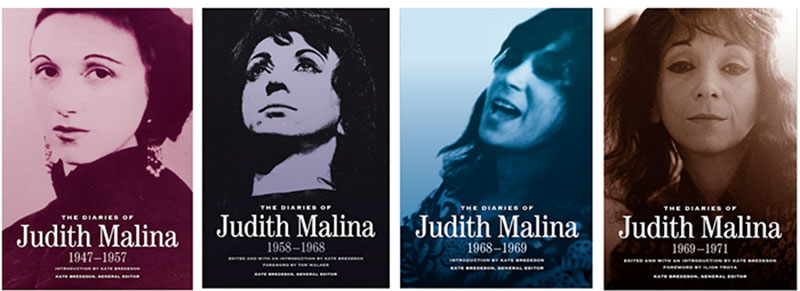
The Diaries of Judith Molina 1947-1957, Judith Molina (550pp, Northwestern University Press)
The Diaries of Judith Molina 1958-1968, Judith Molina (508pp, Northwestern University Press)
The Diaries of Judith Molina 1968-1969, Judith Molina (176pp, Northwestern University Press)
The Diaries of Judith Molina 1969-1971, Judith Molina (336pp, Northwestern University Press)
The Living Theatre was one of the most experimental, provocative and anarchic of theatre companies. Judith Molina and her husband Julian Beck strove to create a theatre that was inclusive, relevant, political and utopian; a theatre for all. Drawing on ideas, writing and performances by Bertold Brecht and Erwin Piscator, and Antonin Artaud’s more shocking and provocative Theatre of Cruelty, The Living Theatre presented radical plays by modernist writers but all three of their (sequential) New York theatre and workshop spaces closed down, the last ostensibly for tax evasion.
The company became itinerant, exploring addiction, sexual energy and freedom, revolution, imprisonment and resistance, often in street performances and semi-improvised work. They toured Europe, endured periods in jail, and later returned to Manhattan, where the company still reside, despite the deaths of both Beck and Malina.
Although The Living Theatre were in many ways well documented – in contemporaneous reviews as well as in books such as We, The Living Theatre and The Living Theatre: Art, Exile, and Outrage – and had a huge influence on theatre in general, especially on American companies such as Bread and Puppet Theatre and The Open Theatre (which in turn would have influence on UK radical theatre), it is usually Beck whose name is associated most with the group. This may be because he published many books of poetry gathering up his Songs of the Revolution, that it was his name was on the cover of The Life of the Theatre, that he appeared in several prominent films such as 9 1/2 Weeks and Poltergeist II (although Malina was in several Al Pacino movies), or simply society’s inherent sexism or the fact that he seemed angrier and shouted louder than his partner.
Whatever the reason, these four volumes of Malina’s diaries, carefully edited by Kate Bredeson, should help put the matter right. Three of them are new publications, whilst the 1968-1969 volume was originally published as The Enormous Despair in 1972. It is this sense of compassion and despair, along with a utopian idealism that underpins this writing, which is far more rooted in feeling, emotion and the moment than Beck’s uplifting and challenging poems.
Malina was sure that anarchism could work, but only if it included a commitment to non-violence, and allowed individualism as well as community, reflection and personal space as well as revolutionary action. It is this personal reflection that ripples through the poetry, brief prose notes and lengthier considerations which make up the journals. Sometimes the pace is breathless – the founding of The Living Theatre takes up only a few lines – whereas at other times there are detailed observations of fellow actors, friends and acquaintances, or shocked responses to police or audience responses.
It is all immediate and heartfelt yet lucid and intelligent, sometimes shockingly confessional and psychologically transparent. Yet there is an energy and commitment throughout, a prolonged engagement with how theatre might be used to achieve a practical and working anarchist society; something Malina is never idealistic or naive about. She always has questions, always sees possibilities but is also aware of associated impossibilities and difficulties.
The diaries are not only a personal history, but tell of different times, places and cultures. The Introductions and Forewords in each volume offer a distanced overview, along with previously unseen photos, but it is the immediacy of Malina’s own writing that takes us back, for example, to late 1960s Manhattan, where Merce Cunningham and John Cage are producing radical dance and music, anti-war protests are going on and the hippy dream rises only to be beaten back down with institutional and authoritative violence.
In 1958-1968 Malina recounts, considers and explains the group’s decision to abandon New York, and instead adopt a position of ‘self-exile’, travelling around Europe for several years, whilst in the 1968-1969 volume they are exiled no more but are still travelling, this time around the States, often facing arrest and confrontation. This touring would lead to the group moving on from their previous big productions and attempting to work in new, even more radical ways. During the same period the fourth volume covers, 1969-1971, the whole cast and crew are put in prison in Brazil but even here Malina is practical (she encourages them to clean up and organise their cells) and accommodating: ‘I live here as I live anywhere, with love and with sorrow in a balance that I can accommodate.’ She insists, even when confined, that ‘love proves itself, as always, stronger than every other feeling. Stronger than fear, anger, frustration’.
Malina comes across as strong, determined and inspirational, insisting that ‘None of us are free till all of us are free.’ These four books offer optimistic guidance and consideration of how that freedom might be achieved; of transformation, aspiration and possibility, not to mention what theatre might and could be.
.
.
Rupert Loydell
.