
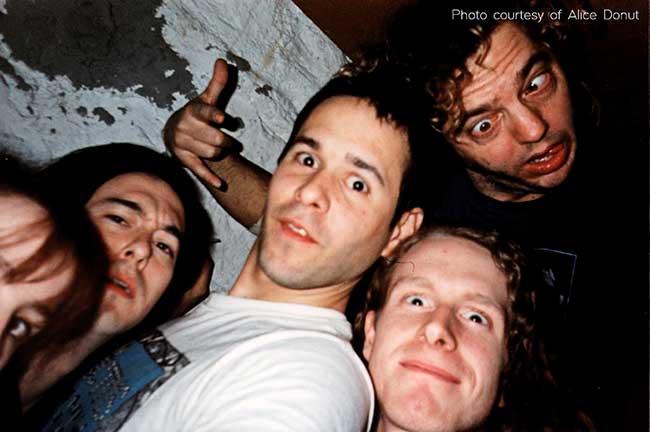
Alice Donut emerged in New York City during the mid-1980s as an unlikely and somewhat accidental collaboration. The band began when Tomas Antona, Tom Meltzer, David Giffen, Ted Houghton and Stephen Moses started playing together without a clear plan beyond exploring abrasive sounds and unguarded ideas. Guitarist Michael Jung soon replaced Meltzer, sharpening the group’s musical focus while preserving its unpredictable spirit. What followed was not a calculated ascent but a gradual shaping of identity through rehearsal rooms, small venues, and a shared resistance to polish or posturing.
At the center stood vocalist Tomas Antona, whose approach rejected theatrical dominance. His voice often sounded as though it were thinking in real time — subdued one moment, cutting the next. Rather than projecting authority, he delivered observations with an uneasy calm that could tip into bitterness or unexpected tenderness. Guitarist Michael Jung brought a disciplined sensibility that favored tension, repetition, and deliberate restraint over flash. In the rhythm section, bassist Ted Houghton developed a restless, melodic undercurrent alongside drummer Stephen Moses, whose playing combined steadiness with flexibility. Moses’ occasional use of trombone added a dry, almost sardonic accent that surfaced unpredictably. As the band expanded, Richard Marshall joined on guitar, creating a dense, interwoven three-guitar dynamic in which parts overlapped and pushed against each other instead of settling neatly into place.
Their early rehearsals reflected the unsettled energy of late-eighties New York. The music was forceful but avoided spectacle; confrontational yet stripped of grand gestures. Punk informed their foundation, though it was never treated as doctrine. Elements of country phrasing, noise textures, cyclical structures, and deliberately awkward melodies filtered into the mix. Guitars frequently moved in opposing directions, creating friction rather than harmony. Above this shifting terrain, Antona’s lyrics examined ordinary frustrations — boredom, resentment, private fantasies, social discomfort — expressed without slogans or overt declarations. The words felt overheard rather than announced.
A defining early composition was “Lisa’s Father,” which circulated widely during the band’s formative period. The track rested on a stubborn rhythmic pattern, guitars circling without resolution. Drama was held in check; tension accumulated through repetition and distance. The main vocal was delivered by Tom Meltzer, with Antona providing accompaniment, a pairing that enhanced the song’s observational quality. The narrative sketched an unsettling domestic scenario without moral commentary. Its restraint was precisely what made it disturbing. The song revealed the band’s commitment to ambiguity and their refusal to direct listeners toward neat conclusions.
The 1988 release Donut Comes Alive captured a group still discovering itself in public. The recording preserved rough edges and abrupt turns, favoring immediacy over refinement. Bass lines frequently operated independently of the guitars, giving momentum to songs that seemed ready to veer off course. Moses anchored the shifting structures with steady but adaptable drumming. Rather than presenting a definitive artistic statement, the album documented a band evolving in motion.
In 1989, Bucketfulls of Sickness and Horror in an Otherwise Meaningless Life marked a heavier and more deliberate chapter. The material carried a darker tone, and the humor that remained was sharper and more austere. The expanded guitar lineup thickened the sound into compact layers that pressed inward. Antona’s writing gravitated toward emotional fatigue and quiet revulsion, delivered in a voice that resisted melodrama.
Mule (1990) broadened the band’s vocabulary. Subtle traces of American roots music surfaced only to be bent out of shape by distortion or repetition. Rhythms alternated between looseness and rigidity. The album felt exploratory yet stubborn, as if resisting formula even while growing more assured. During this period, Houghton’s bass lines became increasingly melodic and mobile, binding together compositions that threatened fragmentation.
Following extensive touring, Revenge Fantasies of the Impotent arrived in 1991 with tighter construction and heightened focus. Abrasion remained, but it was applied with control. Antona’s lyrics addressed resentment and imagined triumphs filtered through bleak humor. The album concluded Houghton’s tenure, closing the initial rhythm section chapter and subtly altering the internal balance.
The early 1990s brought bassist Sissi Schulmeister into the fold. Her playing introduced a firmer, more grounded presence. This shift was evident on 1992’s The Untidy Suicides of Your Degenerate Children, a dense and demanding record that sustained tension without offering release. Schulmeister’s bass anchored the turbulence, allowing the guitars to press forward with greater force.
Dry Humping the Cash Cow (1994), largely recorded live, presented the band in its most immediate form. Room noise, uneven mixes, and volatile energy remained intact. Songs stretched and fractured before reforming. Moses’ drumming drove the performances relentlessly, while the trombone cut through the layered guitars in moments both absurd and fitting.
By 1995’s Pure Acid Park, the cumulative weight of touring was audible. The album retained its acerbic edge but introduced a reflective dimension. Repetition became abrasive rather than inviting, and pacing grew more deliberate. Schulmeister’s bass was fully integrated, lending gravity to the increasingly textured guitar interplay.
After a vast number of performances — including a milestone show frequently cited as their thousandth — the band stepped back in 1996. The pause arrived quietly, without spectacle or public fracture. For years, their presence persisted primarily through recordings and the lingering reputation of their singles.
Those singles formed an essential thread in the band’s story. “My Boyfriend’s Back” twisted familiarity into unease. “Get a Life” delivered pointed mockery. “Magdalene” and “Medication” turned inward toward darker emotional spaces. “Nadine” gained notable recognition, particularly in the United Kingdom, yet the band never shifted toward overt commercial pursuit. Each release served as a concise extension of their larger body of work.
When the group resurfaced in the early 2000s, it did so without grand announcement. Three Sisters (2004) reflected a later phase shaped by time away. The songs unfolded patiently, aggression appearing in controlled surges rather than constant impact. Antona’s writing carried reflection alongside critique. The guitars intertwined with deliberation, forming weighty but contemplative textures.
Fuzz (2006) emphasized atmosphere and tone. Repetition generated hypnotic unease, and heaviness emerged from density rather than speed. The rhythm section provided an unyielding base while guitars shimmered and scraped above it.
By the time Ten Glorious Animals appeared in 2009, the band’s identity felt fully integrated. The music was substantial without aggression and strange without chaos. It suggested a group comfortable in its own contradictions, no longer compelled to explain itself.
Today, Alice Donut continues intermittently, reappearing when the moment feels right. Performances retain their tension and vitality, carrying decades of accumulated experience. Their catalogue does not unfold as a linear ascent but as a series of distinct, lived chapters — awkward, incisive, stubborn, and unmistakably human — sustained by a resilient underground powerhouse.
.
Ade Rowe
.