
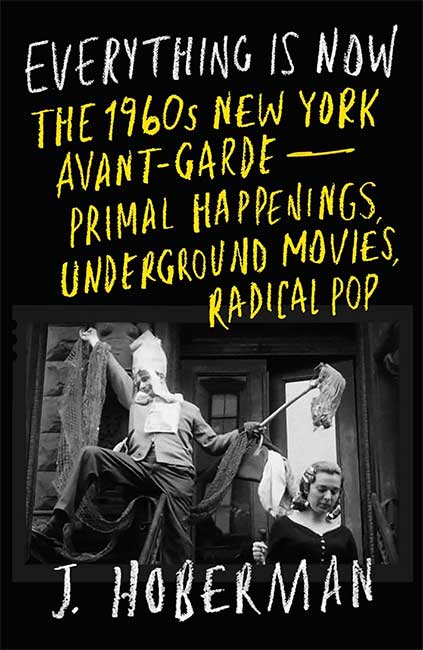
Everything Is Now. The 1960s New York Avant-Garde – Primal Happenings, Underground Movies, Radical Pop, J. Hoberman (Verso)
We all, whether there or not, tend to idolise the 60s now. It seems to be the last time that a huge amount of people (in the West at least) had any ideas of ‘revolution’ and changing the world. The blurb on this newly-into-paperback book says that ‘New York in the 1960s was a cauldron of avant-garde ferment and artistic innovation’ and that the people involved’s art was ‘rooted in the detritus and excitement of urban life, was taboo breaking and confrontational’.
Everybody, of course, knows about Bob Dylan and the Greenwich Village coffee bars, about Andy Warhol’s art and the Velvet Underground, some people even know that Yoko Ono was a famous performance & conceptual artist before she met John Lennon. What you probably don’t know about, or I certainly didn’t, is all the poets, avant-garde musicians, alternative film makers and radical theatre groups whose names have been forgotten or their radical pasts ignored but are present in this book.
Allen Ginsberg was, of course, Howl-ing at the time, The Living Theatre were exploring performance art as political theatre, and the likes of Nam June Paik were using new technology such as film, TV and sound equipment to radicalise the visual arts, but there were hundreds of others making their own statements about artistic form, politics, gender and sexuality.
Budget films, often in tentative or provisional edits, were shown in pop-up cinemas, reappearing months later as something else, or simply abandoned. Some were censored and the makeshift cinemas shut down, others were collaged together or cut-up into psychedelic anti-narratives, just as others were doing to language in new forms of fiction and poetry. There were concerts in people’s lofts (once industrial spaces now illegally lived in) for free jazz, improvisational music, rock and contemporary classical works by the likes of Stockhausen. Noise became part of music’s vocabulary, as did atonality and rhythmic complexity.
Drones could be sustained indefinitely (there is a current ‘Dream House’ installation by La Monte Young and Marian Zazeela, featuring lights and sine waves, currently in Tribeca, which has been running since 1993), jazz could be used for meditation or aggressive political statements. Miles Davis attempted to combine bop with Stockhausen and African music, The Velvet Underground were the house band for Warhol’s music and dance venue The Exploding Plastic Inevitable, offering dark hymns to sex and drugs and mental angst amongst strange projections and perverse dancers.
Theatre companies reinvented existing plays according to the brutal deranged visions of Antonin Artaud, or created new ones as processions, festivals or durational events, whilst films also became lengthy, whether detailed close-ups or clusterfuck abstract provocations. Nudity and profanity became everyday artistic occurrences, narrative was out, mood and emotional provocation in.
Of course, there was censorship, audience revulsion and arguments between individuals, organizations and movements. There always is. And Capitalism is good at commodification, so soon certain aspects of this new artistic activity would be incorporated into more mainstream releases and events, which could me marketed as ‘alternative’ or as part of ‘the counterculture’. You could try selling albums of experimental jazz or you could dilute it as jazz funk or call it Afro-jazz; art exhibitions could encourage bewilderment and confusion (and then investment/purchase); the freakshow could be monetised or shut down. And it was.
And then of course there was political fightback and urban redevelopment. Loft living would go on to cost thousands of dollars in rent, uninsured events, shops and concerts would be outlawed, venues closed down, and the city tidied up and gentrified. New York may have officially been dangerous, dirty and bankrupt back then (it was also full of energy and opportunity, and a great place to be) but cheap rents, artistic exploration and the like wouldn’t be tolerated for long, even though the city and its compatriots fought back.
Everything Is Now is encyclopedic. Its 400 pages of very small typeface come with another 30 pages of notes as well as a lengthy index, and is bewildering in its detail and coverage. It’s fascinating stuff but there is simply too much to take in: I ended up dipping in and out of it, reading a few pages at a time, or using the index to follow the antics of someone specific.
I have to be honest and say I learnt a lot but reading the book was a bit of a chore. For a less detailed but more enjoyable account, I recommend Kembrew Macleod’s 2018 book The Downtown Pop Scene which follows events from 1958 through to Punk in 1976. Like Everything Is Now it has a long subtitle – New York City and the literary punks, renegade artists, DIY filmmakers, mad playwrights, and rock ‘n’ roll glitter queens who revolutionised culture – and is wide-ranging and well-informed, in a more generalised and less-specific manner. They make a good pair of books.
.
Rupert Loydell
.