
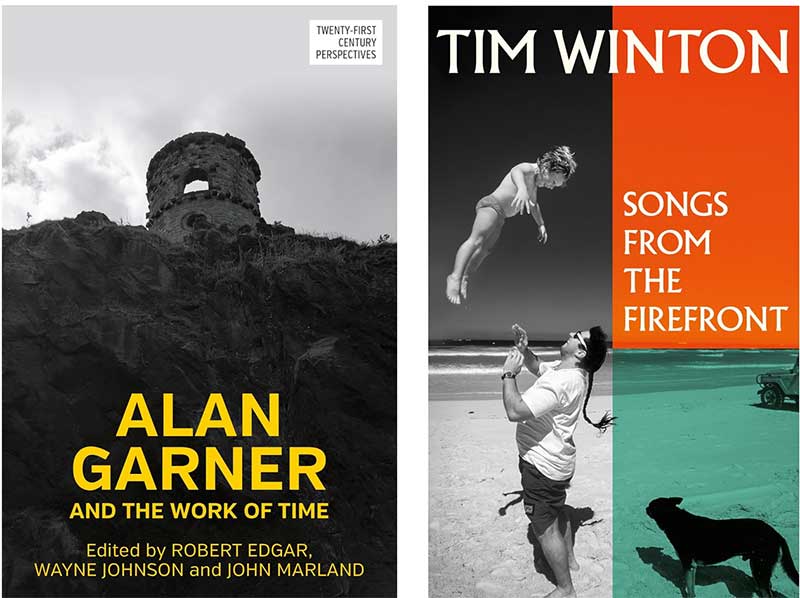
Alan Garner and the Work of Time, eds Robert Edgar, Wayne Johnson and John Marland (Manchester University Press)
Songs from the Firefront, Tim Winton (Picador)
Two very different books of essays, one an academic anthology of writing about the Cheshire novelist, the other a gathering up of personal writing from an Australian author and activist.
There’s been a tragic lack of critical writing about the work of Alan Garner, despite huge sales of his earlier books and the fact of his most recent short book, Treacle Walker, being shortlisted for the 2022 Booker Prize. He didn’t win, but it did draw attention to Garner’s later writing rather than the fantasy fiction he made his name with (The Weirdstone of Brisingamen, Moon of Gomrath, Elidor and The Owl Service) which was marketed as writing for children.
Otherwise fans of his work have had to rely on Garner’s two books of essays, Neil Philip’s 1981 book A Fine Anger (Philip was working on a revised and expanded edition before his untimely death, with additional chapters on newer titles and themes such as shamanism), the special edition of Labrys magazine, the rather mawkish and back-slapping 2016 collection First Light: A Celebration of Alan Garner, along with the rather wonderful The Unofficial Alan Garner Website, which gathers up or links to numerous articles, reviews, blog entries, essays and interviews.
I was expecting Alan Garner and the Work of Time to be a well overdue correction to the paucity of published critical work – in book form – on Garner, but unfortunately it is more akin to First Light than A Fine Anger. Although embracing current or recent ideas of psychogeography, deep time, hauntology and folk horror, there is little here that hasn’t been said before, usually in better form. Take John Marland’s ‘Dancing on the Edge: Alan Garner’s shamanic art in Thursbitch’ for example. It’s actually one of the better and most informative essays here but Neil Philip’s essay ‘England’s Dreaming’ says it better in a more lucid and readable manner.
Another problem is the lack of overview. The authors of these essays are mostly focused on a single or small cluster of titles rather than stepping back and giving us a wider view. They also seem unable to interrogate Garner’s romanticism with regard to his own writing process, question his cultural appropriation when it comes to Welsh myth or the Aboriginal dreamtime, or to offer criticism. I know I am not alone in finding Boneland a clunky and awkward book, especially when read as the final book in a trilogy with his first two fantasy books, which Garner himself tends to regard as juvenalia.
Many of the chapters here seem to pick up important themes – history, landscape, time, memory and myth – that are key to understanding Garner’s work, but the essays turn out to be very specifically focussed. Personally I am very interested in Garner’s ideas about time, most recently with reference to the ideas of theoretical physicist Carlo Rovalli, suggesting that time is not linear but co-existent. I’d like to have seen this applied to or considered in relation to the intertwined stories of Red Shift, intergenerational family history and storytelling (self-mythologising?) in The Stone Book Quartet, embedded memory in the landscape of Thursbitch and The Owl Service as well as the re-enactment and co-existence of the two worlds in Elidor. Not to mention how folk tales, including Trickster stories, both of which Garner has collected and retold, fit into all of this.
Maybe I just want a different book from the one this is? Perhaps it is unfair to judge a book by what it isn’t? But for me there is too much personal reflection here, too much summary rather than critical intervention or understanding, none of it helped by two ‘Afterwords’ which are again personal works that are out of place in a book of academic essays. Garner’s work since Elidor has been original, innovative and at times bewildering; all of it at the very least interesting and conceptually creative, and that work deserves more attention and thought than most of the authors here offer the reader. In the main this volume feels slight and sometimes disengaged, a little removed from the concerns of Garner’s writing.
I hope it won’t be too long before there is more informed and wide-ranging attention to Garner’s work. In the meantime I shall mostly be returning to Philip’s book, the essays in Garner’s own non-fiction, The Voice That Thunders and Powsels and Thrums, and of course, the Unofficial website.
Tim Winton’s Songs from the Firefront is perhaps more wide-ranging than Garner’s essay collections and less directly concerned with Winton’s own writing. It’s a strange mix of autobiographical fragments, lyrical nature writing (for want of a better term), militant eco-warrior opinion and personal reflection. That lyricism is at times at odds with Winton’s tougher take on things, although a piece like ‘Rednecks’ reveals the author as an older man dealing with disappointment, compromise and the realities of jogging along with others in a small town.
Winton, it seems, divides Australians. Only this morning someone emailed me a review article about Songs… with a title that begins ‘Loved and scorned for his sincerity’. I’m reminded of U2’s Bono: famous people who use their fame to try and change the world, and get flack for it; who talk, write or sing about spirituality, faith and doubt but swear and drink too much in public. Even though they manage to write great novels and make good music.
Anyway, where was I? When I was a kid my Ladybird book about Australia enthralled me, but along with reports of embedded sexism and racism, reading Winton’s account, in ‘Staying’, of enduring a cyclone, locked down on his own in a house, not to mention other parts in the book about the extreme heat or aftermath of storms, have only convinced me to abandon the idea of travelling there as a childhood dream. (We’ll probably be getting those extreme weather conditions here before too long anyway.)
So being a Pommy softie, I prefer to read about Winton’s face-to-face encounter with a whale, or his family enabling his ill mother to get into the sea with Heath Robinson like eccentric approaches, eventually abandoned in favour of human contact, natural buoyancy and support in the water. And his intelligent critical responses to big business and corrupt politicians attempting to subvert justice or make use of natural resources. Winton is big on saving mangrove swamps and coral, creeks and estuaries that act as habitat for both native and endangered species.
That willingness to be outspoken and critical, which sometimes spills over into his novels, also trips itself up sometimes in defending or championing ordinary people. Winton falls into the woolly liberal trap of thinking everyone is special, different and unique, that they make up the world which he is part of. He’s right, of course, on one level but he seems unaware that he has silenced and perhaps compromised himself when it comes to his redneck neighbours, and that a lot of the characters in his novels are not, in any way, ordinary. They are often angry, hurt, abused, violent, lonely or gifted. They sometimes act and speak strangely, run away, damage others and themselves, often in a militant, occasionally macho, way.
Highlighting things such as male anger and dysfunction is, of course, a form of critique. I’m not someone who shies away from the very real forms of emotional and physical abuse and hurt that Winton writes about, nor the questioning spirituality that sometimes flickers into view. Winton may at times eulogise or hymn nature, but he knows human life is dirty and painful, whether conducted in urban or rural environments, wherever it occurs in the world. Despite this Winton appears to proudly embrace the cliché version we hold of Australians: surfer dude who is always in the ocean, happier outdoors than inside, with a love of BBQs, cans of beer and camp fires. That, however, sits alongside his concerns about Aboriginal rights, wildlife and colonialism, and that dedication to staying put and jogging along in a community he sometimes seems at odds with: politically, culturally and artistically.
When I interviewed Winton several years ago, he gentle teased me about the fact that several of my questions were about his most popular novel Cloudstreet, but the final chapter in this new book (predictably, my favourite essay here) addresses some of the criticism he faces about what many perceive as colonial and nostalgic tropes, along with the book’s bizarre scenes of familial and household turmoil and conflict in a shared house, not to mention a grandmother camping in the garden and the strange use of a talking pig and a child with cognitive disability to facilitate parts of the story.
Winton’s essay refutes some of the accusations, mostly by revealing how he made use of his family’s biographical details, remoulding and adapting them within his fiction, yet retaining the everyday attitudes and speech idioms of the time he writes about. Although he still distances himself from the book he ‘know[s] it has music in it, and that there’s life in its pages’, noting that ‘[w]hile it’s not strictly about my family, I feel them in its riverine currents’.
Just as Alan Garner writes about where he lives – a part of Cheshire where his family have been for generations – Tim Winton writes, in this book anyway, of how he sits in the landscape and tries to respect its indigenous peoples, as well as the natural world. Both have written books about imaginary and bigger landscapes, both are rooted and at home rather than restricted by the specificities of place. Understanding where they are allows them to wander and travel in their fiction through both inner and outer worlds, and us with them if we so choose.
.
Rupert Loydell
.