
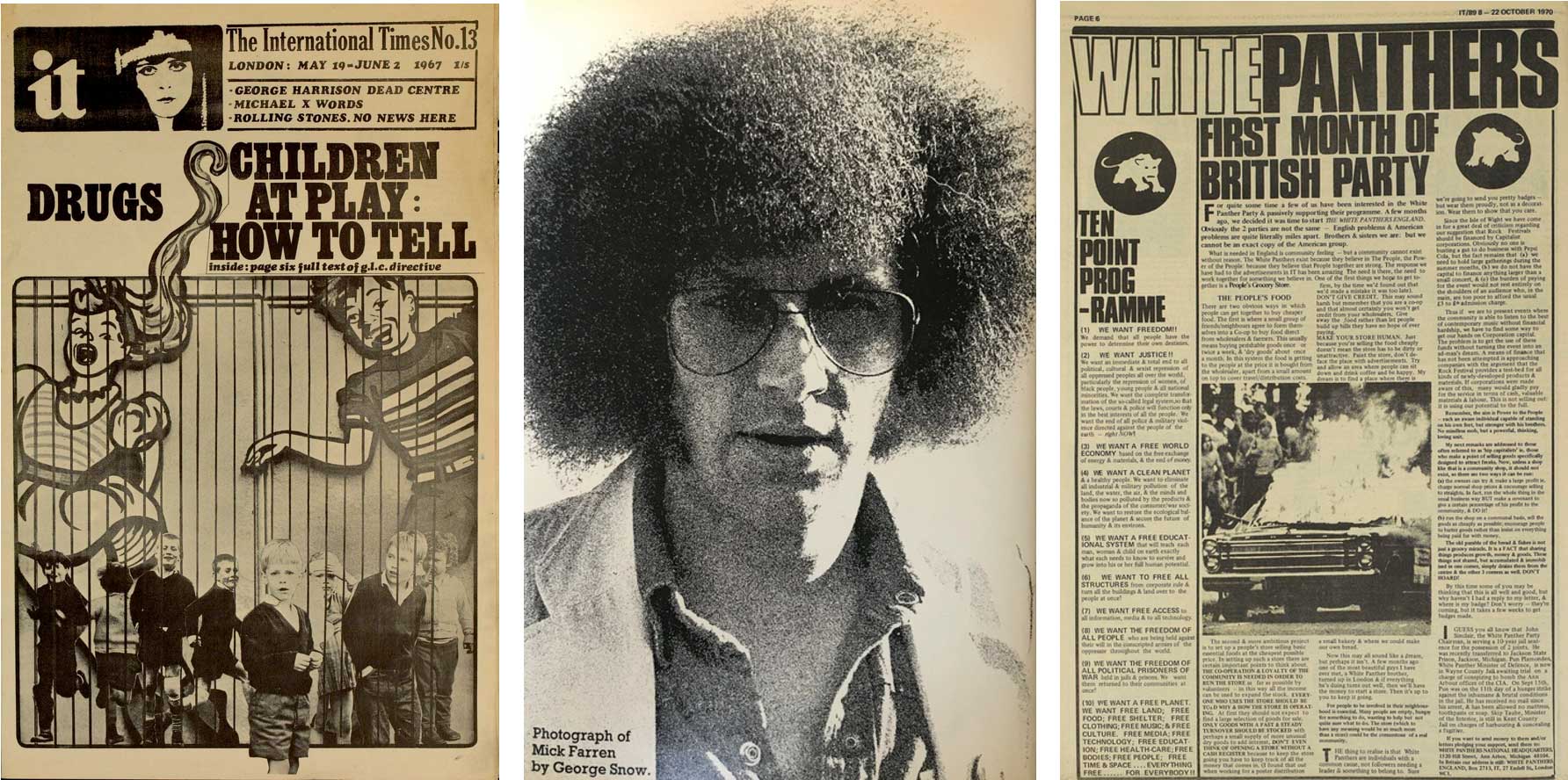
For a while during the early 1970s, International Times almost approached the status of ‘official’ newspaper for a political party, sort of on a par with Pravda or the Chinese People’s Daily… (sort of). How this surprising situation came about is an unexpected story.
There was always a turnover in the editorial staff at IT. In May 1967, coinciding with the appearance issue 13 of the paper, a fresh News Editor was appointed – Mick Farren. Mick (besides being the husband of Joy, whose work I described in a previous article) was something of a Swinging Sixties Renaissance man. He was, at the time, the vocalist for the band The Deviants. They were a stripped-down rock outfit – akin to the MC5, sort of proto-punk- whose first album, Ptoof!, was described as “the worst record in the history of man” according to their own manager Steve Sparks, thereby endorsing the judgment of critic Richard Williams that the Deviants were the second worst band he’d ever seen. Maybe this lack of critical praise is why Mick felt it was good to have a proper job.
For all their musical shortcomings, though, the Deviants supported the right causes. They were committed to playing benefit gigs to raise funds for charities and others: they performed for striking students at the University of Essex, they played to help Young CND and Oz magazine and they appeared at anti-Vietnam war and anti-apartheid festivals. This practical action was part of Farren’s politics, as we shall see. All the same, he didn’t see the band as the limit of his ambitions; he had bigger plans- he soon became a music journalist and, in the longer term, a writer of science fiction. Oh, and he also founded a political party- by accident.
To understand how Mick Farren went from raising funds by playing gigs to leader of a revolution, we need to know a bit about International Times during this period. Finances had always been a bit precarious and the paper’s critical, anti-establishment stance didn’t help with this at all. The early issues of IT featured regular columns on drugs and censorship and the paper was vocal in its opposition to the Vietnam war and to the British military intervention in Ulster, whilst at the same time fully supporting the Sexual Revolution, the counter-culture and a liberal, permissive agenda generally. The authorities wanted to rein IT in, if possible, and first tried to do so in March 1967, when the paper was barely nine issues old. A police raid took place under the Obscene Publications Act 1959, during which officers confiscated all available copies of the paper as well as a great deal of the paperwork from the office- such as the subscription list. The aim seems to have been to have made life impossible for IT but, as it turned out, there was no evidence to support obscenity charges and so the investigation had to be abandoned and all the paperwork returned.
However, that summer, the Sexual Offences Act came into effect, decriminalising sex between men over the age of twenty-one. IT moved with the times and was soon known for its gay personal ad column. This, unfortunately, gave the police an excuse to have a second go at shutting the paper down, and another raid took place in April 1969. This time it was much more serious and, in December that year, the company and the editor were formally charged with two offences – conspiracy to “induce readers to resort to the advertisements for the purpose of homosexual practices and thereby to debauch and corrupt public morals, contrary to the common law” and conspiracy to “outrage public decency by inserting adverts that were lewd, disgusting and offensive.” The case finally went to trial at the Old Bailey in November 1970. Although it’s not directly relevant to the subject of this article, I’ll say that IT lost at the central criminal court (and at the subsequent appeals to the Court of Appeal and House of Lords). The judges’ reasoning was shocking- the 1967 Act may have made gay sex between consenting adults lawful, but it turned out that doing anything to help those adults meet each other was still illegal…
Needless to say, the personal and financial pressures of preparing defences and appeals for such serious charges over a period of more than three years were enormous. International Times was in a bad way and needed to raise money desperately to keep running and to meet the ever-mounting legal bills. Enter Mick Farren and a good idea.
Mick had been in a band who did benefit gigs. He proposed organising a festival, the proceeds of which would go to the IT bust fund. Now, the omens here weren’t especially fantastic. Back in April 1967, at the time of the previous legal trouble, a huge multi-band benefit (including the Deviants) had been arranged at Alexandra Palace. We can’t really say that this event was ‘organised,’ because the organisation was so poor that much of the ticket money went missing and IT actually got very little. Secondly, of course, Mick was a vocalist, he wasn’t a promoter; he’d never organised a major festival in his life. Still, what could possibly go wrong? Almost everything.
There were numerous problems for Phun City festival, held near Worthing in late July 1970, but by far the biggest was that the main sponsor pulled out just days before the gates opened. It was too late to find alternative funding- and too late to cancel- so Phun City became – unintentionally – Britain’s first free festival. Naturally, a large loss was made and no funds were raised for IT. The only good news was that the freak community had pulled together to make the festival happen and had shown that the counter-culture could achieve things outside the conventional system of ‘bread’ and material ambition.
Was Mick Farren bitter about the fate of Phun City? Yes, it seems that he was. He decided to take some sort of revenge against the next large commercial festival that was to take place – the huge August bank holiday event on the Isle of Wight. This promised an incredible line-up, including Jimi Hendrix, the Doors, Leonard Cohen, Joni Mitchell and many others. Mick resolved to go to protest against the music business exploiting the music of the ‘freaks’ – charging young hippies extortionate sums (actually, £3 for the weekend) to be able to see the bands that they themselves had fostered and supported. Mick intended to cause trouble and to try to make the Isle of Wight a free festival as well. However, he didn’t want to do this as a representative of the IT editorial team – the paper had enough problems; a cover was required, one that could be denied and abandoned later.
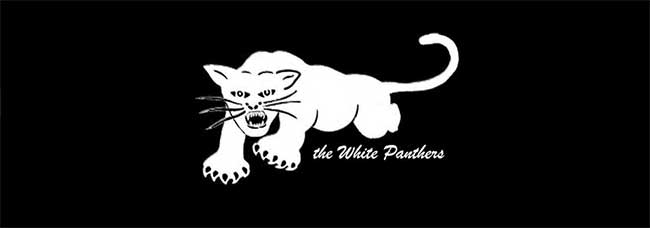
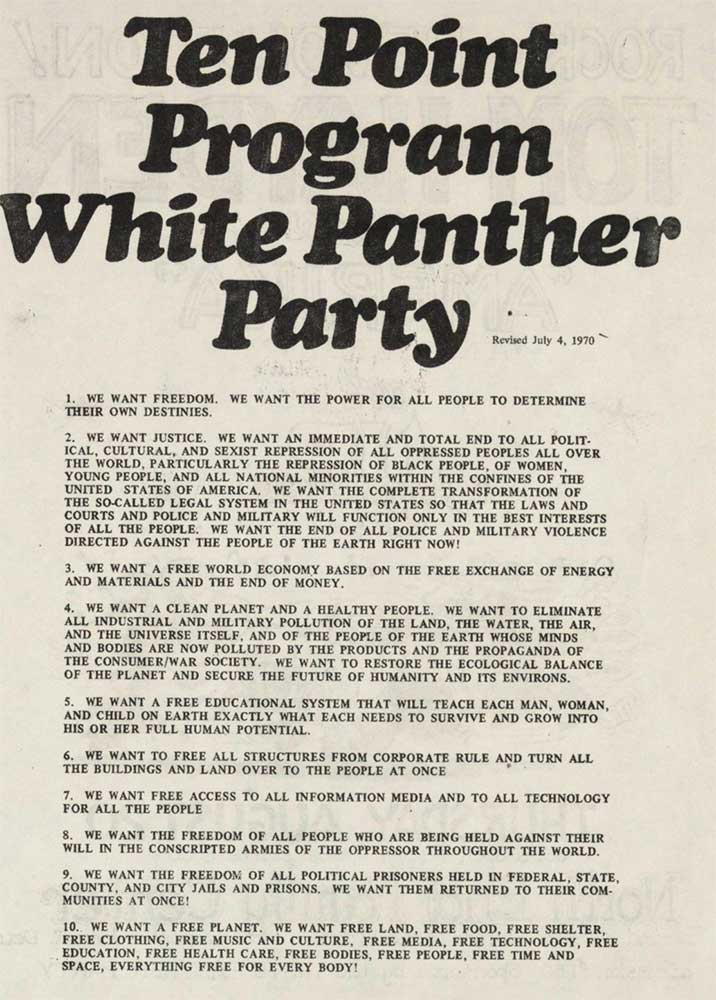
Mick Farren chose to act in the name of the White Panther Party. This was already well-established in the United States; it was focussed around Detroit and was closely linked to the rock band, the MC5, who were active party members as well as raising most of the funds for the Panthers through their gigs. Like the Black Panthers, which they copied, the White Panthers were an explicitly socialist and revolutionary movement and one not necessarily averse to violence.
In August, Mick founded the UK White Panther Party (WPP) and began to issue statements in its name, attacking the profiteering of forthcoming Isle of Wight festival. Arriving on the island, he continued to harangue the organisers but also found that the situation at the festival site favoured his plans. Firstly, the venue sat in a depression, surrounded by hills, which meant that thousands of fans were able to camp outside the perimeter fence for free and yet see and hear all the acts. Secondly, a variety of political activists and anarchists had turned up with the same aim as Farren. After the failure of negotiations to open up the festival for all for free, the WPP and their allies stormed the security fence and managed to demolish a section. The promoters gave in to the inevitable and the gates were thrown open. Mick Farren had made his point. A day later, Isle of Wight 1970 ended and everyone went home.
On the face of it, the fictional WPP had served its purpose and wasn’t needed any longer. However, what Mick discovered was that he had – to misquote Withnail and I – “gone on holiday and started a political party by mistake.” The idea of the White Panthers was what a lot of people in Britain had been looking for and they responded by taking Farren completely seriously and forming their own local ‘chapters’ across the country. Carried along by events, Mick and Joy found themselves part of the West London chapter, centred around the hippie bohemia of Notting Hill and Ladbroke Grove; further, given their leading roles at International Times, the paper naturally became the national medium for spreading the WPP message. It regularly carried statements from the UK Party, as well as updates and news from the local branches.
In the US, as I described, the Panthers were radical and flirted with armed insurrection: the MC5 were photographed with automatic weapons and some party members bombed a CIA office in Ann Arbor, near Detroit, where the Panthers had their HQ and commune. In the UK, needless to say, the issues and society were very different. The WPP became local activists, organising squats, food banks, free shops, nurseries, youth clubs and theatre and arts groups. They had their own chapter newsletters and, whilst they were particularly interested in the needs of the ‘freak’ community – matters such as police harassment and drugs busts – they were engaged with helping pensioners and poor families as well.
All these projects needed money and this is where the musical link comes in again. Benefit gigs were often arranged by local chapters as a means of raising funds. More importantly, just as the MC5 were the ‘house-band’ of the Panthers in Amerika, in Britain Hawkwind and the Pink Fairies (the new name for the remaining members of the Deviants) were particularly identified with the WPP, regularly performing benefits or making donations.
The White Panther Party took on a life of its own, out of the hands of Mick Farren. The DJ John Peel once jokingly claimed that “there were only two White Panthers and Mick Farren was the leader.” This was funny, but it wasn’t fair: there were at least twenty chapters across the UK and, although their national impact was limited, they did a lot of tangible good for the poor and vulnerable in their areas. This is an achievement to be recognised and praised, rather than dismissed and forgotten. Sadly, though, the White Panther Party always comprised a relatively small number of committed people. It never took off or built a mass following, with the inevitable result that the activists suffered burn-out and the various projects quickly lost momentum. Founded in August 1970, the WPP had largely vanished by mid- to late 1973. People moved on to other political parties; Mick Farren became an early and vocal advocate of the need for something like punk to shake up the music industry, as well as writing novels and penning short stories for glamour mags. In due course, he moved to live in Amerika and became a prolific author. Sadly, he died in July 2013, performing on stage with the reformed Deviants.
 For the full story of the WPP, see my book White Panthers, Dwarves and Diggers – Music and Radical Politics in the 1960s and 70s, published as an e-book and paperback by Amazon.
John Kruse
The IT International Times archive can be found here.
.