
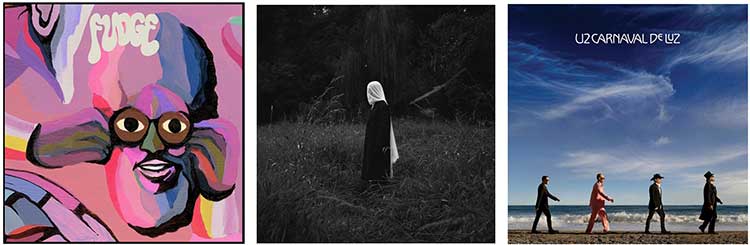
Fudge by Michael Kiwanuka (Polydor)
I Killed A North American Songbird by Natalie Bergman (Third Man Records)
Carnaval de Luz by U2 (Island Records)
Michael Kiwanuka’s Fudge begins with the voice of the late jazz pianist Chick Corea speaking about the importance of musicians creating what they ‘think is beautiful’, not what they think ‘sounds good to others.’ That is what Kiwanuka has done with this self-produced and semi-improvised album created in his own studio at the same time that his wonderful fourth album Small Changes was being recorded.
At the end of ‘Summer Clothes’, the opening song that begins with the Corea quote, is an outro, another quote, this time what sounds like a studio outtake spoken by Kiwanuka in which he says: ‘I don’t know what I’m doing. I don’t know if this is the right thing to do. It’s frickin’ scary.’
These two quotes provide the parameters for an album that musically is relaxed, languorous and sinuous – drawing comparisons with the vibe and feel of Isaac Hayes’ Hot Buttered Soul, with its lush and slow string-surrounded soul-gospel extensions of pop songs – while, lyrically, the album explores anxiety, loneliness, break-up, insecurity, and the importance of relationship and music.
Consummate intuitive musicianship and beautifully meditative melodies entrance throughout but the songs are primarily reflections (not personally confessional) on the kind of mental health issues Kiwanuka faced earlier in his life and career. ‘Drowning In Your Heart’ is symptomatic of the feeling Kiwanuka explores: ‘Your face / To face / With life / And all it’s gonna be / I know / You feel / You don’t belong’. As a result, ‘Over and over again / I see you / Drowning in your heart / Baby, every chance that you get / I see you / Drowning in your heart’.
‘Drowning In Your Heart’ is addressed to a lover but many songs are written as expressions of loneliness, distress or fear: ‘If I could see what you could see / I would walk around / I wouldn’t have to hide / The way I feel / For a long, long time now / I only talk about / The pain I feel inside / When you’re not there / Volunteer and change for me / All my trouble / And worries on my mind’ (‘Love In My Heart’). The central character has love in their heart and knows who they long to be, so asks to be taken to the time ‘When you were by my side / And I would share’, but is not there.
When love is genuinely found it sets free from such mental distress and sends ‘me flying’ and keeps ‘me smiling’ (‘You Sent Me Flying’). He also lauds the power and presence of music, ‘We’re nowhere if we never sing’, so sing (‘Sing’). The album ends on a point of equanimity with those forces coming together: ‘I see the wood through the trees / Tears in my eyes stay with me / Now that my heart feels like a hotel room / I can be clear / I can be clean … Baby, it’s alright / I’ll hear you sing again / Life has a way / Swings and roundabouts.’
‘Steve’s Paradise’ encapsulates the plea Kiwanuka makes through this album to any who have felt as he has felt: ‘Run / To the one you love / We can be friends / Shine / Everyone you love / Is free in the end / Come / To the other side / Follow the road / Now / I can’t be the one / I’m hollow and done / Hollow and done’.
The warmth and wonder of Fudge are all the more poignant in that its release was delayed due to the haemorrhagic stroke Kiwanuka experienced in July 2025. Still in rehabilitation and unable to return home, he doesn’t when he will next make music. Without knowing what was about to happen to him personally, with Fudge Kiwanuka has made the perfect album to encourage holding on in distress with the hope of coming through to experience better days, love and flights. Thoughts and prayers for Michael in his recovery.
Natalie Bergman has released an unusual EP on which she has turned her attention to the natural world and its increasingly fragile existence. I Killed A North American Songbird is a small collection of songs ‘inspired by the disappearance of the natural world around us — specifically the creatures that surrounded me while I was growing up, and their very obvious demise. Oaks, songbirds, salamanders, foxes…’
Bergman: ‘started to think about how I have directly contributed to their destruction in so many ways. After accidentally hitting an Indigo Bunting with my pickup truck, I made a series of blue/indigo paintings which inspired the music for this EP. It’s a direct plea to myself to continue to take care of the earth and all its inhabitants.’
In gentle songs featuring Bergman’s trademark razor-sharp melodies and interlaced harmonies but in a more contemplative and experimental frame, she writes about loss with deep insight and beauty, from the space at the Christmas table through the absence of her father to the inability to find honey in the woods any longer.
She listens for the sweet voice of the indigo bunting but worries that what she hears is an illusion (‘Indigo Bunting’). In ‘Disappearing’ she walks into the woods ‘to remember my name again’ and mourns the loss of wildlife she observes – ‘Everything has turned into dust’. In ‘Peregrine Falcon’ she finds freedom through observing the falcon sweeping and riding the thermals. She laments the tethering of such birds, concluding ‘All that is wild is better left alone’.
Bergman is increasingly a multi-media artist combining music and painting, while commissioning intriguing art films to accompany her music. Her collaborators here include the distinctive and empathetic voice and harmonies of Staz Lindes, from The Paranoyds, which grounds the sonic flights of Bergman’s breathy and light vocals.
Mid-career, U2 famously went away to ‘dream it up all over again’. They returned then with Actung Baby, their best and most experimental album. They accomplished the same feat by returning to their classic sound with All That You Can’t Leave Behind and have pulled off the same trick again with Carnaval de Luz by returning to their experimental mode.
‘Go (Carnaval de Luz)’ begins with a Zooropa-style sonic firestorm but leaps into a lithe loping semi-rapped electronic number that is an invitation to a carnival of light in the face of the darkness sweeping our world currently: ‘I’ve had it with the fear, can’t bеlieve I made it hеre / Came to find the other people who feel like this (Go) / Carnaval de luz (Go)’.
The band, and Bono in particular, have been activists who have used their fame and influence to negotiate better allocations of resource to those most in need in our troubled world. They recognise here that we are now in a different place where such change is not possible, at least for them, and a different approach is called for. Bono has said ‘It’s a new world. This is different. There’s a whiff, there’s a honk, and we’re all just trying to discern it. There’s a brand new dance and we do know its name. It’s a little … fascistic. And it needs a different response.’ Their response on the two EP’s that preceded Carnaval de Luz has been to become both more openly political and spiritual. In doing so, they also highlight others in the same territory they are in – ‘Catholicism, the saints, love for God’ – ‘The re-enchantment of the world’ (‘The Mirror Maker (Rosalía)’).
In this world where the carnival of light is needed, the ‘kings or queens or emperors of despair’ are those through whom ‘the prince of the power of the air’ speaks (‘If the World Is At War We Better Not Be’). While the powers of evil are often operating at national level, they also need to be faced more personally, as in ‘Torn’, the closing mournful duet that was Dolly Parton’s last recorded vocal: ‘Hands that used to hold you clenched in fists / Words that used to soothe you cut you into bits / Are you your brother’s keeper now? Or know what you’re fighting for? / Nothing hurts a mother more than a family at war’.
The carnival of light begins with resistance: ‘if you’re mad at this world and you’ve had enough / Don’t give up, no / In the imagination of God we are all made up’ (‘Midnight Sunshine’). When ‘the news can’t break us / That don’t make us superficial / Serious is what that makes us’ (‘Superficiality’) – with this line U2 respond to all the complaints in the media over the years about their earnestness. Such resistance involves turning the other cheek: ‘You spit in my eye, you’re a bareface lie / There’s nothing you can do to keep me from loving you’ (‘Glorify’). Then, in the dancing at the celebration of light, we learn to pray: ‘In your dancing, we learn how to pray (Rosa, Rosa)’ (‘The Mirror Maker (Rosalía)’). Our prayers are heard: ‘God hear me shout / Lend your ear to my prayer / When I’m far from anywhere / Down to my last breath of air’ (‘Street of Dreams’). As a result, we can ‘sing this without a doubt / A light has entered the darkness / No darkness can put it out’ (‘If the World Is At War We Better Not Be’).
After a series of albums that were somewhat insular and failed to fully ignite – Songs of Innocence and Songs of Experience reflected aspects of the band’s own story, while Songs of Surrender reworked their back catalogue – the band have their mojo back, as a result of looking outwards once again. The crisis of conflict and oppression that bedevils our world currently has re-ignited the band’s artistic imagination and musical attack as they seek to rise to resist those forces in the ways that music can. Carnaval de Luz builds on the EP’s from earlier in the year and taken together represents a body of work that stands with the very best of U2. ‘In case of emergency, break the glass / And go through the mirror’ (‘The Mirror Maker (Rosalía)’).
Jonathan Evens