
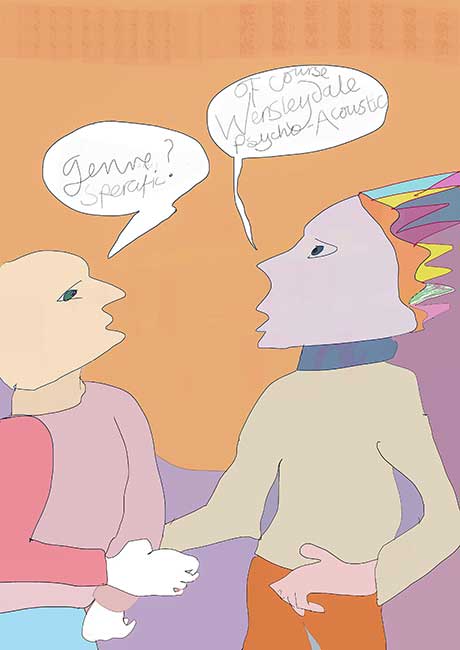
The Wensleydale Psycho-Acoustic Cheesemakers Society is an eccentric and fiercely secretive association of dairy artisans based in the rolling hills of North Yorkshire. Founded sometime between the invention of the tuning fork and the discovery that cows prefer classical music, the Society is dedicated to exploring the mysterious relationship between sound vibration, perception and the maturation of cheese. The Society combines traditional dairy craftsmanship with experimental acoustics, speculative gastronomy and a distinct strain of rural eccentricity. While no formal scientific institution recognizes its methods, the Society has nevertheless attracted a devoted following among artisanal cheesemakers, amateur physicists, folklorists, musicians and gastronomic adventurers.
According to Society lore, the organization was founded when local dairy farmer Barnaby Thistlewaite allegedly observed that several wheels of Wensleydale stored near the choir loft of a village church developed unusually complex flavours. Intrigued by the phenomenon, he spent the next decade exposing cheeses to various sounds, ranging from brass bands and cathedral organs to sheep bells and thunderstorms. His notebooks, known collectively as The Resonant Curd Papers, remain among the Society’s most treasured documents, despite the fact that no complete copy has ever been publicly displayed.
The French have caves. The Swiss have mountains. We have a carefully
calibrated collection of gramophones and an unreasonable amount of optimism.
Harold Finch, Master Acoustic Cheesemaker
The Society traces its origins to a period of intense experimentation in rural Britain. The late nineteenth century saw advances in acoustics, psychology, agriculture, and industrial manufacturing. While mainstream scientists investigated sound waves and human perception, a handful of agricultural enthusiasts became fascinated by the possibility that vibration might influence biological processes.
The founders of the Society argued that cheese occupies a unique position between the living and the inanimate and contemporary members believe that every cheese possesses a unique acoustic character. Their workshops are filled with wheels of Wensleydale suspended on velvet slings while carefully selected recordings of chamber music, rainfall, church bells, and occasionally experimental jazz are played through antique loudspeakers. The goal is not merely to mature cheese, but to cultivate its sonic terroir, a response to the subtle influence of sound on texture, aroma and flavour.
Society members argue that a hillside pasture possesses not merely a geographical identity but an acoustic one: the wind through dry stone walls, distant sheep calls, flowing water, church bells, and seasonal birdsong all contribute to a location’s sonic fingerprint, which in turn affects every regional cheese.
Our critics insist there is no evidence that cheese responds to music. We reply
that there is equally little evidence that cheese enjoy silence or being ignored.
– Statement issued by the Society’s Grand Council
The Society’s annual gathering, known as the Resonance Affinage Symposium, attracts cheesemakers, musicians, foodies, would-be philosophers and the curious from across Britain. Highlights include blind tastings of cheeses aged under different musical conditions, debates over the optimal frequency range for curd development, and the prestigious Golden Ear Award for excellence in psycho-acoustic maturation.
Among the Society’s most controversial claims is the assertion that a wheel exposed to string quartets develops a more nuanced flavour profile than one aged in silence. Sceptics remain unconvinced, noting a lack of rigorous scientific evidence. Society members counter that the proof is self-evident to anyone willing to listen carefully and eat generously.
Whether viewed as pioneers, enthusiasts, or charming eccentrics, the Wensleydale Psych-Acoustic Cheesemakers Society has become a beloved fixture of local folklore. Whether it represents a forgotten frontier of agricultural experimentation, an elaborate cultural performance or simply a celebration of human imagination remains uncertain. What is beyond dispute is the Society’s enduring fascination with the idea that flavour is never experienced in isolation. Every meal exists within a world of sounds, memories, expectations, and sensations and by treating cheese not merely as food but as a participant in that wider sensory landscape, the Society has created one of the most unusual processes in the history of gastronomy.
The Society’s motto could not be clearer or more succinct: “Every cheese has a song. Listen to the cheese, and the cheese will sing it to your tastebuds.”
.
Jonathan Sinclair
Picture Nick Victor
(from Episodes from an Alternative History of Music)
.