
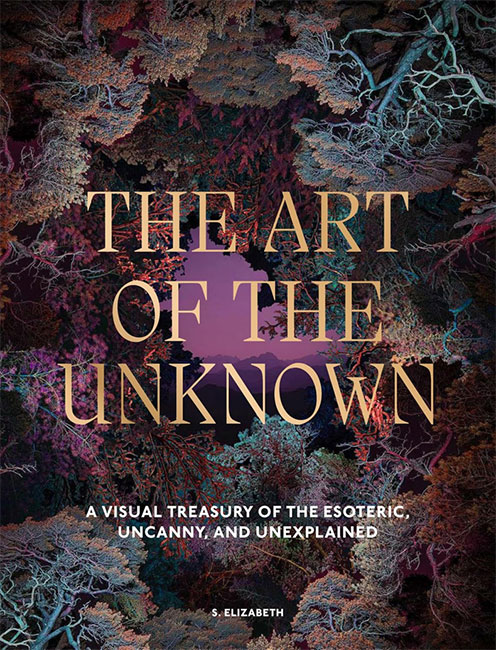
The Art of the Unknown, S. Elizabeth (240pp, hbck, £22, Frances Lincoln)
This ‘visual treasury of the esoteric, uncanny and explained’ starts with a great Introduction, entitled ‘The Mind Wobbles’, that riffs on one question: Why is it so hard to say ‘I don’t know’? Even better, it goes on to note that the book will not provide answers or explanations, just showcase how artists have filled the unknown, with stories, aliens and monsters, ‘cosmic forces and celestial powers’, ghosts and other apparitions, angels and impossible visions. There are strange spirits, mirrors that do not reflect what they should, unrealizable architecture and unlikely dwelling places, doppelgängers and mystical twins, charts, illusions and alchemical mysteries. S. Elizabeth, the editor or curator of this collection of images, suggests that this kind of art, along with fiction such as Magic Realism and Fairy Tale genres, and the non-fiction of occult, religious and mystical texts, helps us to dream, to process the incomprehensible, and to learn to wonder.
The Art of the Unknown is neatly divided into four sections, each with three parts. ‘Forces Beyond’ starts with ‘Cosmic Mysteries’, then moves on to ‘Hidden Watchers’ and ‘Transformative Powers, whilst ‘Realms Between’ considers ‘Parallel Worlds’, ‘Liminal Spaces’ and ‘Terra Incognito’. Primeval and creative forces are envisioned by the likes of William Blake, Van Gogh and George Frederic Watts, whilst Samuel Palmer, Odilon Redon and Goya imagine bogeymen, felt presences, as well as UFOs and their crews. Victor Hugo depicts ‘Casquets Lighthouse’ as a crumbling, Gothic staircase crowned with a smoky fire, whilst those who would employ or discover ‘Transformative Powers’ are often undertaking their alchemical and cosmic explorations within untidy, cluttered rooms, using mystical runes and charts to create new flowers, leaves, plants and creatures. Tino Rodriquez’s faerie, riding on a butterfly, is a girl in party dress with a skull head; Ithell Colguhoun’s ‘Alchemical Figure’ is a translucent stain revealing its inner organs; whilst Agostine Arrivabene’s ‘L’orbe’ features a headless birdlike torso holding the barely visible orb of the title.
The themes of ‘Parallel Worlds’ overlaps with some of the first section. There is a map of Hell (Botticelli), splendid depictions of a moth personified, the essence of vertigo, heroic kings and knights and ladies, a picture of ‘A Wrinkle in Time’ with flying horse and a visored alien, and a beautiful, bright and vivid imagining of the death of Cock Robin. This part ends with darker, more uncanny figures, including René Magritte’s one-eyed chess piece staring at a tower in ‘La Belle Lurette’, before we enter far emptier and eerier ‘Liminal Spaces’. Here are empty rooms, moonlit streets, a grey, blue and yellow nocturne, a surreal street scene depicting a train on a distant viaduct and a mirror reflecting an oil lamp that is not there, black cats and cemeteries. Cathedrals, abbey ruins, and empty theatre, the detritus in an artist’s studio, contrast with Kay Sage’s impossible architecture. Her ‘Hyphen’ shows a makeshift tower assembled from construction site detritus, lined with doors and curtains that are entrances to nowhere. ‘Terra Incognito’ is just as strange, even liminal, but rooted in more real, physical worlds. The mountains, woods and cliffs imagined here may be inhabited by mysterious figures and unexpected animals, even Robert James Enraught Moony’s ‘Wind Fairies’, but the mysterious elements are overlaid on existing, if sometimes unmapped, worlds. Andy Goldsworthy lays pieces of frozen ice on a fallen tree then photographs them, Santiago Rusinol uses a labyrinthine maze to focus our attention on the statue of the ‘Old Faun’ which gives his painting its title.
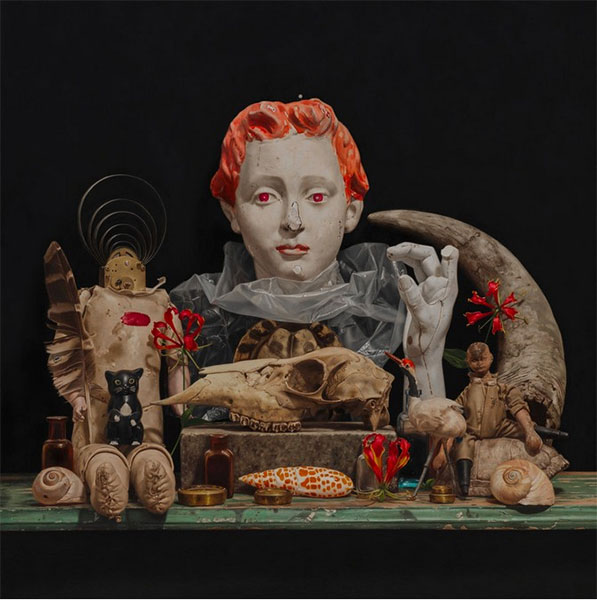 ‘Performance 4’, Matthew Bober
Next, Elizabeth gives us ‘Remnants, Relics & Revelations’, visual engagements with ghosts and spirits, the uncanny and then ‘Forgotten Knowledge & Mysterious Objects’. Welcome to worlds where the past lingers, the dead walk among us, and apparitions are an everyday occurrence, worlds haunted by memories of lost loves, desires and other selves, signalled by the presence of ‘death smoke’, distant, staring figures or ectoplasmic emissions. ‘The Uncanny Familiar’ in some ways presents less strange and more real images, but these can often be all the more disturbing because of this. Here are twins and differing versions of a person, the oddly strange, frozen ‘Arnolfini Portrait’, Narcissus adoring his own image, masked figures, distorted reflections, and Matthew Bober’s ‘Performance 4’, an assemblage of objects – including a stone head, plaster hand, animal skull, feather, flower and shells – as altar to something or someone unknown. We are then returned to the idea of secret things, of alchemy, natural wonder and imagined cosmologies, wrongly-mapped geographies, star maps and science we would now call magic. Here is Meret Oppenheim’s disturbing ‘Object’, a fur covered teacup and spoon, Félicien’s new ‘Religuary Group’ with found objects enclosed in fantastical glass containers, a painting of ‘John Dee Performing an Experiment before Elizabeth I, and Saint Jerome seeking knowledge through reading. Elsewhere we find diagrams of conjectured planetary orbits, a cross section of the Earth as a ‘cosmic machine’ filled with fire and rivers, and Durer’s personification of Melancholy.
The final part is ‘The Human Mystery’, which firstly considers ‘Visionary States’. Here we find depictions of dreamers, priests and priestesses, and of dreams and premonitions themselves. Some are caused by nature, others by music or drugs, all not only affect the mind but also the body itself, which the second part, ‘Corporeal Energies’, engages with. Here are images of bodies dancing, walking, at rest, lost on a raft at sea, or imagined as an angel or musical instrument. The short closing part, ‘Sacred Cycles’, attempts to gather it all up within the circle of life and death. Here are mandala, a wheel of fortune, notes of the phases of the moon, Hieronymus Bosch’s calm depiction of ‘The Seven Deadly Sins and the Four Last Things’, nature personified and flowers as constructive material for portraits, death and grief and, to end the gallery, Susan Jamison’s ‘The Mothership’ a nude figure cradled in a landscape, ‘her body serving as both womb and tomb’.
Like all good exhibitions, this book is the product of its curator. It relies on surprising the reader with contrast and juxtapositions, as indeed do many of the semi-surrealist works included. Through these surprises new connections and ideas are formed, new histories of knowledge: not just of art history but of ideas, concepts, imaginings and questioning. Will our scientific ideas be laughed at and dismissed in the same way we now regard alchemy? Will we allow the involuntary and unexpected to inform us? Will wonder remain a human faculty in an age of computing and A.I.? Can we know everything or is the unknown just our communal and individual over-active imagination?
S. Elizabeth does not offer answers, she simply shows us the creative evidence she has assembled and organized and encourages us to think and dream. There are a thousand other works that could have also been included in The Art of the Unknown but what we have here is an intelligent, glorious sample in a beautifully written, designed and produced book.
.
Rupert Loydell
.