
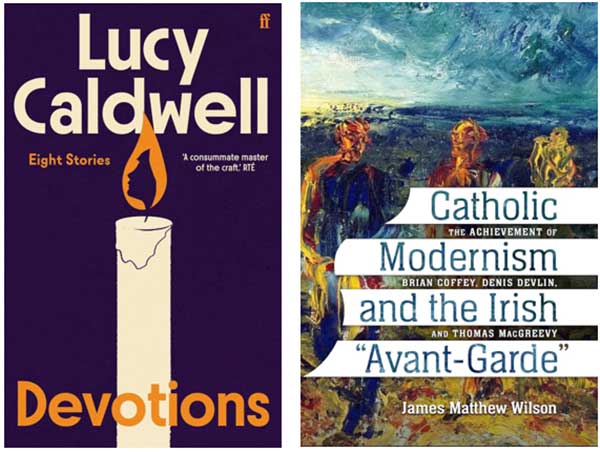
Devotions, Lucy Caldwell (Faber, 2026)
Catholic Modernism and the Irish ‘Avant-Garde’: The Achievement of Brian Coffey, Denis Devlin, and Thomas MacGreevy by James Matthew Wilson (The Catholic University of America Press, 2023)
The short story changed with the publication of Dubliners by James Joyce in 1914. Joyce said that he intended Dubliners ‘to betray the soul of that hemiplegia or paralysis which many consider a city’. He therefore conceived the work ‘as a sequence of fifteen epiphanies’, ‘written to let Irish people take “one good look at themselves”’ in ‘his nicely polished looking-glass’.
Epiphanic short stories, where a sudden spiritual transformation occurs for a central character – whether in vulgarity of speech or of gesture or in a memorable phrase of the mind or in the recognition of the soul of an object, person or event – have delivered many of the most interesting and revealing short stories published since, with Flannery O’Connor and Raymond Carver being exemplars of the genre.
Northern Irish novelist and playwright, Lucy Caldwell, is another such. Accordingly, she has said that ‘Some of my favourite stories are those in which nothing and everything happens – stories that seem to operate on this material and human plane, and yet have another, palpable spiritual dimension.’
Devotions is her fourth collection of short stories. The stories of Multitudes ‘were tightly focused on Belfast girlhood’, Intimacies on motherhood, and Openings about the ways that our lives can shut down and open up. Devotions contains eight stories of love, grief, longing, of new beginnings, and the ways we find shelter in each other. Rosemary Jenkinson writes that: ‘Devotions, overall, is a heartfelt hymn to discovering spirituality amidst a life of stasis. The unifying strength of this collection is the superbly realised sense of epiphany for each protagonist.’
These epiphanies arrive in a variety of different forms, some relating to organised religion, others not. A young Belfast theatre troupe brings its experimental production of Hamlet to New York and the central character ponders her life direction in the wake of an offer of a new relationship following the death of a former partner. A mother ponders the things to which she is devoted as she shares her love of The Sound of Music with her daughter. On a night-flight, travelling with a violin older than the United States, a professional musician slips through time in order to contemplate the mystery of what survives and why. ‘Devotions’, the final tale, is also, as Caldwell notes, a ‘story of great mysteries across space and time’, one centred on an online viewing of the Winter Solstice. ‘The Day He Met Jesus’ asks us to reflect on ‘how different life might be if you could see every traffic warden as Jesus, or set out to be the sort of person who might, just might, be able to’. The diversity of these stories and their inspirations is deepened when we read that this latter story ‘owes a debt’ to one told by Ram Dass.
Caldwell comments that people often misunderstand the appeal of short stories thinking that they ‘suit our short attention spans’. She writes that stories matter ‘not for their brevity but for their intensity – not because their length makes fewer demands on the reader but because it demands more’. The stories in Devotions demand much of their readers both in understanding their compressed depths and in the questions they ask of us and our lives.
There are more that a hundred years between Dubliners and Devotions with Brian Coffey, Denis Devlin and Thomas MacGreevey being among the literary figures who people that timespan. These three Irish poets are primarily known as a triumvirate that introduced international modernism to Ireland by breaking with the nationalistic antiquarianism of W.B. Yeats. As such, all three spent time in Paris and were known to the likes of Joyce, Ezra Pound, T. S. Eliot and Samuel Beckett.
James Matthew Wilson argues, however, that this aspect of their work and achievements is too narrow and obscures from view the extent to which the Catholic faith of each is expressed through their modernist works. In making this case, Wilson explores the breadth of their writing, not just their poetry, and the other interlocutors with which they engaged; the Augustinian theology of The City of God in MacGreevey, the neo-Thomism of Jacques Maritain’s Paris for Coffey, or the Pascalian or Jansenist-inspired poetics of Devlin.
By means of Wilson’s dense and detailed examination of the work of these three poets and the theological ideas on which they drew, readers gain insight into aspects of Irish nationalism and culture at the beginning of the twentieth century, the early days of modernism and the international links which supported its development, and Catholic approaches to culture pre- and post-Vatican II together with the sources on which they drew. This is all in addition, to the insights provided into the lives and work of these three fascinating poets whose work has not been fully understood or appreciated. Hugely significant poems such as MacGreevey’s ‘Crón Tráth na nDéithe’, Coffey’s ‘Advent’, and Devlin’s ‘Lough Derg’ are explicated in ways that reveal the multi-sided facets of the beauties and challenges each contains.
MacGreevey’s writings provoke us ‘to cross the always troubled partitions between the aesthetic, the political, and the divine’. Uniquely, Coffey stands with Maritain as one in whose work ‘the influence of Catholic devotion broadly, and neoscholasticism in particular,’ inform ‘nearly every dimension of his work over the course of six decades’. Devlin ‘achieved a reconciliation of the modern, skeptical and disenchanted world of Montaigne with the Christian psychology of Pascal and the theological love poetry of Dante’ and, as a result, is indeed ‘Ireland’s Eliot’.
Wilson’s understanding of and appreciation for the work of Coffey, Devlin and MacGreevey, is undoubtedly enhanced by the fact that he is also a poet. His work has been described by Dana Gioia as being in ‘the high humanist Christian tradition’ which ‘represents one of the central continuities of English language poetry from Metaphysicals, such as John Donne and George Herbert, to Modernists, such as T. S. Eliot and W. H. Auden’. As is the case for Coffey, Devlin and MacGreevey, Wilson’s Catholic worldview ‘informs all his verse, even on secular topics’, yet there ‘is no need to accept a Christian worldview’ to read his poetry as ‘Shared ideology is not a prerequisite for imaginative literature’. Such understanding leads to appreciation not only of Wilson’s poems but also the works and achievements of Caldwell, Coffey, Devlin, and MacGreevey.
.
Jonathan Evens
.