
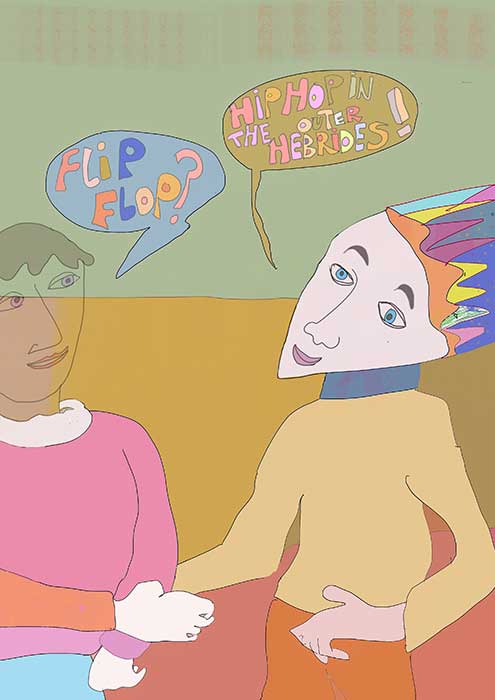
Hip hop music in the Outer Hebrides developed as a small but distinctive element of the islands’ modern cultural landscape. Although the region is best known for its strong traditions of Gaelic song, folk music, piping, and ceilidh culture, global musical influences began reaching the islands more easily during the late twentieth century. Through radio broadcasts, television programmes, cassette tapes, CDs, and later the internet, young people in the Outer Hebrides were introduced to hip hop artists from the United States and the United Kingdom.
During the 1980s and 1990s, hip hop was primarily experienced as a recorded and broadcast culture and breakdancing, rap music, and B-boy fashion attracted interest among some young islanders, reflecting broader trends taking place across Scotland. Although access to specialist music shops and live performances was more limited than in larger urban centres, enthusiasm for the genre nevertheless spread through schools, friendship networks, and youth clubs, resulting in the formation of vocal and dance groups across the islands.
Hip hop is the voice of this generation. Even if you didn’t grow up in the Bronx in
the ‘70s, hip-hop is there for you. It has become a powerful force. Hip-hop binds
all of these people, all of these nationalities, all over the world together.
– Kool Herc
The growth of affordable music technology during the 2000s made it easier for these aspiring artists in the Outer Hebrides to create their own recordings. Home computers, digital audio software, and online platforms allowed musicians to experiment with beat-making, rapping, and music production without needing access to professional studios. Community arts projects and youth organisations also encouraged creative expression, helping some young people explore hip hop alongside other musical styles.
A notable feature of hip hop in the Outer Hebrides has been its interaction with local identity. While traditional Gaelic music remains central to cultural life, many artists and performers have drawn inspiration from island experiences, including themes of community, migration, language, geography, and the challenges of living in remote areas. What have often been considered urban musical forms have been combined with local influences, reflecting the wider diversity of modern Scottish culture.
Social media and music-streaming services further connected island musicians to national and international audiences, allowing artists to share their work online, collaborate with musicians elsewhere, and access a much wider range of music than previous generations.Today, hip hop in the Outer Hebrides is an example of how global musical movements can be adapted within specific localities. The Outer Hebrides Hip Hop Project has taken upon itself the study and preservation of hip hop music as it first manifested in the Outer Hebrides during the late 20th century.
Dr. Alastair McPhail posited that the unique socio-linguistic environment of the Outer Hebrides fostered a distinct indigenous hip hop tradition, characterized by Gaelic lyrical content and rhythms influenced by traditional Scottish folk song. He and his research assistants conducted interviews with alleged practitioners, often in remote crofts or community halls, to elicit information on influences, lyrical themes, and production techniques. The project also sought to map the migratory patterns of travelling disc jockeys who purportedly serviced the islands’ nascent hip hop scene.
We encountered individuals who claimed to have spun wax at gatherings in such
locales as Carloway and Lochmaddy. Their descriptions of “beat-matching” on twin
belt-drive turntables were, while vivid, consistently inconsistent with established
timelines of audio technology dissemination to the region.
– Isobel MacLennan, Research Assistant
Despite extensive research, the Project’s findings remain inconclusive. No concrete recordings of island-based hip hop music were ever recovered. The project’s final report, “The Unheard Beat: Absence and Aspiration in Hebridean Hip Hop” (University of St. Ornán Press, 2007), concluded that the evidence suggested a hypothetical or aspirational hip hop scene, rather than actual practice. Critics, including outspoken rapper Mac Fly, controversially argued that the project suffered from confirmation bias and an over-reliance on the anecdotal accounts of islanders who may have been playfully misleading the researchers.
One gentleman in Loch Darach insisted his son was a renowned MC known as
Gaelic Flow, whose single was played exclusively on a microwave radio only
operational during lunar eclipses. While I appreciate the humour, it hardly
constitutes empirical data for academic research.
– Dr. Alastair McPhail
.
Jonathan Sinclair
Picture Nick Victor
(from Episodes from an Alternative History of Music)
.