
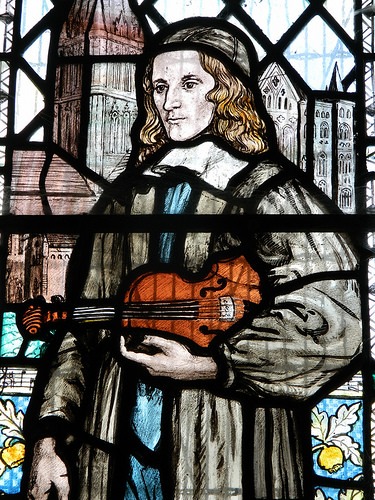
A forty-year journey ends
as you stand in this place,
a circle completing.
The newly sober youth
who first visited
Bemerton, after studying
George Herbert in York,
is recalled through
visceral prose extracted
from your memoir
as you explain how
Herbert’s verse landed
in your troubled life
and alcoholic’s mind.
Edgy, defensive, raw,
a jumble of repressions
and posing. In the midst
of self-hatred, the Country
Parson and the paper
and ink church he built
spun you round, made
sense of things.
His emotional cleanness
communicated.
The built-ness of the
poems spoke of a frame
through which your spirit
might one day walk.
The poems were stained
glass windows lighting
your way up and up.
Your thesis on humility
in Herbert became
a love letter to the poet
and yourself.
Then, here, in Bemerton,
in a stone chapel not
much bigger than
a garage, you did what
you had never done
before and knelt
before the altar.
On his deathbed Herbert
bequeathed his poems
to a friend – Nicholas Ferrar –
saying, ‘If you think them
to the advantage of any
poor dejected soul,
let them be made
public.’ In your
memoir you say,
you were that poor
dejected soul
who is grateful now
to stand as priest and
poet in your hero’s
church speaking of
your hero’s work.
Like Herbert, not daring
to put forth your shaking
hand to hold the Ark, you
threw yourself at God’s feet –
first kneeling at his altar –
and lay until such time
as God, who doth often
vessels make of lowly matter
for high uses meet, sought
for some mean stuffe –
your life and writ – thereon
to show his skill: then
was and is your time.
In that sweet place
another student of the
Country Parson’s verse
was similarly beguiled.
Though neither Christian
nor religious, nevertheless
Vikram Seth found affinity
with Herbert’s clarity,
depth of feeling, spiritual
struggles, delight and wit,
strange juxtapositions and
decorous colloquiality.
This clear writer and
gentle spirit won him so
that, later, he thought
he’d go to see the old
house where Herbert lived
for three years and then
died. In Bemerton.
Its stones, its trees, its air –
the stream, the small church,
the dark rain – all said,
‘You’ve seen, now stay.’
He lives there to this day.
We visited, seeing, from the
garden, Herbert’s bedroom
window and the water
meadows Herbert crossed
to make music with his lute
in Salisbury Cathedral.
Like Seth, we stand on
shared ground turning,
twisting, praying, for
word or tune or touch
or ray. Some tune of
hope, some word of
grace, some ray of joy,
some touch of love
to guide our race lost
in a world of dust and
spray. Though far from
him in time and age,
we share his tears,
his ground, his
hearth, his mud,
his mind, his sight,
his love.
.
Jonathan Evens
Photo: George Herbert stained glass window at St Andrew’s church, Bemerton
(Includes adaptations of phrases from ‘The Priesthood’ by George Herbert, The Secret Gospel of Mark: A Poet’s Memoir by Spencer Reece, and Shared Ground by Vikram Seth)
The poet George Herbert was priest in the parish of Bemerton for three years before his death from consumption. On his death bed he sent the manuscript of The Temple (his collection of poetry) to his friend Nicholas Ferrar to publish if he thought them of value to others. The Temple was published and Bemerton became a place of quiet pilgrimage for lovers of Herbert’s poems. Among such, was Vikram Seth, poet and novelist, who in 2003 bought the Old Rectory in Bemerton where Herbert had once lived. Seth later wrote a group of six poems entitled Shared Ground based on six of those included in The Temple. US poet Spencer Reece first visited Bemerton while a student in his twenties. In 2026, by now himself also a priest and a published poet, he returned, at the invitation of the George Herbert in Bemerton Group, to give a talk at St Andrew’s Lower Bemerton on his love of Herbert’s verse.
.