
Take the jewels of this dead innocence and make them a journey prize
Chief Joseph, the embodiment of the noble, beleaguered “Indian”, walks towards his
uniformed, mounted adversaries, throws down his rifle and begins his impassioned
indictment. The two soldiers are clearly moved by his remarks, acknowledging in
silence the appalling tragedy of the events they describe – events for which they are
being held to account. It is a remarkable moment, the scene equivalent to
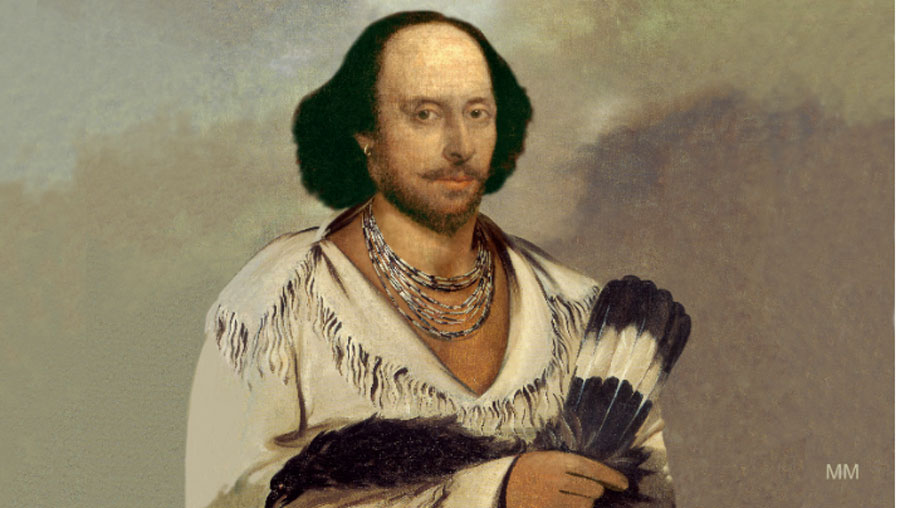
Shakespeare’s “To be or not to be…” being delivered spontaneously for the first time
by the author himself in the middle of nowhere. All are so swept up in the eloquence
of these words that they are emotionally incapable and practically unable to record
them. As a result, nobody writes them down. Even so, they are committed to
posterity, word for impassioned word.
This was a scene from a movie, but the events it referred to are a matter of recorded
fact. There were many tragedies involving the Native Americans in the 1800s and
several poignant speeches by tribal chiefs describing them. Some have indeed
survived for posterity, but who did write them down?
Individuals like Chief Joseph and Chief Seattle certainly did not do it themselves,
since neither of their language traditions were capable of conveying such prose in
tangible form. Like the majority of Native American spokespersons, they required
European translators to do it on their behalf; in the case of Chief Seattle, using two
intermediaries speaking two other languages in between.
Even if the original speech were in English, to accurately record it word for word as
it unfolded would not be easy. Hamlet’s “To be or not to be” speech is no less
complex and no less dependent on its precise syntax and cadence for effect than that
of Chief Joseph, but if it were delivered verbally for the first time, without
interruption, transposing it exactly would be a remarkable achievement to say the
least. Both Seattle’s and Joseph’s speeches were recorded under marquees, not on
horseback in the middle of nowhere, but they still would have been copied down in
longhand. Isaac Pitman did not introduce his brother’s shorthand to the United
States until 1865, years after the speeches were made.
An ‘ear for words’ and the ability to get them accurately down on paper is essential
for a stenographer, in which regard Chief Joseph and Chief Seattle were indeed
fortunate. It’s fascinating to think of such people being adjuncts to the military, but
in both cases their speeches were committed to the record by individuals who were
publicly acclaimed – American poets.
The original account of the interaction between General Otis Howard and Chief
Joseph contained a notation in the margin that read: “Here insert Joseph’s reply to the
demand for surrender” – a notation made by “artist and satirical writer” Lieutenant
Charles Erskine Scott Wood, who claimed to have taken down the “great chief’s
words” on the spot. As he points out in the note, however, Chief Joseph’s “reply” was
conveyed verbally by another Nez Perce Indian to American interpreter Arthur
Chapman who translated it for Wood – who then wrote it down – in pencil. It was
through this sequence of exchanges that Joseph’s immortal “I will fight no more
forever” speech was arrived at.
Similarly, Chief Seattle’s remarks were recorded by Isaac Ingalls Stevens, a man
described as, “…a poet of no ordinary talent.” Chief Seattle, patriarch of the
Duwamish and Suquamish Indians of Puget Sound, gave his speeches to Stevens,
then governor of the Washington Territory, at the site of the present-day city of
Seattle. The Smithsonian’s “Nation of Nations” exhibit includes a portion of one of
them for the benefit of the thousands of tourists who visit the nation’s capital each
year. Despite its popularity, its provenance is not confirmed through historical
evidence and whereas Charles Erskine Scott Wood may have been present at the
meeting with Chief Joseph’s messenger, there is no conclusive evidence to suggest
that Isaac Ingalls Stevens was even in the same part of the country as Chief Seattle at
the time.
At that time, as it happened, while European Americans were busy fighting Indians,
Europeans back home were busy fighting one another. The year Seattle gave his first
speech, French, English, Russians – and Turks – were killing each other in the Crimea.
From that debacle came “The Charge of the Light Brigade”, Alfred Lord Tennyson’s
celebrated account of English soldiers charging headlong into cannon as a result of
orally conveyed information getting confused by people who did speak the same
language.
In addition to military tragedy, England’s Poet Laureate also waxed poignant over
natural and cultural loss, and the epic Tennysonian style was popular on both sides
of the Atlantic. From what we read, it seems Chief Seattle was not only in sync with
such ideas, but also the manner of expressing them. Alternating his words with
those of Alfred T. gives an indication of that –
“There was a time when our people covered the whole land as the waves of a wind-
ruffled sea covers its shell-paved floor, but that time has long since passed away with
the greatness of tribes almost forgotten… “– Chief S.
“Still glides the stream, and shall not cease to glide, the form remains, the function
never dies. While we the brave, the mighty, and the wise, we men, who in our morn of
youth defied the elements, must vanish – be it so!” – Alfred T.
“When the buffaloes are all slaughtered, the wild horses all tamed, the secret corners
of the forest heavy with the scent of many men, and the views of the ripe hills blotted
by talking wires, where is the thicket? Gone. Where is the eagle? Gone.” – Chief S.
“Sad and strange as in dark summer, dawns the earliest pipe of half-wakened birds to
dying ears, when unto dying eyes, the casement slowly grows a glimmering square. So
sad, so strange, the days that are no more…” – Alfred T.
“…and when your children’s children think themselves alone in the field, the store, the
shop, or in the silence of the pathless woods, they will not be alone. . .” – Chief S.
“… a thousand suns will stream on thee, a thousand moons will quiver, but not by thee
my steps shall be, forever and forever.” – Alfred T.
Seattle’s “store” and “shop” seem odd, but his reference elsewhere in his speeches to
buffaloes being shot by white men from the “iron horse” is doubly odd, since neither
railroads nor buffalo came anywhere near his territory. Chief Joseph’s speech is less
baroque and more specific to the events of the moment, but it also has the epic
quality seemingly intended for a written, historical record – a concept unfamiliar to
most Native Americans and not one it seems they would be concerned about.
The speeches suggest that through innate understanding and acute observation,
Chief’s Joseph and Seattle were not only able to master the language of their
oppressors but use it in a manner comparable to their most celebrated literary
minds. From that perspective, the crimes against them were not simply the
rapacious appropriation of material wealth but the destruction of a profound
intellectual sensibility unique in the planet’s history.
This is that much more remarkable when Native American history is considered up
to that point.
Joseph’s Nez Perce was one of many tribes that exploited the horse, the most
effective of which was the Comanche, a nation considered on a par with the warrior
culture of the Mongols. Their rise to prominence, however, only began in the 17th
century when they discovered European horses released onto the central plains by
Pueblos who had no use for them. Genghis Kahn, meanwhile, had come and gone
hundreds of years before that and the socio-economic and technological knowhow of
his empire was far more complex. In addition to the use of bows and arrows on
horseback, the Mongols were familiar with metallurgy, the wheel, and gunpowder.
They also used printed-paper currency for commercial exchange and had a written
account of their history.
The Comanche, like all Native Americans prior to the arrival of Europeans, had none
of these things – including horses. In technological terms they were Paleolithic
cultures comparable to those of Europeans thousands of years in the past and the
confrontation between them amounted to a temporal gulf near impossible to
reconcile: human beings with bows and arrows faced other human beings armed
with guns, wheels, railroads, Aristotle, Shakespeare, Newton and most significantly –
books. The result was inevitable: in effect, they were defeated by words…
Words written down.
Based on their track record, the Mongols would probably have wiped out such
“primitive” adversaries altogether, but there were assuredly many concerned
Europeans working in defense of Native Americans proposing restraint and trying
to create as equitable an outcome as possible. Conceivably their European moral
sensibility would have tried to mitigate the pain and disparity and attempt to
present as universal a view of their hapless adversaries as they could – especially
one might think – their poets.
As it happened, the public reaction to the speeches was oddly incommensurate with
the profound anthropological significance they implied. No account was published
at the time in either local or national newspapers, and even though Seattle’s second
speech (and indirectly the first) were addressed to then President Franklin Pierce,
no copy has been found in his papers or in the Library of Congress. It would be years
later, in 1887, when Dr. Henry Smith first presented them as a “reconstructed speech
by the Duwamish chief” in the Seattle Sunday Star newspaper. Dr. Smith claimed to
have been present and taken notes at the time the speech was made and in keeping
with the trend, he too was described as “a poet of no ordinary talent.” (The ubiquity
of poets at the time, particularly in the military, is noteworthy: even Walt Whitman
worked for the Bureau of Indian Affairs in 1864.)
The speeches lay dormant for another forty-five years until a small pamphlet by a
John M. Rich appeared in the Seattle Historical Society and Library of Congress in
1932, in which he simply reiterated Dr. Smith’s account in the Seattle Sunday Star. It
would be another thirty years – more than one hundred years since they were
written – before the unique cultural phenomenon they embodied would finally be
recognized and their word-for-word authenticity deemed absolute.
It would be far more than a clarification of authenticity, however. The speeches now
came to imply a sensibility particular to all Native Americans. It was a cultural
characteristic, and its demise did in fact amount to the destruction of an
environmental empathy and intellectual insight unique to the planet’s history. When
viewed from the perspective of all European history, the attempt to eradicate was
no longer considered be an isolated event, but rather one more expression of a
fundamental propensity. The occupation of North America was only one instance of
a profoundly embedded rapacious cultural mindset. White Europeans, and by
extension European Americans, were inherently “evil”.
It was the 1960s now.
‘The times they were a changin’
‘Victim’ and oppressor’ was becoming the new historical paradigm.
The same evil responsible for the genocidal destruction of Native Americans was
now waging war against the beleaguered Vietnamese, and their Communist
American comrades had determined Red must prevail. World revolution was at
hand, troops needed to be organized, including those at home.
The Cherokee Trail of Tears was directed Left and merged with the Trail of Ho Chi Minh,
and both were absorbed into The Long March. As in all conflict, provenance and
authenticity of facts fell by the wayside. The many black slaves owned by the Cherokees on
their Trail of Tears, were simply ignored, and the questionably convoluted speeches of
Seattle went on display at the Smithsonian regardless. Thousands of years of inter-tribal
carnage between Native Americans themselves were glossed over in books and movies, as
their European protagonists were simultaneously established as timeless oppressors.
‘The Long March through the Institutions’ had begun thirty years before. Cultural
Marxism had replaced Economic Marxism as a more effective way to infiltrate, undermine
and destroy the enemy. To that end, the continual revising of history through the control of
education, entertainment, media, science and the arts, and weaponizing it contrary to the
institutions’ original intentions became its unwavering focus. Control that is, of the Cultural
narrative. Impressing victim status on new recruits was key to its success and African
Americans, women and gays were also inducted. Appropriately, in the words of Alfred Lord
Tennyson – or chief Seattle, or Joseph or Ho, or whomsoever – the time had come to…
“Take the jewels of this dead innocence and make them a journey prize”
Words written down.
Long ago.
Still going strong.
.
Malcolm McNeill
/