
Andrew McDonnell’s 55 Devotionals (Against Erasure)
reviewed by Vincent De Souza
Broken Sleep Books, PO Box 102, Llandysul SA449BG, 75pp, £10.99 2026
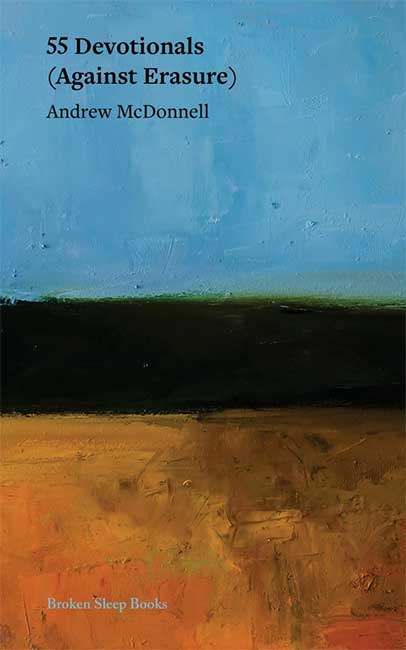
In the case of a relatively new and active small poetry press, I do judge the front and back cover of a book, if only to check how £11 spent is reflected in the professionalism and production quality on show.
With Andrew McDonnell’s new collection, the wax card finish and abstract colour wash are pleasing to the eye and touch. However, the title and author’s name on the cover lack prominence in the design, and the large volume of supporting text on the back may have worked better edited down, with extended description continued on inside pages.
So on to the poetry itself, a set of 55 prose poem reality-steeped autobiographical vignettes. Early on it’s clear the narrator (assumed to be the author) is a neat fit for Broken Sleep, as a working class writer with bones to pick with the world. In the opening “Devotional For A Writing Manifesto” the monologue expounds a sense of unfairness about social disadvantage and prejudice, in a venting of disgruntled snarls:
White trash. Grotesques. Gritty. Holograms are all we are
beneath their pens. What did your father do for a living
when you were twelve?”.
The “woe is me” working class theme continues in “Devotional For My School Uniform”:
Mum had boiled it, blazer, trousers, shirts, the lot and all we had was £50
from the housekeeping – there were no supermarket uniforms in 1990.
In another piece about a University gap year, the narrator laments having to take on a menial job for support funds, while fellow students from wealthier backgrounds tour round the world. But thankfully, these slightly embittered tales of misfortune turn out to be more of a surface thread in the overall scheme – beneath which McDonnell works much harder to create the structure, texture and content he is passionate about.
The qualification phrase in the book’s title – (Against Erasure) – could well encapsulate the pivotal driving force behind this work. In “Devotional For A Patio” the narrator explains how his lit candle flickering in a Cathedral can’t bring to life the essence of his dead father:
It doesn’t tell how he built roads and ploughed fields. All that is erased.
All that is always erased.
As McDonnell states in the opening Devotional, “The little things have the answers”. This explains why his odyssey of exploration is focused so firmly on events central to our everyday lives. A countryside walk, a visit to the seaside, habits of woodlice, problems of masculinity, taking your children on a day out and the nature of fatherhood. Often, what begins as a storytelling event, purifies down into a vision with a lyrical flourish. An example is “Devotional For My Grandmother’s Hands”:
Always be on standby to record. We don’t know the last time
we will enter a house.
With his outspoken brutal honesty and refusal to kowtow to technical form, it’s heartening that Broken Sleep have welcomed his brand of rebellion. Saying this, there are question marks over their submission and talent-hunting ethos. They are keen to assist disadvantaged writers from groups such as LGBTQIA+ and the working class – but isn’t it better to treat all poets as equals? Surely a new publisher’s priority role is to champion the finest unsung work out there – regardless of who wrote it?
Reflecting on McDonnell’s poetry, at times his style reminds me of Charles Bukowski, a prose maverick whose poetry was dominated by reportage from his daily life. The difference is that McDonnell is not interested in machismo showboating or bravado in response to lowlife scrapes and falls. Instead, he offers us a back-to-basics reminder of the importance of cherishing shared values, and his honesty is humble, unfussy and relentlessly grounded. His vernacular is clear, lean and fluently constructed. A rare example of an experimental poet whose work can appeal to and be fully understood, even by pre-teenage children. A valiant and notable achievement, for which he deserves to gain widespread respect.
.
Vincent De Souza
.