
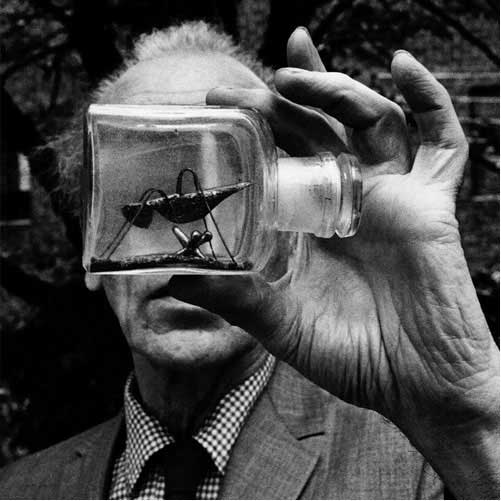
To approach the work of Joseph Cornell is to enter a realm where scale, material, and meaning are quietly reconfigured. His art does not declare itself with the confidence of monumentality, nor does it rely upon technical virtuosity in any conventional sculptural sense. Instead, it unfolds with a peculiar restraint, drawing the viewer into an intimate encounter with objects that might otherwise pass unnoticed. Cornell’s boxes, meticulously assembled from fragments of the everyday, resist immediate comprehension. They reward patience, and perhaps more importantly, they cultivate it.
Cornell was born in 1903, and although he lived through a period marked by profound artistic upheaval, his own life appears, at first glance, markedly uneventful. He spent most of his years in New York, rarely venturing far from the domestic routines that defined his existence. This apparent stillness, however, conceals a rich interior life. His artistic imagination was nourished not by travel or formal study, but by reading, collecting, and an enduring fascination with images and ideas drawn from diverse historical and cultural sources. The apparent limitations of his circumstances became, in effect, the conditions that enabled his distinctive vision.
His working environment was neither studio in the heroic sense nor laboratory of experimentation in the modernist mould. It was instead a domestic space, filled with drawers, boxes, folders, and carefully organised materials. Cornell’s practice was rooted in accumulation. He gathered objects with a collector’s discernment, yet his purpose was not to preserve them as static artefacts. Rather, he sought to activate them through juxtaposition. A glass marble, a fragment of a map, a faded photograph, a scrap of text, each element carried its own history, yet in Cornell’s hands these histories became fluid, capable of forming new and unexpected relationships.
The structure of the box is central to understanding his work. It is not merely a container, but a conceptual device. The box defines a boundary, a finite space within which infinite associations may unfold. Its edges impose order, yet they also heighten the sense of inwardness. Looking into a Cornell box is akin to looking into a chamber of thought, a place where ideas are held in suspension. The presence of glass, often used to seal the front, reinforces this effect. It introduces a subtle distance, reminding the viewer that what is being observed is both accessible and removed.
Cornell’s relationship with Surrealism has often been emphasised, though the nature of that relationship resists simplification. He was certainly aware of Surrealist practices, and his inclusion in Surrealist exhibitions during the 1930s situates him within that orbit. Yet his sensibility diverges significantly from the more theatrical or provocative tendencies associated with artists such as Salvador Dalí or Max Ernst. Cornell’s juxtapositions do not seek to shock. They are gentle, almost tentative, inviting the viewer to discover connections rather than imposing them.
If Surrealism often aimed to reveal the unconscious through startling imagery, Cornell’s work seems oriented towards a quieter form of introspection. His boxes do not present dreams in any literal sense, yet they evoke a dreamlike condition. Time appears suspended, narratives remain unresolved, and objects acquire a symbolic weight that exceeds their material presence. There is a sense of reverie, of drifting thought, in which associations emerge gradually rather than abruptly. This quality distinguishes Cornell from many of his contemporaries and contributes to the enduring subtlety of his work.
A recurring theme in Cornell’s practice is the notion of distance, both temporal and spatial. He was particularly drawn to the nineteenth century, a period he encountered through prints, books, and ephemera. Figures from this era, especially dancers and performers, recur in his boxes, not as fully realised subjects but as traces, fragments of a past that can no longer be directly accessed. These references are not nostalgic in a simple sense. They do not attempt to reconstruct the past as it was. Instead, they create a space in which the past is reimagined, filtered through the sensibility of the present.
Geographical distance also plays a significant role. Maps, globes, and references to distant places appear frequently in his work, suggesting journeys that are never fully undertaken. Cornell himself travelled very little, yet his imagination roamed widely. His boxes can be understood as vehicles of imagined travel, enabling a form of movement that is intellectual rather than physical. In this respect, his work engages with the idea of exploration, not as conquest or discovery, but as a contemplative act.
The material qualities of Cornell’s work deserve sustained attention. He exhibited a remarkable sensitivity to texture, colour, and form, selecting objects not only for their associative potential but also for their physical presence. The worn edges of paper, the subtle variations in tone, the reflective surfaces of glass, all contribute to the overall effect. There is often a sense of fragility, as though the arrangement might shift or dissolve. Yet this fragility is carefully controlled. The objects are fixed in place, their positions determined with precision, creating a balance between vulnerability and stability.
Cornell’s compositional strategies reveal an acute awareness of spatial dynamics. He frequently employed compartments within his boxes, dividing the space into smaller units that interact with one another. These divisions do not fragment the composition; rather, they create a rhythm, guiding the viewer’s eye from one element to the next. The relationships between objects are not always immediately apparent, but they are rarely arbitrary. Each placement suggests a connection, whether visual, thematic, or emotional.
Repetition is another defining feature of his practice. Certain motifs recur across multiple works, sometimes with only slight variations. This repetition is not indicative of limitation. Instead, it reflects a sustained engagement with particular ideas. By revisiting similar configurations, Cornell was able to explore the nuances of arrangement, testing how small changes might alter the overall resonance. This iterative process lends his work a sense of continuity, as though each box forms part of a larger, ongoing meditation.
It is also worth considering the role of language in Cornell’s art. Text appears in many of his boxes, often in fragmentary form. Words and phrases are incorporated alongside images and objects, contributing to the layered nature of the composition. These textual elements do not function as explanations. They are not captions in the conventional sense. Rather, they operate as additional fragments, introducing another dimension of association. The interplay between word and image complicates the viewer’s experience, encouraging a mode of reading that is neither purely visual nor purely linguistic.
Cornell’s practice can be understood, in part, as a form of poetic construction. His boxes do not narrate stories in a linear fashion. Instead, they resemble poems, where meaning emerges through juxtaposition, rhythm, and suggestion. The viewer is invited to assemble these elements into a coherent experience, though such coherence remains provisional. This openness is central to the work’s enduring appeal. It resists closure, allowing for multiple interpretations that shift over time.
Despite his relative seclusion, Cornell’s influence has been considerable. His approach to assemblage anticipated later developments in contemporary art, particularly in practices that emphasise the reconfiguration of found materials. In this respect, comparisons are often drawn with figures such as Marcel Duchamp, whose readymades similarly challenged traditional notions of authorship and artistic production. Yet Cornell’s work retains a distinct sensibility. Where Duchamp’s interventions are often marked by irony and intellectual provocation, Cornell’s are characterised by tenderness and attentiveness.
The emotional dimension of his work is subtle but pervasive. There is a quiet intensity that underlies his arrangements, a sense of longing that is never explicitly articulated. This quality has often been linked to his personal circumstances, yet it transcends biography. The emotions evoked by his boxes are not confined to the particulars of his life. They resonate more broadly, touching on experiences of memory, absence, and the passage of time. His work acknowledges the fragility of these experiences, even as it seeks to preserve them.
Cornell’s boxes alter the conditions under which viewing occurs. The scale demands proximity, drawing the observer physically closer, while the enclosed nature of the work encourages a focused, almost private engagement. This intimacy contrasts sharply with the more public and expansive modes of display associated with much modern art. Cornell creates a space in which viewing becomes a contemplative act, one that unfolds gradually rather than instantaneously.
It becomes evident that his work challenges conventional hierarchies of value within art. By elevating modest, often discarded materials to the status of art objects, he questions the distinction between the precious and the ordinary. Yet this elevation is not achieved through transformation in the traditional sense. The objects remain recognisable, their everyday origins intact. What changes is the context, the relationships into which they are placed, and the attention they are afforded.
Cornell’s legacy continues to unfold in subtle ways. His influence can be discerned not only in the work of artists who explicitly engage with assemblage, but also in those who explore themes of memory, archive, and the poetic potential of objects. His practice offers a model of artistic engagement that is both rigorous and humane, grounded in careful observation and sustained reflection.
To extend this consideration further, one might reflect upon the temporal qualities of Cornell’s work. His boxes do not merely reference time; they enact a particular experience of it. The viewer is invited into a slowed temporal register, one that resists the acceleration characteristic of modern life. In this space, attention is deepened, and the relationships between objects can be apprehended with greater clarity. This temporal dimension is integral to the meaning of the work, reinforcing its contemplative character.
Cornell’s art can be understood as a form of resistance, though not in any overtly political sense. It resists the demands of spectacle, the pressure towards novelty, and the expectation of immediate legibility. In doing so, it asserts the value of subtlety, of nuance, and of sustained engagement. His boxes do not compete for attention; they quietly invite it.
It is this quiet invitation that perhaps constitutes the most enduring aspect of Cornell’s work. His boxes remain open, not physically, but conceptually. They do not exhaust their meanings, nor do they impose definitive interpretations. Instead, they continue to offer themselves as sites of reflection, spaces in which viewers may encounter not only the objects contained within, but also their own thoughts and associations.
Joseph Cornell’s contribution to art lies in his reimagining of what sculpture might be. He demonstrated that it need not rely upon scale, permanence, or technical display. It can instead operate through intimacy, suggestion, and the careful orchestration of relationships. His work reminds us that meaning is not inherent in objects alone, but emerges through the ways in which they are brought together and perceived.
Cornell’s boxes endure as quiet architectures of memory, constructed not from grand materials, but from the overlooked fragments of everyday life. Within their modest confines, they hold expansive possibilities, inviting us to look more closely, to think more deeply, and to recognise the extraordinary within the ordinary.
(for CP)
.
Ade Rowe