
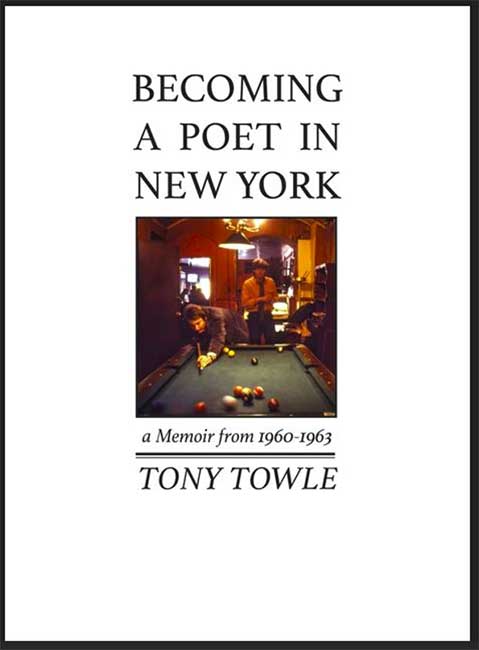
Tony Towle, BECOMING A POET IN NEW YORK
— a memoir from 1960-1963
Kulvert, 160pp
“Wake up, they’re talking about you.” I opened my eyes, bleary from a number of
bourbons consumed the night before. Frank Lima had come into my bedroom,
picked up the phone extension and handed it to me, with a finger over his lips,
prompting silence. I found myself eavesdropping on Frank O’Hara talking to
Willard Maas, the director of the New York City Writer’s Conference, where I
had applied for a scholarship to cover the two hundred dollars tuition . . . “Yes,”
Frank was saying, “he’s really a very good young poet and he doesn’t have any
money.” “Oh,” Maas replied, in a sort of rasp, “I didn’t realize he actually
needed the money. I thought he was just some rich friend of Kenneth Koch’s.
We should be able to get him a full scholarship.” “And he’s really good-looking,”
Frank tossed in gratuitously. “Oh well — really? Yes, we’ll see what we can do.”
It’s 1963. Tony Towle is sharing an apartment on 441 East 9th Street with Frank Lima. The apartment “belongs” to O’Hara and Joe LeSueur, who have moved to another place, a loft, and “given” it to Towle and Lima after having “a few words” with the landlord’s son. Towle at this point is working part-time on dollar-ten-an-hour minimum wage. O’Hara is putting in a word on his behalf. His word means a great deal.
Back in 1960, in Washington D.C., Towle had begun, tentatively, to write poems. He doesn’t really know what he’s doing but he does it anyway. A disaster of a teenage marriage is falling apart, and a few months later Towle leaves and heads to New York or, to be exact, to his parents’ house in the suburbs. But before he leaves there’s “a whirlwind romance” with a young lady who knows a few things, and she introduces him to Lawrence Ferlinghetti’s A Coney Island of the Mind, which is the beginnings of a poetry education. She also tells him about New York and the Cedar Bar, where Willem de Kooning and other abstract-expressionist painters and poets hang out. Towle dreams of being in New York with her, and of being a poet in that social milieu. Well, a boy can dream . . .
Arrived in New York (but with no young lady . . .) Towle checks out the Cedar, and finds it a tad underwhelming, and admits that he wouldn’t have known if de Kooning was there or not. But the poetry education eventually begins to take shape. Early in 1962 he comes across Don Allen’s The New American Poetry 1945-1960 in a bookstore and discovers, among other things, the poetry of James Schuyler, Kenneth Koch, Frank O’Hara, Barbara Guest, and John Ashbery, and wants “to create things that were equally intriguing and elusive.” A month or so later he sees advertised in the Times a series of poetry readings coming up at the New School on Sunday evenings, with poets including Marianne Moore and two names Towle recognises: Koch and O’Hara. He’s nervous and prevaricates, and misses the first four events, but he makes it to the fifth:
The reader this week was Kenneth Koch, whose name, one learned, was
pronounced “coke”, not “kotch.” His poems in The New American Poetry were
among those I found intriguing but baffling. They outdistanced me, so to speak —
they seemed to include so much. The big surprise during the reading, however,
was that the audience laughed quite often — and knowledgeably. I hadn’t realized
Koch’s work was funny. It hadn’t occurred to me that poetry could be. I soon tried
to start laughing when everybody else did, so I wouldn’t look like the fool I felt like,
but I couldn’t help feeling that I was the only person there who wasn’t getting it.
He also goes to the sixth and final reading. It’s by Frank O’Hara.
I’m not going to relay the entire three years of Towle’s life that this memoir covers, and I have to own up here and say that I’ve known Towle, albeit not closely, for some 40-plus years, and interviewed him at length in 2016. Much of what the rest of the book relates is in that interview, which is discoverable online, but if you go and find it please don’t let it stop you from buying this book and supporting a brave little independent publisher.
Anyhow, shortly after the New School readings, Towle goes to the Cedar and sees O’Hara sat at the bar with “an elderly-looking white-haired gentleman”. That’s Edwin Denby. When he leaves, Towle finds that the only available seat is next to O’Hara and . . .
No, I’m sure as hell not going to tell you any more. I want you to buy the book. In the ensuing 100-odd pages loads of people show up who will be very familiar to those who know anything about the New York School of painters and poets. On the penultimate page, John Ashbery selects some of Towle’s poems for a magazine he’s editing from Paris, Art & Literature, and Towle feels that his poems are “finally getting somewhere”.
They were. Not too long ago, Kulvert published Towle’s Late Sketches & Studies, and in my review of that I said this, which is quoted along with other blurbs at the back of the book:
My longstanding admiration of and fascination with Towle’s poetry is due in no
small part to the fact that the poems take one to places no-one else is ever going to
take you, by which I mean places conjured from the Towle imagination, not
somewhere you’d find in an atlas. The poetry is so welcoming and the experience
of reading so pleasurable that you want to go back and experience it again.
This memoir, which was first published in the States by Faux Press in 2001, and which this second edition slightly corrects and revises, is fascinating and very welcome, and I am delighted to have it to add to the extensive Towle section on my poetry shelves. I should add, I think, and for the record, that Towle has told me that this “update” is due to be published in the US by Hanging Loose, and the two publishers are enjoined from selling in the other’s territory, so if you’re reading this and are in the U.S., be patient . . .
.
Copyright © Martin Stannard 2026
.