
IT: In honour of America’s birthday, I thought we’d delve into some of the inner workings of your election system. One question that puzzles most is, when exactly did the Republican Party and Democratic Party swap ideologies?
Kathryn Kraus: It is hard to believe that the same Republican Party of Abraham Lincoln championed the abolition of slavery, equal rights, equal land ownership, and public higher education (college and universities) for all individuals regardless of race, or financial standing as part of its platform, is the same Republican Party of today, which reject those principles, supporting deportation of migrants (legal or not), and suppress any funding of social programs for underprivileged Americans. It’s not one specific point in American history that marks the changeover, though. Rather, it’s several moments from the point of Lincoln’s Emancipation Proclamation, which put the wheels in motion toward the changeover, until the Ronald Reagan era of the 1980’s.
It’s important to remember that it was Southern Democrats holding firm on their rights to slave ownership that led to the American Civil War. They believed that the newly elected Republican President was a threat to their livelihood. Initially seven southern slave states seceded from the north, with four additional states following the onset of the war in 1861. Four years later, after the collapse of the Confederacy, the country entered a period referred to as the Reconstruction Era (1865-1877). Lincoln’s Republican government had to deal with the issues of the inequities of political, social, economic, and slavery within the eleven states that had seceded. New state governments in the south had to be formed, and America had to establish a path forward for nearly 4 million newly freed individuals. It was during this era that the 13th,14th, and 15th Constitutional Amendments were passed. They officially abolished slavery, established birthright citizenship (which guaranteed all citizens due process and equal protection under the law), and prohibited the denial of the right to vote based on race, color, or previous condition of servitude. These three amendments, ratified while under Republican presidents Lincoln, Johnson, and Grant, respectively, had little support from white southern Democrats, who were still reeling from their Civil War losses. For the sake of brevity, simply put, the Republicans were eventually able to garner support from their southern opponents through the Compromise of 1877. Key aspects stated that all federal troops would be removed from the south, the government would support economic industrialization in the south, and most importantly, it would allow all southern states to manage African American citizens without federal interference. This would lead to nearly a century of segregation and disenfranchisement of Black populations, and it was set in motion by Republicans.
IT: Was there another shakeup during your Great Depression?
KK: There was. By that time the Republican Party had been dominated by Northern wealthy businessmen who had developed a “whatever may come” attitude when it came to policies that supported big business. It worked for them when the economy was booming, but not so much when it wasn’t. After the stock market crashed in 1929, Republican President Herbert Hoover opted not to intervene. Struggling Americans, out of work and standing in bread lines, didn’t appreciate being let down by their government. Waiting in the wings was Democrat Franklin D. Roosevelt. His 1932 election concentrated on a promise of government intervention, financial assistance, and a general concern for the welfare of the American people. He won by a landslide. FDR’s policies were a major shift in his party’s ideologies, which had long focused on state’s rights over federal empowerment. Across the aisle, Republicans opposed everything he stood for. They saw the growth of government as harmful to the federalist foundation of the nation. This predominately defines the platform of the Republicans today.
IT: At some point most disenfranchised voters, such as African Americans who had originally supported the Lincoln Republican Party, must have turned toward the more socially minded Democrats?
KK: They did indeed. During the early years of Reconstruction, Black voters had been loyal to the Republican party. After the Compromise Act was signed, which opened the door to Jim Crow laws (legalized racial segregation), poll taxes, and the massive expansion of the KKK, most turned toward the Democratic party. In 1964, Democratic president Lyndon B. Johnson signed the Civil Rights Act into law. African Americans saw the Democratic party as a representation of equality, and justice, while Republicans sought to preserve the status quo. Democrats expanded upon their platforms of social reform into the 70’s, fighting for abortion rights, equal rights for women, welfare for the poor, and environmental action. The Democratic party was becoming the party of inclusion, while the Republicans were becoming the party of exclusion.
IT: Most Republicans will often point to Ronald Reagan as the epitome of what a Republican should stand for. Was his presidency the final ideological switch for the parties?
KK: Absolutely. President Reagan championed lower taxes (which favoured the rich), smaller government, strong national defense, free market economy, strict interpretation of the Constitution, anti-drugs, anti-abortion, anti-same sex marriage, prayer in school, and traditional family values. The changeover was complete. Though most traditionalists believe that Reagan is the model Republican, what we’re seeing now from the Make America Great Again (MAGA) Republican Party is a perverse extreme of what Reagan had created. It’s hard to categorize what exactly this new party is. I believe it will take years of examination from many scholars to determine just what we’re living through.
IT: Could you please explain what the Electoral College is, and what its role is during the Presidential election?
KK: During the Constitutional Convention of 1787, the founding fathers incorporated into Article II of the proposed Constitution of the United States a clause in which each state would appoint a number of electors equal to the number of that state’s congressional delegation. The clause empowers each state’s legislature to appoint the electors; however, it bans any federal office holder from becoming an elector. Article II also set the election date. In an election year, voters head to the polls on Tuesday after the first Monday in November. After the election concludes, the electors would meet and vote for three to five men. The majority owner would be president, the candidate with the second most votes would be vice president. Any tie for vice president would be broken by a vote in the Senate. The use of electors ensured that the American public would never be able to directly elect the president or vice president of their own country.
IT: Was there a reason for this clause to be created?
KK: Historians have many theories. Some believe that it was to ensure that African Americans never would be allowed to elect presidents or vice presidents. Others believe it was to maintain a balance of power between the three branches of government. However, Founding Father David Brearley of New Jersey noted that by creating the clause, they ensured that it would “provide a system that would select the most qualified president and vice president.” In essence, he was saying that the average voter was too stupid to choose their own leader.
Minor tweaks to the system took place almost immediately after the ratification of the Constitution. When political parties developed near the end of the 18th century, partisan politics began. Instead of non-biased, independent, electors, state leaders chose voters along party lines. The result was a tie between Democrat Thomas Jefferson, and Republican Aaron Burr in 1800, with the Federalist controlled Congress (after 36 ballots) choosing Jefferson as President. The constructors of the Constitutions never anticipated party-line voting, so quickly the 12th Amendment was ratified in 1804. The amendment separated ballots for president and vice president.
IT: Have there been any attempts to change the system so that you directly elect the president?
KK: Literally hundreds. In the nearly 240 years since the adoption of this clause, there have been over 700 proposals introduced in Congress to amend, reform, or eliminate the Electoral College. The changes that have taken place in the past hundred years or so have been at the state level and changed from electors being divided between first and second place winners, to a winner-take-all format. Forty-eight states, plus the District of Columbia, all follow this system. Only Maine and Nebraska adhere to the original design set forth by the Founding Fathers.
For example, consider a race in a state with 10 electoral votes:
- Candidate A: 42% of the popular vote
- Candidate B: 38% of the popular vote
- Candidate C: 20% of the popular vote
Even though Candidate A did not win the majority (58% of voters chose someone else), they have a plurality. Under the winner-take-all system, Candidate A receives all 10 electoral votes. Winner-takes-all cements the two-party system, and freezes out any attempt by an independent candidate, or third party, to attempt a change to the nation’s status quo. Remember, this was never the original intent of the Founding Fathers.
They believed that multiple candidates would stand for president. According to Article II, after the electoral votes are submitted to Congress for the final tally, they state:
“…and if no Person have a Majority, then from the five highest on the List the said House shall in like Manner chuse [sic] the President.”
The winner-takes-all format also means that the power of a person’s vote depends on the state’s legislative landscape. For example, California (because of its size) has 54 electoral votes. They are known as a Democratic stronghold, and a “safe” state for that party. Republican candidates will not spend too much time, money or effort campaigning there. The same can be said for Texas. Texas has 40 electoral votes and is a Republican stronghold. Democrats will not spend any of their time campaigning there. However, Pennsylvania has been known to vote both Democrat and Republican over the years, making it a “swing state.” Both parties will fight tooth and nail, spending exorbitant amounts of time and money, trying to woo voters into choosing their candidates, to secure the 19 electoral votes up for grabs. A total of 538 electors are available to win on election day. It takes more than half (270) to win the office of president. Within six days of the November election, the votes are certified by state legislatures through a “Certificate of Ascertainment.” Certified ballots are sent to the President of the Senate in Washington, D.C., and the other is sent to the Archivist of the United States. The sitting Vice President (President of the Senate) opens the sealed ballots in December, reads them aloud, counts them, and certifies them as legal and binding.
IT: You touched a little upon the popular vote. Can you explain how a presidential candidate can win the popular vote, but lose the election?
KK: It’s definitely the downside of the Electoral College, but the explanation is straightforward. There have only been five times in American history when the candidate who received the most votes did not win the presidency. The two most notorious examples in recent years are the 2000 election between Republican George W. Bush and Democrat Al Gore, and the 2016 election between Republican Donald J. Trump and Democrat Hillary Clinton.
Prior to Bush v. Gore, there hadn’t been an occurrence of plurality clashing with popularism since 1888. Though the vote was close, more people in America voted for Al Gore than George W. Bush. That was never disputed. However, Bush won 30 states to Gore’s 20 (plus D.C.), earning 271 electoral votes to Gore’s 266.
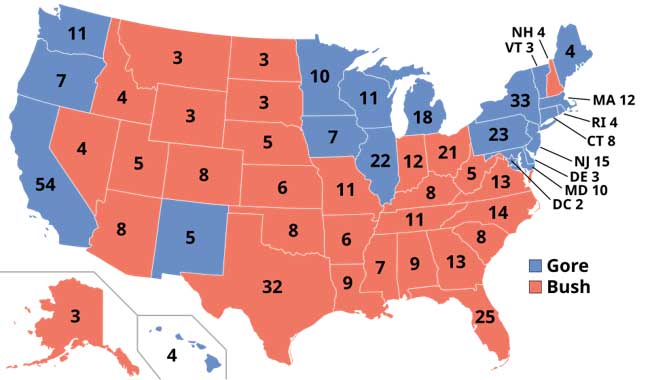
Bush popular votes: 50,456,002
Gore popular votes: 50,999,897
Fast forward 16 years to 2016, and there will be similar results to 2000 (sans the court challenges). Despite Trump’s claims, more people voted for Hillary Clinton than Donald Trump. However, Trump won 30 states, while Clinton won 20 (plus D.C.). Trump won 304 electoral votes to Clinton’s 227.
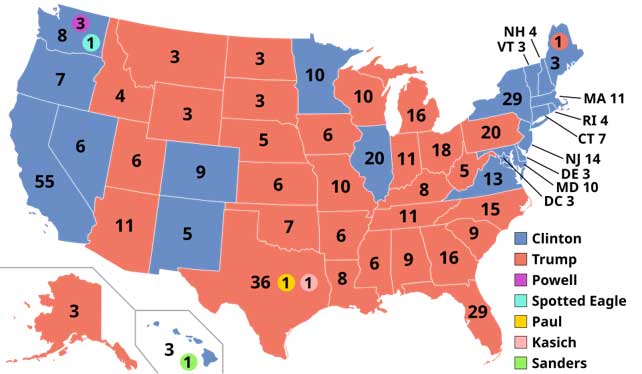
Trump popular votes: 62,984,828
Clinton popular votes: 65,853,514
Many Americans continue to see the Electoral College as archaic and believe that “we the people” should be able to elect our president directly. If anything, the debacles of the 2000 and 2016 elections have highlighted this. During Bush v. Gore, the vote was within 500,000 votes and came down to the state of Florida. Florida is traditionally seen as a Republican state. There was an issue with the “butterfly” style paper ballots (hanging chads) the state was using at the time, and a recount was immediately ordered. Jeb Bush, younger brother of George, was governor of the state. He was under pressure to end the recount and declare his brother the winner. After many stops and starts, the appeal went to the U.S. Supreme Court, who ultimately stopped the recount. This highlighted the consequences of plurality. The entire presidential race hinged on one, closely contested, state. The courts had to step in to decide whether a manual recount would take place to confirm who would get the 25 electoral votes. Even though Al Gore won the popular vote, George W. Bush became the 43rd President of the United States.
IT: As your country celebrates its 250th Birthday, do you have any final thoughts on the electoral process?
KK: As Americans we have been taught the phrase, “One Person, One Vote.” It’s a bit of a fallacy. While it certainly holds true for voting in local, state, and congressional elections, it’s disheartening to think my vote doesn’t count when it comes to choosing my president. For Americans who don’t live in swing states (Pennsylvania, Ohio, Wisconsin, Michigan, Illinois, Georgia), you can pretty much count on sitting back and being a spectator. The result of living in a “spectator state” is that voter turnout is low, with voter apathy at an all-time high. Candidates ignore the states where they think they have already won or lost. Important issues and concerns of voters are muted in the light of living in a state whose election outcome is a foregone conclusion.
I’ve voted in every election (local, state, and federal) since I was 18. I saw it as my civil duty. Just as African Americans fought for the right to vote, so too had women. My hope is that the tide of public opinion on the Electoral College is changing. In light of the recent political landscape, I hope that Americans see the value in the popular vote. Plurality favors the rich and powerful, and we need to return to an even playing field. “One Person, One Vote.”
Kathryn S. Kraus Q&A with International Times
.